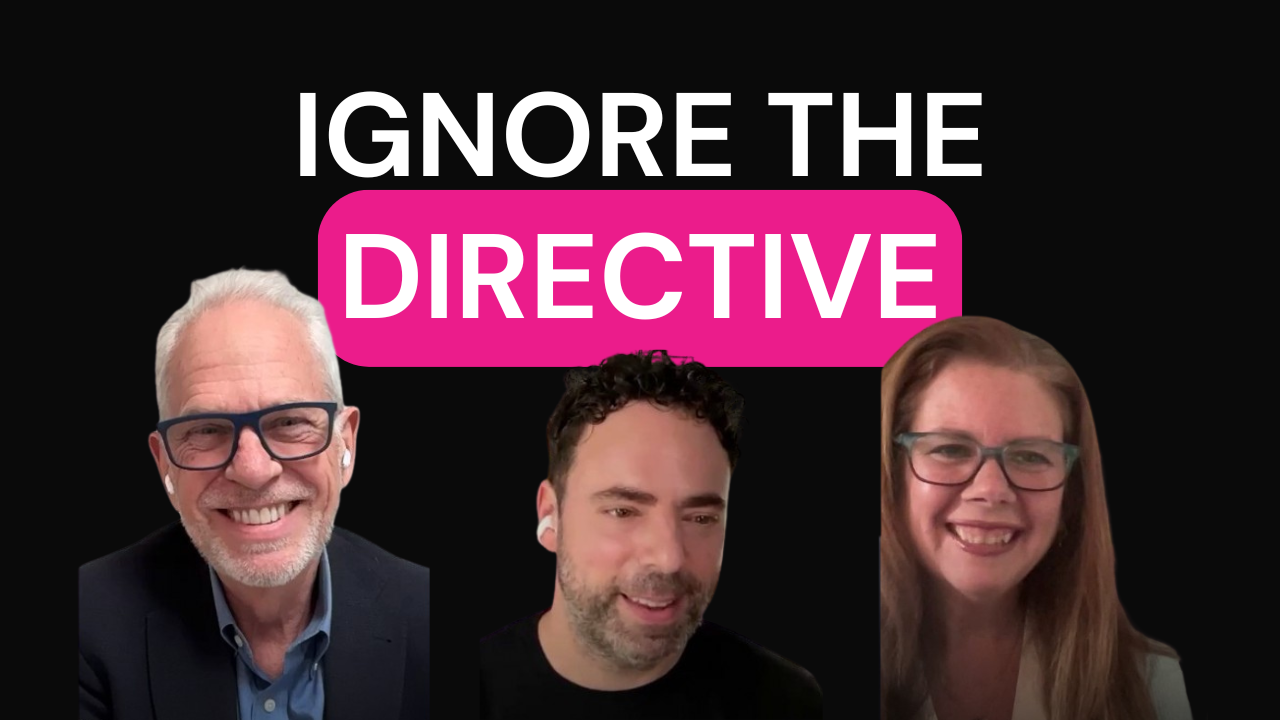
Leading the Alliance for Decision Education's work to make decision science part of core curriculum are David Samuelson, the organization's Executive Director, and Mary Call Blanusa, its Director of Public Policy. Samuelson spent his career leading digital transformation at national associations before turning to teaching students and school leaders the skills to navigate uncertainty — the same skills, he says, that make a good sailor in unpredictable water.
Blanusa brings two decades of education policy and philanthropy experience, including co-designing decision-making courses with state systems like the Tennessee Board of Regents. Together they're building the research, courses, and district partnerships that treat decision making as a teachable skill, not an innate trait.
A principal ignored a direct order from central office — and made the right call anyway. This post breaks down the decision-making process that got him there: how to turn gut feelings into percentages, separate good decisions from good outcomes, and keep your judgment sharp as AI takes over more of the thinking for you.
🧲 What You'll Learn
- How to turn vague words like "maybe" and "highly likely" into percentages your whole team agrees on.
- Why judging decisions by their outcomes alone will wreck your team's confidence in a good process.
- The weight-and-rate framework David and Danny used to decide whether to defy a district directive.
- Why decision-making skills now show up explicitly in 41% of job postings nationally.
- What "don't give your agency to an agent" means for how you use AI in your building.
👀 Key Insight #1: Why Vague Language Kills Good Decision Making
- What's broken: Leaders use words like "maybe" and "highly likely" as if they mean the same thing to everyone in the room.
- The shift: Assign an actual percentage to the word — "highly likely" might be 95% to one person and 80% to another — so the team is agreeing on a number, not a vibe.
- Impact: A goal like "highly likely to graduate 95% of students" only works as a shared commitment once everyone has agreed on what "highly likely" actually means.
💟 Key Insight #2: How to Separate Decision Quality From Outcomes
- What's broken: Principals get judged — and judge themselves — on how a decision turned out, not on how it was made.
- The shift: Evaluate the process (the options you considered, the criteria you weighted, the probabilities you assigned) as a separate question from whether things happened to work out.
- Impact: A slow, evidence-based call — like keeping two struggling teachers in place with more support instead of transferring them — can be the right decision even before you know how it ends.
💡 Key Insight #3: Why AI Makes Decision-Making Skills Non-Negotiable
- What's broken: Schools are handing students and staff more AI tools without teaching the judgment to question what those tools produce.
- The shift: Treat decision making and media literacy as explicit, teachable skills — how to ask AI for the counterfactual, spot a confirming answer, and decide what to hand off to an agent versus what to keep for yourself.
- Impact: Decision-making skills already appear explicitly in 41% of job postings nationally, and hiring managers treat them as table stakes even where they aren't listed.
🎧 DAVID & MARY QUOTES FROM THE RUCKUSCAST
"Don't give your agency to an agent. Keep your agency and choose what you want to give an agent to do. And that is empowering."
— David Samuelson
"Your life depends on your decisions."
— Mary Call Blanusa
"The process used correctly is always going to be better than the process not used at all."
— David Samuelson
"The quality and success that you experience in life comes down to two things: luck and the quality of your decisions. You can't change luck, but you can always improve the quality of your decisions."
— Mary Call Blanusa
"Stop and think. When in doubt, stop and think with curiosity."
— David Samuelson
🚵♀️ Your Do School Different Challenge
Ready to implement these ideas? Start here:
- Tomorrow: Run the words-to-probabilities exercise at your next leadership meeting — have each person put a number on "highly likely," "maybe," and "unlikely," then compare answers out loud.
- This Month: Take one decision you've been circling and run it through the weight-and-rate process — name your top three criteria, like academics, culture, and training, and score each option against them.
- This Semester: Build a shared, written definition of "what's best for kids" with your leadership team so the phrase can't be used as a one-person trump card.
⌚️ Episode Timestamps
- 00:00 - The decision to defy central office
- 03:26 - David's sailing certification built decision agency
- 07:13 - Why decision paralysis freezes school leaders
- 10:47 - The science behind high-stakes decision making
- 14:48 - The words-to-probabilities exercise explained
- 18:12 - Why best for kids needs a shared definition
- 19:43 - Weight and rate your decision criteria
- 23:31 - Kahneman's System 1 vs System 2 thinking
- 25:10 - Annie Duke on process versus outcome
- 33:24 - Why AI makes decision skills more urgent
- 39:01 - Inside the Alliance's district partnership model
- 44:45 - Closing lightning round with David and Mary
00:03
Speaker 1
At the time, a principal that I was supporting in his administration at central office said, these two grade level teachers are terrible, right? Their scores are no good. You're gonna move them, and where you move them doesn't matter, but move them. Right? And he called me because it was like, I don't know that this is right. That's what his gut was saying. I'm kind of concerned about how this would impact the culture, you know, and this kind of thing. So we slowed things down. We really thought through it. So long story short, I think there were like three or four realistic scenarios. We had come, we had evaluated, investigated, and one of the decisions was not to move the teachers at all. Said another way to basically ignore the directive from central office.
00:55
Speaker 2
Whoa.
00:56
Speaker 1
Talk about putting yourself out there. My friend Corey built something I wish I had as a principal. It's called Orchard. It gives every student a real career plan, not just a quiz result. The motto says it all. Don't fall into your culture. Climb to it. Check it out at Better Leaders. Orchard Careers. That's BetterLeaders. Orchard Careers. For over 30 years, ODP Business Solutions has helped schools transform from whiteboards to smart boards.
01:36
Speaker 3
Why?
01:37
Speaker 1
Because when you get the right tools, everyone wins. Visit ODP business.com education to revolutionize your school's learning spaces. It's ODP business.com education. Over 1 million teachers rely on IXL because it's empowering. It helps them make better decisions with reliable data, and it adapts instruction based on student performance. You can get started [email protected] leaders. That's ixl.com leaders. 98% Of educators told us they left a Kids first session ready to use what they learned. That's not a fluke. It's the standard. This episode is brought to you by Kids First Education, professional learning that's built for the way schools actually work. See the proof at Kids First LLC Leaders. That's Kids First LLC Leaders. A principal I work with walked into her staff meeting last week with one clear next move on the culture problem she'd been circling for months. She didn't get there alone.
03:01
Speaker 1
She got there with Digital Danny. He's always there, never forgets.
03:06
Speaker 3
It's.
03:06
Speaker 1
And he evolves with you. Get started with Digital [email protected] Ruckus. That's my principalcoach.com Ruckus. All right. And David and Mary, welcome to the show.
03:24
Speaker 3
Thanks. Nice to be here.
03:26
Speaker 1
Absolutely. So, David, I want to start with you, and can you talk to me about Sailing certification, getting that in, you know, treacherous conditions. And what made that experience memorable for you?
03:39
Speaker 3
Yeah, I started sailing as a boy scout when I was a teenager and then, you know, I, I enjoyed it and I probably got the sailing merit badge at the time. And then I taught, you know, sailing on little sunfishes on the lakes of Minnesota. But then in my later years I ran into a buddy of mine who got me to out back on a boat and it got me interested in learning more about sailing and the details of sailing. Mostly because I wanted to be comfortable going out in all kinds of situations and being safe and being able to take my grandchildren out and things like that. So I signed up for the American Sailing association certifications. They have a number of certifications. And I did it with my 30 year old son.
04:29
Speaker 3
And we would go out and have to practice, we'd have to take a test and we'd have to read and do certain skills on different size boats. And the thing that taught me was it gave me agency to really navigate in uncertainty, which is the heart of what the alliance for Decision Education is trying to teach. And that is, you know, if I don't know what the weather's going to be like, I don't know whether or not I'll be able to navigate through, you know, a rainstorm or lots of boats on the water. And just being able to rely on these skills that I was taught that allowed me to do that was incredibly freeing in a way that I could have much more fun. I could sort of find my way into sailing with some agency.
05:21
Speaker 3
And I think that sailing is an ancient skill that has allowed us as humans to really discover unchartered waters and to discover new lands. And so the history and the continuity and the idea that there's a set of skills that I could learn really gave me a lot of confidence and in being able to be a good sailor.
05:48
Speaker 1
Yeah, absolutely. I know I know nothing about sailing, but I do know a lot about sort of volatile environments where things are consistently changing. I'm guessing like the seas and we're sort of ambiguous at times, you know, what to do next. So I could see how that's, that's helpful in that piece.
06:08
Speaker 3
You know, some of those skills become second nature, Danny. You know, like you, all of a sudden the wind shifts and you automatically start to do something that you've learned to do. And just in that example of sort of uncertainty, if you think about, you know, a school leader having to deal with something on the fly you need to kind of instill some of those skills.
06:29
Speaker 1
Right. So what I'm hearing you say is by putting in some reps, it starts to become second nature. So when the chaos erupts, you almost can trust your intuition because you've put in that time and that experience. Right. To, to face those things. Am I hearing you correctly?
06:46
Speaker 3
That's, that's correct. Yeah.
06:48
Speaker 1
Right. In Mary, when it comes, you know, to these skills and decision making and that kind of thing, I guess, you know, I believe this, but I'm guessing you would argue that we could, we can teach this stuff. Right. What David was talking about in terms of the automatic. Right. And the things that are just going to happen, like we can teach that. And how do you do that through what you're doing in your work?
07:13
Speaker 2
Yeah, absolutely. And I think, you know, as y' all were mentioning, navigating uncertainty is a big part of decision making and why you need to practice your decision making skills so that when there's a high stakes decision that needs to be made quickly, you have the skills and the knowledge to be able to make an informed decision with as much information as you have available. One of the things that a lot of times people face is kind of decision paralysis and just being frozen and either having too many options or feeling like they don't have enough information and so they don't make a decision. And if you build the skills and tools and mindsets early on, you can avoid that by being prepared for those situations.
08:04
Speaker 2
So that's what we seek to do not only with students in K12 classrooms, but also with teachers and with superintendents and with policymakers. This is something that most people haven't learned really forthright in their educations. It's something that kind of came alongside with things. Maybe if you were in a college psychology program, you learned about cognitive biases and how the mind can think in different ways under different circumstances. But for the most part, people aren't explicitly taught about decision making. And that's what we're seeking to do, is explicitly teach it, but as part of the core curriculum, not as something completely different. How it integrates into all of the subjects and into all of your everyday life.
08:57
Speaker 1
Absolutely. And can I double click on the idea of like, that paralysis? Right. Because I see school leaders, students too. Right. With just the influx of information and what do I do now? And sometimes people wait. You wait too long. It's like, all right, well, the ship has sailed. Let's keep going with the sea metaphor. And you miss the opportunities. So that analysis paralysis is very real. How, how do you encourage people to deal with that? Right. Because they are paralyzed by so many options often, and they need to move forward. I know what my answer is, but I want to hear your answer.
09:37
Speaker 2
Well, I would say part of it is practice and practicing decision making with different levels of information under different levels of certainty. And we do that through some things like forecasting, looking at a current event and saying we what's the likelihood that the, you know, new movie coming out this weekend is going to make $10 million on opening day? Or I don't even know if 10 million is like, I feel like Austin power is like $1 million. I have no idea if $10 million is a big amount these days. But, you know, looking at current events and my forecasting clearly is not good for movies.
10:19
Speaker 2
But say, looking at what information can you get, what kind of base rates can you identify of similar things that have happened and depending on how quickly you need to make a decision, understanding that if you don't act within that time, that is a decision and that by not taking action and not making a decision, you are making a de facto decision.
10:47
Speaker 3
And Danny, this is a science that's existed for 40, 50 years. It's been taught at graduate school level, PhD level. There are professionals in the oil and gas industry and the pharmaceutical industry and the military. Wherever high stakes decisions with uncertainty have to be made with very little information, you use these skills to kind of navigate outcomes that are more often better than not. It's not going to make all your decisions good, but the process used correctly is always going to better than the process not used at all.
11:25
Speaker 3
And, and so we believe that teaching kids these skills, especially now in a time of unprecedented uncertainty with AI and things going on in the world, that these skills gives you agency, like my sailing example, they give you agency to step into that uncertainty and sort of allow to sit with it and find your way. And that's why we think this is important for schools and not only for students, but for leaders to understand and to learn.
11:59
Speaker 1
It's important as well because I think, you know, were talking about analysis paralysis and that you're doing too much research and never necessarily making a decision which is a decision in itself. But I think the process that you're talking about is a good function of slowing down, right? Seeing things objectively, seeing things from multiple angles as well as the trying to take the emotion out of it. You know, as well, there was at the Time a principal that I was supporting in his administration at central office said, these two grade level teachers are terrible, right? Their scores are no good. You're gonna move them. And where you move on doesn't matter, but move them, right? And he called me because it was like, I don't know that this is right. That's what his gut was saying.
12:49
Speaker 1
I'm kind of concerned about how this would impact the culture, you know, and this kind of thing. So we slowed things down. We really thought through it. We did some of the things that I think you might teach in terms of putting percentages to certain scenarios and how likely they were to happen in reality. So long story short, I think there were like three or four realistic scenarios. We had come, we had evaluated, investigated, and one of the decisions was not to move the teachers at all. Said another way to basically ignore the directive from central office. Whoa, talk about putting yourself out there. But as we worked the process, you know, and then saw the probability and sort of the score, you know, that was likely, we thought, to happen.
13:48
Speaker 1
And why keeping the teachers exactly where they were, but with additional support was best for the culture. So anyways, he shared his thinking process with central office. They're like, I don't know, because it's not what we're telling you to do. But you really thought through this in a way that we haven't seen principals do before. He didn't move the teachers. He gave them the support they needed. And just like a Disney movie, everything was perfect in the end. So, you know, thankfully, like, it worked out right. But it was really pretty neat to go through that process. So I sort of alluded to some things that I'm assuming you all teach and you've already referred to a bit, but maybe we can dig into, like, what does it mean to think in probably, you know, think in percentages and think probabilistically and how to.
14:38
Speaker 1
How do you put numbers to stuff that like, I, I don't know, like, what is the likelihood of something happening? Right. So. Yeah, can we dig into that?
14:48
Speaker 3
Sure, go ahead.
14:50
Speaker 2
One of the, one of the first things that we do when we're introducing decision education to a lot of audiences is an activity called words to probabilities. And you know, you have everybody sit down and look at a list of words that we use every day in all different kinds of conversations. Words like, maybe that's not likely, that's a slam dunk. This is absolutely never going to happen. And ask people individually to look at that and say, what is the percentage likelihood you assign to that word? So I like to say when I'm introducing this activity, sometimes, you know, think about this in your role as if you're an educator, you know, your role as an educator or as a superintendent, not as your. In your role as a parent, where maybe might mean 20%, but when you're at work, it might mean 60%.
15:49
Speaker 2
So if I say maybe to my kids, that's a 20% likelihood that's going to happen. Right? But if I say maybe to my colleagues, then that's a 55 to 60% likelihood that, that item that I said maybe to is going to happen. So I'd love both of you to just think about if. When you use the word highly likely, what's the percentage in your mind? If you were to say, it's highly likely that I'm going to go to the gym tomorrow, what's the percentage in your mind right now for that? I'll ask you each to tell me what that is.
16:26
Speaker 3
Danny, you go first.
16:28
Speaker 1
My wife once gave me one of the best compliments, which was, if Danny says he's gonna do it, therefore it's highly likely. Right? It's as good as done. So although I'm. I do make mistakes, right? But I would give it a 93 to 95% chance it's gonna happen.
16:45
Speaker 3
And mine is 80. About 80, 85. Highly likely. There's just so many things that could come up, and I mean, I intend to go to the gym tomorrow. It's highly likely. But for me, that's 80 to 85% compared to Danny's 90 to 95%.
17:02
Speaker 2
And so that's not a huge difference, but it is a difference. Right? And so clarifying this by saying let's use those numbers instead of those words just facilitates clearer communication in all aspects of life. So it gets students and leaders to think about percentages, think mathematically, think about probabilities of different outcomes using numbers and be more clear in their meaning. Therefore, there's less misunderstanding amongst people when you're making group decisions.
17:42
Speaker 3
In particular, it's a good example if our intent is we want it to be highly likely to graduate 95% of the students this year. Does everyone understand what that means? Or, you know, when. If I didn't use the percentage, if I just said, we want to high. We want it to be highly likely that kids graduate this year. And I don't know if everyone's going to agree on that number. And you automatically have a disconnect with your team.
18:09
Speaker 1
Yeah.
18:10
Speaker 3
You know, from that moment.
18:12
Speaker 1
Absolutely. So I think you're encouraging us too to sort of discuss that. Right. And make the invisible visible and almost come up with a common definition. You know, what is that? Percentage. You know, putting the math behind the words. It's somewhat unrelated, but I think it's similar in the sense, you know, I, I, I really dislike the idea of what's best for kids. Right. That's just a term that makes my skin crawl a little bit. There's nothing wrong with the term we should be thinking about what is best for kids. But my riff on it is as a principle, when I use that, it usually means we do on this campus what's best for kids, according to me, because I'm the boss, I have the title, right. Etc. Etc.
18:55
Speaker 1
And that's a problem because when you say it that way, everyone looks at you and they're like, well, yeah, that's your point of view. How do you know you're right? Right. So we have to come up with these common definitions and if you do that hard work and agree on what's best for kids, then you can, you have permission to use that language because people are all on the same page. So to your point, you know, highly likely, 95%. I think that matters also context. Right. Really important because highly likely for fitness. That's going to happen for me because it's like, it's an essential thing in my day and my priorities. But if it was a different thing, like let's say, oh, I don't know, any honey do list item right around the house and like fixing things. Highly likely drops down.
19:37
Speaker 1
It's not, it's no longer 93 to 95%. Unfortunately.
19:41
Speaker 3
It's a sarcastic statement.
19:43
Speaker 2
Yeah, yeah, no, Danny, when you talked about that decision making process about the two teachers, I think, you know, it sounded a lot like what kind of was going on in the background. There was what we refer to as a weight and rate and kind of outlining the different criteria that are important in making that decision and assigning values, weights to them. So percentages, like what's the most important thing it sounded like to this principle was preserving the culture. And that was the top value for this principle and it wasn't the top value for the central office to preserve the school's culture. And so that definition of your own values and figuring out how they fall into things.
20:29
Speaker 2
When you talk about what's best for students, what's best for one Student is not necessarily what's best for the student sitting right next to them because of their differing goals and values as individuals. And so that's a really important part of a decision making process is identifying and framing your own values and goals.
20:53
Speaker 3
And the tools help you to identify those values and goals. If you think about a kid making a decision about where to go to school or where to go to college, you know, they don't often put all the criteria on the table you have to reach for, you have to think past it, you have to have some curiosity, you have to be pushed a little bit or have a framework for it. And I think that what the science has taught is that there are frame tested frameworks that keep you honest about uncovering things, whether, because sometimes you're blinding yourself from seeing those things. Those biases are keeping you from seeing a potential that like the central office said, well, that wasn't even on our list. We never even thought about the fact that the culture might be ruined.
21:40
Speaker 3
And that has a bigger impact on the school success than anything. But the principal knew that. And that's a great example of why these tested systems and skills matter.
21:54
Speaker 1
Yeah, yeah. David, Mary, it's clear that, you know, you're experts in this. Wrong. Because like I didn't do a very great job of explaining the process. Right. That, that Scott and I went through, but you already knew it. And his variables, I had to pull it up as you were chatting because I'm like, oh, I wonder what they were. And we thought about the three decisions were either move none, move one teacher or move both. Right. And the variables were academics. Right. So how would this impact, you know, achievement? How would it impact culture, which was extremely important to him. And then the other variable, what kind of training would be necessary for this to work? Moving zero, one or two. And then I don't know if I'm sure you teach this as well.
22:37
Speaker 1
But we also looked at it, okay, if making this decision and it all works out like we think it will, what's that worth? But what if we think this is the right decision and it doesn't work out because that happens. Right. What, how does that change sort of the worth and value of those variables? And we put a probability to each of those that gave us the score. And then also just connecting family, the family tree and connecting the dots. Seth Godin taught me this process in his alt MBA program. And he also was talking about Annie Duke's work. Right. And I believe, you know, Annie is involved with you alliance for Education.
23:19
Speaker 3
Yeah, she's a co founder.
23:21
Speaker 1
So it's like full circle. Right. I was sort of learning it from her and from you, but just in another space. So. Yeah, yeah, it's great.
23:31
Speaker 3
I'd love to just circle back to one thing you said a few minutes ago about, you know, slowing down and a well known author. Many of your listeners might know Danny Kahneman and his book Thinking Fast and.
23:44
Speaker 1
Slow and loved or hated within my community, by the way.
23:48
Speaker 3
Exactly.
23:49
Speaker 1
It's a, it's not an easy read, but an important one. Yeah.
23:53
Speaker 3
Well, even if you just get the concept that there's system one thinking and system two thinking or what, when you slow down, you're kind of forcing the system two thinking. And when you're on autopilot, which means like you're good at what you do or you've been there, done that, or, you know, it's often used as a driving analogy. You don't have to think about putting your blinker on or tapping the brakes, but if a cat jumps into the road, you jump into system two thinking so that you slow down. And maybe it's at that moment that you want to draw upon a set of skills that say, how can I make a better decision in this instance? And that just, that construct is very helpful, I think, and at least it was for me when I read his book.
24:37
Speaker 3
And you know, it's not rocket science, but it is science. There's a lot of science underpinning much of what we're talking about.
24:46
Speaker 1
Yeah, I love that book. And we only read books outside of education in my school leadership community, and we've been doing that since 2016. Thinking fast and Slow was one of them. And I had some grumbling from the members and I was just like, listen, this is like your vitamins and vegetables you might not want to take, but like you need this foundational content and knowledge. So, you know, I would highly recommend,.
25:10
Speaker 3
I would highly recommend Andy and his book Thinking in Bets. And she also has a book called Quit. But Thinking in Bets gives you a nice outline of some of these things that we're talking about and using, you know, her success as a poker player and using analogies that really kind of bring it home. Because actually decisions, all decisions are. Betsy, you're making a bet on yourself or you're making a bet on something, you know.
25:34
Speaker 1
Yeah, absolutely. We read Thinking about in the Mastermind as well, in that metaphor she used with Pete Carroll and the Seahawks in the Super Bowl. Right. You know, like running in for the. Yeah, yeah. Like you got the guaranteed touchdown or you run the play that probability wise was had a higher success rate and it just so happened, you know, the interception and oh well, legendary Super Bowl. But the important piece there for all the ruckus makers engaging with today's episode, you have to separate the process of making a sound decision from the outcome. They're different because you can be an idiot, you can be really stupid and have a terrible way of making decisions and get lucky a lot and you can make a very objective, slow, thorough, thoughtful decision and at times not get the outcome you expect.
26:28
Speaker 1
But that doesn't make you a bad decision maker. Right. It's just a poor outcome. So yeah, separate that stuff we have to talk about. Oh, go ahead Mary.
26:38
Speaker 2
Say one of the things Annie says is that the quality and success that you experience in life comes down to two things. Luck and the quality of your decisions. You can't change luck, but you can always improve the quality of your decisions. And so that's why it's so important to build those decision making skills. Because there are things you can't do anything about and no matter what happens, there's that luck aspect. But knowing that you've taken the steps to make the best decision you could in those circumstances, then at least you know that you have a higher probability that of a good outcome.
27:16
Speaker 1
Correct. And to connect one more dot from the earlier conversation, the more you put in the reps right. Of of having a sound sort of decision making process, the luckier you seem to get as well. Right. It's just by like being. Being prepared. I want to tell you about Corey. Corey is the founder of Orchard and he's been a guest on the show. Growing up, Corey watched his dad hate his job. He'd worked just long enough to pay the bills, then stop, then panic when the money ran out. It's over and over. This was happening. And Corey decided early on that's not going to be his life. It shouldn't be anyone's life to be honest. And that's why Orchard exists.
28:04
Speaker 1
It helps students explore careers, understand their real options and build an actual plan so they climb toward a future they want to be a part of instead of falling into whatever comes next in their life. Every student deserves that. I think you agree. So go see what Corey built at orchard by visiting BetterLeaders Orchard Careers. That's BetterLeaders Orchard Careers. ODP Business Solutions, formerly Office Depot Business Solutions Division, has been a trusted partner for schools for 30 years. And ODP business solutions. We're by your side to meet your evolving education needs. Here's the thing about creating remarkable learning spaces. You need a partner who gets it, someone who understands that transforming education isn't just about swapping whiteboards for smart boards. It's about reimagining what's possible. That's why innovative school leaders trust ODP Business Solutions. We don't just deliver supplies.
29:12
Speaker 1
We help you design dynamic learning environments that make students actually excited to show up. From tech integrations that bring lessons to life to flexible furniture that transforms any space into a collaboration zone, to sustainable solutions that teach by example, we've got everything you need to do school different. And the best part? You can get it all from a single supplier that helps you simplify ordering and streamline budgeting while staying compliant with easy access to cooperative contracts. However you want to advance, ODP Business Solutions has 30 years of experience helping districts like yours get ahead. Visit ODPbusiness.comeducation to learn more. That's ODPbusiness.com education something that drove me nuts as a ruckus maker was hearing teachers say things like I taught it, they should have learned it.
30:11
Speaker 1
But really, some teachers just don't know how to teach or reteach for that matter, so that all kids get it. That's where IXL comes in. IXL's diagnostic automatically identifies knowledge gaps for teachers and provides them with a personalized growth plan for each individual student. Teachers can step into the classroom every day knowing what their students know and what they don't know. IXL's adaptive platform makes differentiating instruction easy. As students learn, IXL adjusts to the right level of difficulty for each student. Close knowledge gaps and accelerate learning with IXL. Get started [email protected] leaders. That's IXL.com leaders when you bring in professional development, you're making a bet with your team's time and attention. And let's be honest, often it doesn't pay off. Kids First Education is an exception to this.
31:17
Speaker 1
Nearly all educators that they work with have told them that their session directly connected to the district priorities, and 98% walked out ready to use what they learned right away. That's because every kid's first session is built around your goals, led by coaches who have done the work and grounded in how adults actually learn. Principals Admin District Leaders if you're done gambling with PD that fades by Friday, check out what Kids first offers. You can learn more at Kids First LLC Leaders. That's Kids First LLC Leaders. I was talking with a principal last month who'd been wrestling with the same staff problem for six weeks. Every Monday it was on her list. Every Friday it was still there. She kept telling me she needed more information before she could make the call. Here's what she actually needed.
32:23
Speaker 1
She needed someone to ask her, if you already knew the answer, what would the answer be? That question cut six weeks of circling down to about four minutes. She made the move that afternoon. And that's the conversation Digital Danny is built for. He's your AI coach, trained on a decade of how I actually work with principals. And he's available the second you need him to think through something. You can get started with Digital [email protected] Rukus. We have to talk about AI because, you know, you were mentioning uncertainty and jobs are being disrupted. The world is obviously changing quickly, and schools have an interest. Schools are very. I get why. They're very slow to change, and they're trying to figure out what their policy and what's going to be safe for kids, et cetera. Meanwhile, AI is moving so fast, right.
33:24
Speaker 1
And I know a lot of leaders that I support are wondering, how do we not prepare kids for this very uncertain future where jobs we thought were like, go be a coder, an engineer. Now we're a little less likely maybe to recommend that field. So, yeah. How do those two things, like, collide for you in the work you do with campuses?
33:46
Speaker 3
Well, I think it's one of the catalysts for the alliance right now. If we're going to equip our young people with the necessary skills to navigate an uncertain future with a lot of agents doing the work or taking jobs, then we have to teach them some of these human skills, some of these skills that, you know, it's not that math and science and reading and writing and all those things are going to become less important. It's that these decision skills are becoming more important. And they're more important because of the discernment that is necessary to manage a world that is supported with AI. I tend to put it in one simple term. It's like, don't give your agency to an agent. You know, keep your agency and choose what you want to give an agent to do. And that is empowering.
34:45
Speaker 3
That is the definition of agency, in my view. And so I. I think that because, yes, you can teach kids about better prompting or, you know, the. When to use these kind of technologies and when not to. But the. The better thing to do is to think that, teach them how to Think about using these things and how to. How to manage an uncertain future with a set of skills. Again, like my sailing analogy, you don't really know what the weather's going to be, but you have enough skills to get through it. And that's why I think it's essential for all kids to learn these skills.
35:21
Speaker 2
And I think part of this ties into other areas like media literacy. And we know from our use of AI that it tends to tell you what it thinks you want to hear. Right? And that is a really big cognitive bias. And if you're not aware of that, and if you can't question those outputs from AI and ask for an outside view or for different sources, or give me the counterfactual to that answer so that I can see what the other options may be. Those human judgment skills are really important as students use AI more and more in their life. And even if it's not being used specifically in the classroom, particularly at lower grade levels, kids are being exposed to it and they need to understand how to apply their own judgment to analyze the information that AI is giving them.
36:21
Speaker 2
And as David said, retain their own agency when they use an AI agent. We also did some work last year with the Burning Glass Institute looking at the skills that are needed in the job force as it is extremely uncertain with AI changing things on a daily basis. And decision making skills showed up in 41% of job postings nationally explicitly. And then through conversations with hiring managers, Burning Glass identified that there were, you know, it was table stakes at a lot of other jobs where it was kind of expected that you had some decision making, analysis, problem solving skills, and that was addressed in the interview process. So we know that across all industries, at all different types of levels, from entry level to senior level, these skills are valued by employers.
37:23
Speaker 2
And even as AI changes the nature of work, that these skills remain really important for success in the workforce across all industries.
37:34
Speaker 3
And if I could make one fear statement, I worry that kids who are tethered to a phone, empowered by AI will get lazy, will stop thinking, they'll just rely on. I don't need to. It's like me with my Google Maps. I don't really think about where I'm driving anymore. I just put it in Google and go. Now I also think that I'm doing that because I like to have the information about whether it's red or blue on the way that I'm going, you know, so I justify it like that. But a part of my brain is shut down. You know, I don't I no longer really have to think about what street I'm going down or where I'm going. Just follow the line on the phone.
38:14
Speaker 3
And if we have a generation of kids who just have to have their phone to make decisions, I think that that's trouble.
38:22
Speaker 1
It's happening. I see it in adults as well, you know, so you're 100% right with kids and what they're giving away. But yeah, anybody that's not really, I think to the bigger point. We've been talking about when my mentor says that thinking about thinking is the most important kind of thinking. Right. So just not giving that away and just consistently considering, you know, why. Well, we're just trying to get out of autopilot all the time. Right. Can be good. Saves us time and resources and that kind of thing. But yeah, for a job as important as school leadership, you know, that's what I love to talk about. Let's certainly slow things down at times before we get to the questions I love to ask all my guests.
39:01
Speaker 1
You know, maybe we could dig in a little bit in terms of what the decision education program, you know, looks like. So when you partner with districts and campuses. Yeah. What does that partnership look like?
39:15
Speaker 3
Yeah. I'll let Mary tell you about some of the. We've been co designing with school districts because we're not trying to solve the problem for everyone. We're trying to experiment and understand what works. And then I'll talk a little bit about some leadership work that we're contemplating.
39:31
Speaker 2
Yeah. So as David mentioned, we do a lot of co design work with districts and at the state level in some locations, really looking to integrate decision making skills into core subject areas based on the local needs. So a great example is in Tennessee we've been working with the Tennessee Board of Regents, which is their higher ed system for community and technical colleges. They have a program that is for high schools and one of their courses is called Mathematical Reasoning for Decision Making. And that course is designed to give kids the math skills that they need to enter a credit bearing math course in a Tennessee technical or community college or go into a industry that requires math skills post secondary and give them the real life examples of real applications of math.
40:35
Speaker 2
So we've worked with Tennessee school leaders and classroom teachers to build out examples around career and technical education. Doing some analysis of if you were in the catering industry, what kind of supplies do you need to run your food truck? How likely is it that you're going to get business at one corner versus Another corner looking at those kinds of real life examples that students can then go and say, hey, this is something I'm going to be doing next year and I'm going to be working at my uncle's food truck and maybe I can do analysis to see the other corner is a better place to park than this one. So you know, that's one example as a math program that goes across all of the high schools in Tennessee.
41:25
Speaker 2
We've also worked in middle school levels on media literacy, working with getting kids to understand information literacy, digital literacy, and looking at those cognitive biases and the ways in which the media and kind of like, you know, your bubble can impact the way that you view the world and really helping them to get a broader worldview, to be more open minded, to be able to have conversations with people with differing views. And I mean, that's something that everybody needs these days, right? People don't have those conversations anymore. They just cut each other out. So we're working with middle school students to build that muscle so that they can hear other sides of things and really have those open conversations.
42:16
Speaker 2
And there's lots of other examples and we've been working with educators, we have educator training programs and with school administrators to find the right pathway in based on the local needs.
42:31
Speaker 3
There's a. We visited one of the schools and it was 49% free reduced lunch school where they were teaching CTE courses. And just the joy in this mathematical reasoning and decision making course that were observing, we asked the kids questions about how this applied to them and just the hope and joy and just you could just feel a difference in those kids agency and their ability to think about what's possible and what they could do. And I haven't been in a high school classroom where I remember that kind of spirit and joy. So it was really moving. And I think, you know, the reason that we're doing a lot of experiments as in as the alliance, is we're not trying to be a program provider, we're trying to be a field builder.
43:22
Speaker 3
So we'd like to get people to understand why this is important, to adopt it as an idea that decision education should be taught in schools, but then engage and help support those who have ideas or are already starting to do something like this. And to that end, as we've been talking to school district and to school leaders, we realized that it's hard to understand how to do something if you don't understand it well enough. So we're developing a course that we hope to launch soon. That would allow school leaders to do kind of a short virtual course and you know, it would include some of these principles and just kind of walking through that and getting it embedded in your thinking process so that you can start to think, how would I use something like this?
44:10
Speaker 3
And then what would I design for my students? Much like you solved the problem with your co principal or your co leader, you know, what should we do in this situation? But you have enough knowledge about the science to make some, you know, you get, you have the data to make good decisions about what to do with this information for students. So we're excited about that as well.
44:34
Speaker 1
Absolutely. And just for the ruckus maker who's engaging with us today, that's going to be in the show notes too. So just look for that link for the on demand decision making course.
44:44
Speaker 3
Great.
44:45
Speaker 1
Awesome. Well, I'd love to ask you the questions I ask all my guests at the end of every episode. And for this first one, I'd like to hear from both of you. But if you could put one message on all school marquees around the world for a single day, what would your message be?
45:02
Speaker 2
It's a really tough question. My immediate thinking is to go to lyrics, but I think I'm going to go along with the decision education lens to this and really saying, you know, your life depends on your decisions.
45:20
Speaker 3
And I think for now, in this moment, for me, I'm going to borrow the line I already used is don't give your agency to an agent. You know, embrace your agency is some form of that that makes them curious about what, what am I, what is she talking about? But you know, trying to understand it.
45:39
Speaker 1
All right. And Mary, you're going to get the dream school question. So if you were building your dream campus, you weren't limited by any type of resource. Your only constraint was your ability to imagine what would be the three guiding principles designing this dream campus.
45:55
Speaker 2
I think the top principle, and this may be teasing a little bit, is connection. And it's connecting the school to community, family and business and really having that fully connected experience where you know what the opportunities are. That information is flowing in both directions to the students, from the students, informing the growth overall of a really interactive, engaged community and having all of those people involved in the design so that the learning is applicable to life and that students see that in everything that they're doing.
46:41
Speaker 1
Awesome. And David, I'll share with you in terms of everything we discussed today, which was a lot right what's the one thing you want a Ruckus Maker to remember?
46:53
Speaker 3
Stop and think. When in doubt, stop and think with curiosity.
47:02
Speaker 1
Hey, Ruckus Maker, thanks again for pressing play. I hope you enjoyed this show as much as I enjoyed recording it. And before you go, if today's episode shifted something for you where you want to do school different or you have a new idea about education, then I want to invite you to subscribe to ruckusmakers News. That's our newsletter, and you get three new opportunities to do school different every week sent to your inbox. It's trusted by over 5,000 school leaders. And if you want to reimagine education within a traditional setting so that you could create a campus experience worth showing up for, subscribe for [email protected] news.
Transcribed by https://fireflies.ai/
💻 Connect With Alliance for Decision Education
🌍 Website: https://alliancefordecisioneducation.org/
💟 Facebook: https://www.facebook.com/AllDecisionEd
👩🏻💻 Instagram: https://www.instagram.com/alldecisioned/
👉 LinkedIn: https://www.linkedin.com/company/alldecisioned/posts/?feedView=all
- Report: Decision Skills in the Workforce
- New course on Decision Making: https://alliancefordecisioneducation.org/on-demand-learning-course/
- Weight and Rate tool and instructions
- Decision Skills in the Workforce" report highlights (Mary referenced the report during the interview)
- Probability worksheet here.
🎧 Listen & Subscribe
Listen to Better Leaders Better Schools on Apple Podcasts, Spotify, Youtube or wherever you get your podcasts. If today's episode moved you, leave a review — it helps more Ruckus Makers find the show.
🧔🏻♂️ Your Self-Mentorship Guide
Meet Digital Danny — your self-mentorship guide. Always available, never forgets, and evolves with you. Think through your next leadership move at myprincipalcoach.com.
🫶 Today's Ruckuscast Partners
IXL
IXL's adaptive platform finds every student's knowledge gaps, adjusts difficulty as they learn, and gives you a dashboard showing exactly where growth is happening. Over 1 million teachers use it
🔎 Get started at https://ixl.com/leaders
ODP Business Solutions®
ODP Business Solutions has supplied schools for 30 years — converting dead computer labs into STEAM centers, stocking multiple campuses, upgrading whiteboards to interactive displays — all from a single supplier through cooperative contracts.
🔎 Learn more at https://odpbusiness.com/education
Orchard
Orchard gives every student a personalized career action plan and scores readiness across 8 dimensions — a number you can take to your board.
🔎 See how it works at https://betterleaders.orchard.careers
Kids First Education
Kids First Education builds professional learning around your district's priorities, your data, and your classrooms — not pulled off a shelf — and 98% of educators walk out ready to use what they learned.
🔎 Partner with them at https://kidsfirst.llc/leaders
Twelve Practices LLC © 2026 | If Education Ain't a Bit Disruptive, Then What Are Your Students Learning?


