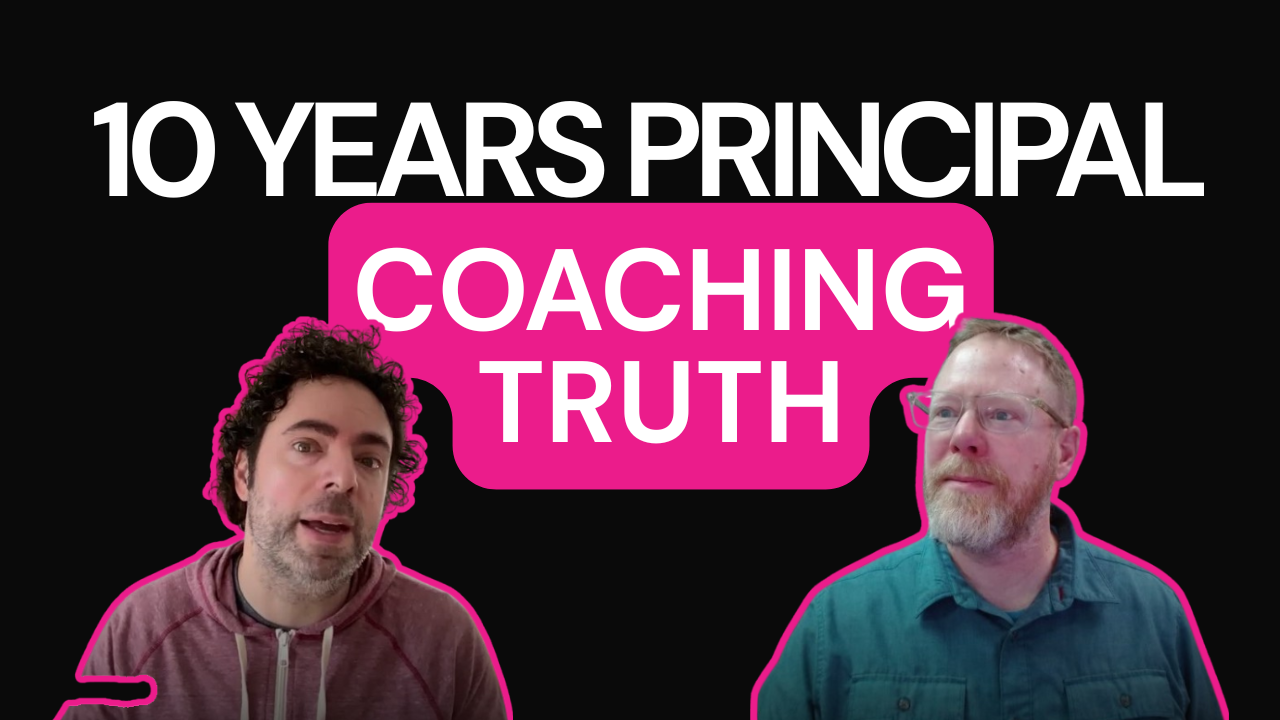
Ten years of school leadership podcasting reveals one consistent truth: most principals are doing it alone when they don't have to. In this special anniversary episode, Danny Bauer sits down with co-host Dan Watt to trace the arc from isolated AP to category-defining podcast host — and what he's learned coaching hundreds of school leaders along the way.
Dan Watt is a school principal, leadership coach, and Mastermind coach for Better Leaders Better Schools, based in northern British Columbia, Canada. He joined the Ruckus Maker community as a member before stepping into a coaching role, and now co-writes the weekly Ruckus Makers newsletter. He brings a practitioner's lens to every conversation — someone still in the building, still doing the work. Find him through the Ruckus Makers community at ruckusmakers.news.
☑️ What You'll Learn
- Why Danny started the podcast and what leadership gap drove the decision
- How the Ruckus Maker Mastermind was built to fill a void no one else in education had addressed
- The mindset shift that separates thriving principals from burned-out ones
- What patterns Danny sees repeatedly in the leaders he coaches today
- Where the Ruckus Maker brand is heading — and why it's bigger than school leadership
🧰 Key Insight #1: Working More Hours Is Not a Leadership Strategy
- What's broken: Districts treat effort and visibility as the measure of a leader's worth — the longer you're on campus, the more you're seen as committed.
- The shift: Value created and culture built are the real metrics — not hours logged or sleeves rolled up.
- Impact: Mastermind member Justin stopped seeing more hours as the solution to feeling overwhelmed, found his North Star, and called it transformative.
🧰 Key Insight #2: Isolation Is a Choice, Not a Condition
- What's broken: Most school leaders wait for the district to provide mentorship, community, or coaching — and the district almost never delivers.
- The shift: Choosing yourself means actively seeking a community, a coach, and the tools to grow on a weekly basis — not waiting for permission.
- Impact: When Danny built the Mastermind in 2016, he introduced peer coaching to an industry that had nothing like it; leaders who join stop leading alone.
🧰 Key Insight #3: You Become What You Think About
- What's broken: Leaders absorb a deficit mindset — kids are broken post-COVID, resources are disappearing, the system is against them — and it becomes a self-fulfilling prophecy.
- The shift: The Beautiful Constraint mindset asks: given this reality, what needs to be true to accomplish what we want
- Impact: Principals who reframe obstacles as constraints to work within — rather than walls to hide behind — lead higher-engagement campuses regardless of what the district hands them.
🗣️ DANNY BAUER QUOTES FROM THE RUCKUS-CAST
"The strangest secret is we become what we think about."
– Danny Bauer
"I no longer see putting in more hours as a solution to this feeling. I very much feel like I'm failing forward with this approach, but I feel like I've found a North Star."
– Danny Bauer (quoting Mastermind member Justin)
"You can work in isolation and get bumps and bruises and learn from sparring in real life — or you could join a community and hear about everybody else's war wounds and scars, and learn from that without having to go through it yourself."
– Danny Bauer
"I don't want it to be like a cult of personality. I have an expiration date. And also, I'm only one guy with one perspective, and it's not always the best."
– Danny Bauer
"Every school leader that wants to grow and meet their potential should join our Mastermind. If you don't want to do that, don't join."
– Danny Bauer
👩🏻💻 Connect With Danny Bauer
🧗♂️ Your Do School Different Challenge
Ready to implement these ideas? Start here:
- Tomorrow: Identify one place you're measuring your leadership worth in hours instead of value — and write down what the actual result looks like instead.
- This Month: Audit your professional development diet: if a conference once a year is your only growth structure, find one weekly or monthly touchpoint — a book, a community, a coach — and commit to it.
- This Semester: Build or join a peer learning structure where you're both giving and receiving feedback on real leadership challenges, not just sitting in a room listening to a presenter.
⌚️ Episode Timestamp
00:00 - Why Danny started the podcast 10 years ago
04:35 - Danny's early leadership gaps as an AP
08:49 - The public feedback mistake and what it cost
13:38 - Why principals always learn even off the hot seat
20:12 - What were the real stakes 10 years ago
29:54 - How the Mastermind started from a void in education
34:11 - Justin's email: stop measuring worth in hours
40:46 - The Beautiful Constraint mindset for today's climate
48:56 - How Danny lives "you're worth it" daily
55:32 - Where the Ruckus Maker brand is going next
00:00
Speaker 1
Foreign. Speaker. So Danny here, listen. I started this show 10 years ago, believe it or not, September 2, 2015. And that first year of putting this show out, I used to have my friend Ivy come on the show and he would interview me talking about different content that I created and put out there for Ruckus Makers. And we would look at it from different angles and just like expand, you know what we're talking about there. Try to create more value for you, the Ruckus Maker audience and so this is a new experiment. Today I'm going to be joined by Dan Watt. Dan has been a coach. He's been a member of the Mastermind. He now coaches the Mastermind. He's been writing for the weekend resource that's available at Ruckusmakers News.
00:53
Speaker 1
And he's a friend and I invited him on this show to be sort of a recurring co host because I'd like to be a guest on the show. I'm always interviewing other people and there's some things that I'd like to be sharing with you, the Ruckus Baker audience. So let us know what you think of this episode. We'll be learning and figuring out the relationship and you know, how to make this the best type of content for you. But we're excited to put this together, so thanks for listening. If this is your first time and like what is going on, this is Better Leaders, Better Schools, the original Ruckus cast for innovative school leaders who want to do school different. That means reimagining this project called School Even within a traditional setting so that we create campus experiences worth showing up for.
01:40
Speaker 1
And thanks to Ruckus Makers just like you, this show ranks in the top 1% of all podcasts. Every category, every niche, anything you could think about because you've pressed play. So thank you from the bottom of my heart. I have so much gratitude that you've engaged with this show over the years. Now, we'll get into the main content in just a second, but first we'll get some messages in from our show sponsors. For over 30 years, ODP Business Solutions has helped schools transform from whiteboards to smart boards. Why? Because when you get the right tools, everyone wins. Visit ODP business.com education to revolutionize your school's learning spaces. That's ODP business.com education staffing stability isn't just about filling positions. It's about what makes educators stay frontline. Education's 2026 K12 lens report highlights what districts are doing differently to strengthen retention and long term support.
02:57
Speaker 1
You can Download the full [email protected] leaders. That's frontlineducation.com leaders. Over 1 million teachers rely on IXL because it's empowering. It helps them make better decisions with reliable, and it adapts instruction based on student performance. You can get started [email protected] leaders. It's ixl.com leaders. Well, all right, Dan, welcome.
03:34
Speaker 2
Welcome.
03:36
Speaker 1
Yeah, good to see you, man.
03:37
Speaker 2
Better Leaders, Better Schools podcast.
03:39
Speaker 1
Yeah, this is it. The Ruckus cast. Here we go.
03:41
Speaker 2
I thought it might be appropriate to start with brief introduction of you.
03:46
Speaker 1
Yeah, yeah.
03:47
Speaker 2
My name's Dan Watt. Got my name on the screen there. I'm a school principal and a leadership coach and a ruckus maker hailing from British Columbia, Canada, northern bc. And today I'm sitting in the host chair as the podcast celebrates 10 years. And also to interview pioneering educator, storyteller, and creator of the Better Leaders, Better School podcast, Danny Bower.
04:15
Speaker 1
So, Danny, I thought, why don't we.
04:17
Speaker 2
Jump right in and I thought maybe we could begin. If you were to think back to 10 years ago when you were first launching the podcast, or maybe even right before, what stands out for you? Where we at in your life? What was going on when you think back to that chapter in your life?
04:35
Speaker 1
Yeah, it's interesting. You know, I, I still have leadership gaps today, but I had a lot more back then. And, you know, the project of the podcast was really just an effort to close those leadership gaps. Right. So back then, I think Serial was like a huge podcast, Right. That was out there. It was done by NPR or at least published by them. And they were sort of. They were looking at this case and whether this person was innocent or guilty. Right. Like, it was a. It was, it was one of those sort of crime shows. I don't know if. Have you ever listened to that one cereal? You should go back and listen to it. Super good. But that's really, that. That show kind of put podcasts on the map kind of. Right.
05:20
Speaker 1
It started to become something that people were talking about in real life and just interesting, like how like, you know, sort of pop culture and stuff out there kind of like right now how. Well, who knows when this gets released? But as we're recording in December, there's a documentary that 50 Cent did about Puff Daddy that a lot of people are talking about. Right. So it's the same. The same type of cultural phenomenon. Right. It was just like everybody was talking about it. And, you know, before that, I was listening to npr. I mean, that was like, sort of news stuff or this American Life, you know, or wait, don't tell me. Like, some really classic shows. And my dad was always, like, really into radio, so I kind of like the audio format of media just in general.
06:04
Speaker 1
And a friend had introduced me to another show called Entrepreneur on Fire, and this was done by the host, John Lee Dumas, and he's still out there doing it, too. But his show, like, he was just talking about, like, you know, what. What makes a great entrepreneur, you know, asking them questions of. Of success and failure. And I was like, huh, that's really interesting. And. And there's. He seems to have a ton of listeners, right? And it's. It's changed his life. I started thinking, well, I wonder. I wonder what would happen if I started talking about school leadership. And so really, that was, like, part of the inspiration is if he could do it, so could I. I looked at the landscape, and there wasn't a lot of education shows 10 years ago. And the ones that were there were. They were okay, right.
06:52
Speaker 1
I thought, you know, there was a space. There was enough space for my voice to be included, and I have just enough confidence to believe, well, maybe I could do it better too. Right? And so I picked up that microphone, started to record, and the rest is history. Right? The show really started to take off in and thinking about, like, category design and not to get, like, too nerdy about business stuff, but I think showing up in that space being definitely different, crystallizing that ruckus maker point of view, you know, made it. Made it the category king of our industry. Right? And then there's no looking back unless I decide to shut it down. So that's just the way it works. My mentors who are into category design, Christopher Lockhead, Eddie Yoon, Katrina Kirsch, at this point, you know, their research shows when.
07:43
Speaker 1
When you design a category like that, you capture 76% of the economics in that market. Right? So, you know, I'm not thinking about it in terms of economics, but in terms of attention and downloads and, you know, engagement. Like, that's certainly been true, you know, with my show.
08:00
Speaker 2
Well, ain't no looking back, but that's what this episode's all about. I'm. I'm curious. You referenced leadership gaps, and I'm wondering how that went. Like, what were those gaps and how did that go initially?
08:16
Speaker 1
I'll give you a great example of a leadership gap. I remember because at the time, I'm an assistant principal, right. And I love to tell the story of how my friend DeAndre got his first principalship. We used to work out together in Chicago. And he said, danny, I need people that I could trust on the team. Right. And I really want you to consider getting your admin licensure so you can be my ap. At the time, I'm a teacher. I have no desire to be an administrator. So anyways, I take care of that. I become an administrator. But like, here's a leadership gap.
08:49
Speaker 1
So I remember once DeAndre was sharing this idea and I was there, maybe the other AP and I know the head of the parent teacher organization was there, he shared this idea and I just straight up say, that's a stupid idea. That idea is terrible. So kind of like a double edged sword. Like, DeAndre knew that I would always tell him the truth, but I didn't realize in the moment because he was pissed, right. And, and he had a little talk with me in the office afterward, but he's like, don't do that in public type of thing. And that's a leadership gap. Because I didn't, I didn't think about how the words might land or hit, you know, or how he might feel or how that might make him look in public. I was just trying to tell him the truth.
09:38
Speaker 1
And the idea was stupid. So objectively I was right. But my timing was very poor in the moment. So that was a pretty big leadership gap. So I learned that lesson.
09:50
Speaker 2
What other gaps have you sort of worked on and filled? Because we're thinking too more broadly about the community and how the podcast continues to be in a sense of service.
10:00
Speaker 1
Yeah, I don't know. I mean, all of them. Right. So just thinking about, like, how to give feedback, you know, communication, how to cast vision, how to be productive, you know, everything, honestly. And something I'm always thinking about is how to motivate people and sort of get them to move along the path that you might think is right without like, coercion or bullying and power, you know, and that kind of thing. Maybe I shouldn't say power because you could have, you can leverage power, but do it in a way that feels good versus like, you know, brute force or memos or because I'm the boss, you know, look at my title. Look at my nice big office. So that's, you know, that was a big one too, is like just how to get people to move and row in the right direction.
10:52
Speaker 1
Because that was something that I saw quite a bit, you know, in all My school experiences is just like people out there doing their own thing, which isn't necessarily bad unless, you know, the school, the organization has said, like, oh, this is the direction we should be heading. Right. And then folks like, after the meeting, you know, have a talk, and then they ignore it. Right. So that's not a good thing. How do you address that type of stuff?
11:16
Speaker 2
Well, and you in the assistant principal or principal's chair have a different focus than you as a leadership coach or a group mentor even. And I think we both know group coach and mentor are almost two different things. But when you use the word power, I think that some of what we do as coaches is give power back to folks like we at a sensor service guide on the side and not telling people what to do. So I'm curious to that.
11:49
Speaker 1
How do I respond to.
11:51
Speaker 2
How do leaders that you coach, maybe back then, maybe now, how do they respond to that approach in your experience?
11:59
Speaker 1
Oh, I see what you're saying. So, I mean, yeah, that is, the approach is just like a lot of curiosity, empathy, and, you know, asking good questions sometimes, you know, at the end. Well, not sometimes. Like, at the end of each session, I'll ask, you know, what was most helpful for you? And a lot of people say, oh, that's a great session. And then I think, oh, my God, what did I do? Right? I asked just a few questions, and I, I shouldn't discount the value of that. Right.
12:23
Speaker 1
You know, sometimes what I find, leaders just need that time to sort of pause into, to sort out their thoughts and to have a sparring partner to run that stuff, you know, by, with versus just keeping it all in your head and, you know, you're not able to make any sense of it and that kind of thing. So, yeah, people respond really great, you know, to that because they're seeing results, they're getting again what they need to have happen done on campus or winning awards. They're making difficult decisions.
12:54
Speaker 2
Right.
12:54
Speaker 1
That could be scary and difficult at times. But we, you know, we. We infuse that ruckus maker swagger and confidence and, you know, let them know too. I think another advantage that I have, at least at this point as well, is, you know, you can talk about, you know, without saying, oh, this specific leader, but, hey, there's a leader I coach. Here's something that they're going through, right. And folks love to hear about that. So whether that's individual coaching and you're hearing about how other leaders are approaching the same sort of challenges and that kind of thing. Or if it's in the group setting, like you're a mastermind coach, right? Like in real time, you get to see how other people think and how they process, you know, the challenges and how they do this thing called school. And that's invaluable. Right.
13:38
Speaker 1
Like, I love that people get their number one challenge solved on the hot seat, but I love even more that when they're not on the hot seat, they get to see how other leaders think and process and approach, you know, the same kind of challenges that they face. And then they could apply it to their context. So in some respects, they're always on the hot seat.
13:57
Speaker 2
Right.
13:57
Speaker 1
They're always getting something and taking it away and being able to put it into practice. So. But it takes a rear leader to also to choose themselves and to say, you know, I want this, because I think, I don't know if I could category it, categorize them all off the top of my head. But to me, like, the optimal ruckus maker is one that does choose themselves and say, I want this kind of experience, I want to grow. Then there's school leaders who aren't ruckus makers. They're just egomaniacs that think they're great leaders and you know, maybe they're doing some things like pretty good, but they don't realize like how much they could grow or whatever. And they don't think they need help nor do they want it. And you know, they're just whatever, like they're kind of losers in my book, honestly.
14:42
Speaker 1
So I'll just say that, I mean, talk about a radical lack of self awareness. Like, oh, yeah, you got it all under control. Yeah, you certainly don't need help. Yeah, sure, buddy. And then, you know, there's also people who are maybe a little bit nervous, you know, and I think that's really, that's very real. Because sometimes when people join like a Mastermind community, they often tell me, I don't know what I'm going to add to this group. All these people are so amazing. Right, right. It's like, well, whatever's in that head of yours because you're the only one with your unique experiences. And I love telling the story of Chris Leffler, right? Because when he first joined the Mastermind, he was a brand new ap, just came from being a teacher and he literally was like, I, I've got zero experience as admin.
15:26
Speaker 1
Well, great. You know, you still got the teacher perspective and you could help some of these veteran principals, remember what it was like being in a classroom and sort of, you know, inquire, right, and challenge some thoughts based on, you know, that experience that they may have forgotten. So that's, you know, that's a really good thing. But everybody has value. Everybody has a great perspective that could push people. And sometimes the simplest, most basic thing that you might say in a group is like the thing that people need to. Need to know, right? There's a. There's a great anecdote about. I think it was Simon Sinek who was sitting in some boardroom, let's say Fortune 500 company, and every. They're talking about their latest, like, product or service or whatever is going to make a. A gazillion dollars type of thing.
16:09
Speaker 1
And everybody around the big mahogany table and the nice, big plush chairs are like talking about the stuff using all the jargon sounds. It's just like education. And Simon has the confidence. It was either him or Greg McEwen. I. I sometimes confused those two. Doesn't matter. But the point is, the guy says, I'm sorry, he raises his hand. I have no idea what you all. And then one by one, everybody around that table, including the presenter, says, yeah, I don't know what we're talking about either. Well, that's kind of a problem, right? But again, like that egotistical leader, right? They just keep going through the motions. They're presenting the thing, the deck, like they're supposed to present, and they're pretending they're faking that confidence and they're getting nowhere. They're spinning their wheels because they're. They're too afraid to admit.
16:59
Speaker 1
Like they don't know what's going on. Right? So. Talk about weird.
17:04
Speaker 2
It's funny you bring up. Chris and I had a recent experience where I was guest sharing a mastermind. And the activity that were doing was kind of a hot seat in a way, but it was a reverse in that everyone was sharing about Chris and sharing the things that they were grateful for having got to know him. And what I loved about that moment was were kind of all pricking him in a way, like telling him stuff that we really liked about him and that were grateful for. And he wasn't aware of those ripples of those tiny stones that he'd been thrown in the pond over the years that he's been a member. And it was really cool when he finally had a moment to soak it in and then, in a sense, respond. He didn't know the impact that he was having.
17:51
Speaker 2
And I love that unintentional part of, maybe intentional part of the mastermind. Where has those long term ripples.
17:59
Speaker 1
Well, you know, because Chris isn't with us anymore. Right. So, you know, we like to send people off on a positive note. You know, it could sting and hurt, you know, when people choose to move on. But we're also celebrating, you know, the relationships we built, the opportunity to serve, you know, and to do this together. He'd been a great advocate for years, coming to live events, you know, faithful and very engaged, you know, member. And now he's in a different coaching program, right. So it's not like he's going out there and still just doing it on his own. Like he's, he feels like he got to some kind of level. He's just in a program that's working on a very specific kind of problem that's going to serve him really well, you know, so we celebrate that.
18:43
Speaker 1
And he was in the group like at least six years, maybe seven. You know what I mean? Like maybe eight. You know, I, I lose count. I could barely count myself, you know, so. But the thing is like, wow, what an amazing guy. And he had such an incredible impact. And so I, I love to tell people that there's no contracts, right. Stay as long as you feel like you're growing and your needs are being met and if that ever changes, then, you know, you're welcome to move on. We wouldn't want to keep you. And I love to tell people too. I said there's literally there's only been one person in all the years since 2016, one person who said, as a school leader, this didn't like, meet my expectations and serve me well.
19:25
Speaker 1
So I tell all these new people that are exploring whether the mastermind's a good fit for them. So you could either be like that guy, it'd be the second person to say this wasn't working for me, or you could be like everybody else who's like growing and thriving, right. And having their needs being met. So I say that tongue in cheek, but I'm proud of those results. Right? Like people, they appreciate the experience, for sure.
19:48
Speaker 2
We often talk about that issue, in a sense, in the Monday night meeting where members recognize that they get out of the experience, what they put into it. And so, oh yeah, those folks that are showing up every single week and chiming in the group chat, in between sharing resources, those folks are growing and leveling up for sure.
20:10
Speaker 1
Yeah.
20:12
Speaker 2
You've kind of alluded a little bit to the stakes, and I'm curious, again, taking you back 10 years, what were the stakes then?
20:21
Speaker 1
Probably just like, personal, you know, because at least how I'm thinking about that question. You know, the beautiful thing about podcasts are really sort of leveled out, like entering into media if you wanted to. Although just in the last few years, did I realize I was kind of building a media company. I thought I was building, like, this educational leadership company, which we do support leaders in that way. But honestly, like, you know, it's. It's. It's media because we're putting out content, so it wasn't too. Too expensive in terms of, like, finances. Although, you know, I love to tell the story of. So that entrepreneur on fire guy, he. He had a program called Podcasters paradise, and I joined, right? So it was like 99 bucks a month for a year, you know, $1,200.
21:12
Speaker 1
And at that time, that was the most I had ever invested in myself. Right. But I did it because the promise was, well, we'll. We'll teach you what I've learned in terms, you know, I'm talking as John Lee Dumas now, right? What he learned as going through and creating a podcast that was performing at a very high level. And so that also, you know, add the category design showing up in the. In the podcasting space differently, plus learning lessons from somebody who had been successful. Right. Like, I could have figured all of that out, and it would have taken forever to get to the place where we're at now. Or I chose, right, to engage in this community, learn some of the playbooks, so to speak. And that sped up the process.
22:00
Speaker 1
And so that's sometimes, you know, a choice to make, too, is like, you know, you could. You can work in isolation and you can go through and be in the arena and get bumps and bruises and learn from, you know, sparring in real life as a school leader, and you'll. You'll get better. Or you could join a community and hear about, you know, everybody else's sort of war wounds and scars, and you can learn from that and not have to go through it yourself. So you save, right, in terms of time and learning those leadership lessons. But, you know, there's an exchange of value, you know, with that. Right. And so it's not, you know, it's not a free experience and it shouldn't be. But that's why, you know, Podcasters paradise helped. It helped me come out of the gates like.
22:45
Speaker 1
Like a Locomotive that had been running full steam ahead. And, you know, again, looking back, right. You can see that worked out for me. So. So stakes were just a little bit of financial resources and time, I think. And, you know, I guess putting yourself out there, people will respond and say stuff, you know, and back in the day, it was. It was difficult to understand why is this person hating so much like, this. This idea, you know what I mean? And being real mean about it. And so, you know, trolls exist and. And also, all my ideas are not good, right? Not at all. And so people might poke holes in those, right? Rightfully so. But you. You have to learn how to, like, deal with that as well, right.
23:30
Speaker 2
And learn from that, maybe.
23:32
Speaker 1
Yeah, for sure. Yeah, for sure.
23:35
Speaker 2
Those stakes have for sure changed over time. And I like how you mentioned about how you made this investment in yourself.
23:43
Speaker 1
Yeah.
23:44
Speaker 2
How do you invest in the podcast and in yourself today?
23:49
Speaker 1
Well, I mean, we're recording on Riverside, so that was a little bit of a software investment. It has better audio and video, you know, so, like, when I first started out, do you even remember Skype? Like, Skype was a thing. And that's what. That's what the early podcasters all use to record back in that even I can't even tell you how to. I don't know. And I wouldn't even know how to log on anymore. Right. Which is funny. And from Skype, we moved to Zoom. I was an early adopter of that. Right. And the Mastermind ran on Zoom for years before the Pandemic. And so I like to say that, you know, the pandemic wasn't easy for members of our Mastermind, but it was certainly easier than everybody else because when we had to switch things like that, they.
24:32
Speaker 1
They kind of understood how to play in a virtual space. So that was. That was a really interesting benefit of being in the Mastermind. How else am I investing these days? I mean, I. I hire coaches all the time thinking about, like, you know, how to communicate sort of the message more effectively or. Or grow the audience and that kind of thing. We've experimented with Facebook ads in terms of growing our email subscribers and email lists. And, you know, I think that benefits the podcast as well. Here you are, you know, co hosting. So, you know, and I'm pretty transparent with sort of my. My master plan. Like when were in Nashville, I think that was the Sustainable School Leadership Summit, and I put up a slide because it's like, how do we stay in the game of school leadership? Right?
25:23
Speaker 1
And it was a Very simple slide. It was three steps, right? That's sort of like the sustainability cycle. I've talked about this before, but you create something awesome. You empower and sort of give feedback, you know, coach up your team, and then you fire yourself, and then you go create something else, and you coach up your team and empower them and that kind of thing, and then you fire yourself. And so, you know, I might do that here. Right? And we're testing that out with you, so we'll see what happens. But we did that with the Mastermind, Right. And part of it, too, is I wanted to see, because it's really important to me. I don't want it to be like a cult of personality, right?
26:08
Speaker 1
Like, I. I'm glad that people get value from whatever perspective I bring to the table, but I have an expiration date. And also, I'm only one guy with one perspective, and it's not always the best. And when more. More voices can speak on the microphone that we use on this show, right? It's going to benefit more people, I believe. And so that's important in terms of picking the guests and that kind of thing. But with the Mastermind, I didn't know if I fired myself as a coach and exited, would everybody leave? And to be honest, I was scared of that. And if that happened then, you know, we might not be talking right now. Right. Because that is a part of. In terms of running the business side of things. It produces revenue.
26:54
Speaker 1
And I think, you know, Mastermind revenue used to be more than sponsorship revenue, and now it's. Now it might be equal or whatever. I don't want to get into, like, that too much. But the point is, if it was just about me, that's great. Like, I love all the relationships. I love what we built, and that would be fine, but it actually would be a little sad for me as well, because I don't want it to be just about me. Right? But if the. If the idea is what works, right, then that means I can leave, we can continue to exist. And that's been the case, which is really just like, so satisfying for me. And so now I'm wondering. I mean, I've done this for 10 years. You know, every week we've shipped an episode.
27:39
Speaker 2
Amazing.
27:40
Speaker 1
52 Weeks. I used to say we never missed a Wednesday, and then my team missed a couple Wednesdays they had. I guess it was me, my poor leadership, because I was like, not on them. Like, hey, where is this? You know? But we've never missed a week. So maybe an episode came out a little bit late, and that's okay. But for 52 weeks, for 10 years. Well, you know, that's over 500 episodes there, and there's been a bunch of bonus content, and that doesn't even come into. Take into account, like the. Remember the School Leadership series? Did you ever listen to that one? You might have participated in it. I can't remember.
28:13
Speaker 2
I really loved that series. I was sad when it ended.
28:16
Speaker 1
Oh, no, it's. Listen, sometimes things have to go, right? So, yeah, that was a daily show, which was really interesting. But yeah, so, I don't know, we'll see what happens with. With this, but then that. That allows, you know, me to go create something else, right. Then I could empower and coach up the team and eventually fire myself from whatever that is next to. So, you know, shout out to Demetrius. I love that guy so much. Right. He's been a great advocate forever as well. And he's a friend. I would consider him a friend. And he says he. He actually loves watching, like, the leadership style and some of the crazy stuff I do because I'm very quick to try out new things and experiment, and I'm also quick to shut it down. Right. You know, like if. If. If we need to.
29:01
Speaker 1
And so that definitely doesn't relate to the podcast, but different communities and, you know, just little things that we've tried out, even like these little cohort, you know, groups that we've been doing, like, play your game in the. In the story stuff. Yeah, we'll see, you know, we'll see what happens with that. But they're all experiments, and I try not to hold on to the outcomes too tightly. So there's a leadership lesson there. Right. Try stuff out. If you see there's some traction, some excitement, some momentum, pour more resources into it. And if it's not getting. Getting to, you know, if you don't see the. The pathway to where you want it to be going, then just shut it down. It's okay. Move on, try something new. You know, life's too short to, like, not do it that way.
29:45
Speaker 2
So how many years into the podcast were you when you created the Mastermind Experience? Started hosting the weekly?
29:54
Speaker 1
Not. Not even. It was. I think it was less than a year.
29:57
Speaker 2
Right.
29:58
Speaker 1
And the story behind that is I was in a mastermind, right. I was in Iron Sharpens Iron. I was in that mastermind for six or seven years. And since then I've joined other community, other groups like Chris.
30:08
Speaker 2
Right.
30:08
Speaker 1
Just because your. Your. Your needs change. That group was really Great. I love them so much. It really helped me get my start. Many of the business owners there had more of like, brick and mortar, you know, type stuff. They're a little bit older, too. And so, like, in terms of. Of. Of media and audience, you know, connecting with audiences and kind of the stuff that we do might have been out. Out outside their sort of range of expertise. And so it was time to move on. Definitely made me a better leader in that kind of thing. So anyways, when I was sitting in that group in early days, just like soaking up so much, you know, a light bulb went on. Because I was an isolated school leader. I wanted a coach, I wanted a mentor. I was in a very big district.
30:58
Speaker 1
Chicago. Right. Third largest district in the states at the time. And, you know, for an assistant principal in such a big system.
31:06
Speaker 2
Right.
31:07
Speaker 1
They're not doing a lot for their aps, and probably rightfully so. It's like a large system. I don't know, maybe they could rethink things. But my point is there's got to be a lot of folks like me out there that want to grow, and they just don't know they don't have a space yet. And a conference once a year, that's not good enough. At least not for me. Adequate. Yeah. I mean, that's like table stakes to stay in the game. Yeah. Go to a conference, learn some stuff. But learning and getting excited, you know, even taking good notes and doing a little bit of networking, that's. That's pretty low effort. Right? Like, you got to take action.
31:46
Speaker 1
And for me, I wanted to be working on myself on a weekly basis, you know, or at least consistently, let's say that it doesn't have to be weekly. I shouldn't say that. So I'm in Iron sharpens iron and the light bulb goes off and I look at education. I'm like, does anything like this exist? So I do my research and I look and look and look. And to my surprise, there is an absolute gigantic black hole. A void of, like, nothing, you know, And I introduced masterminds to our industry. Right. Wrote. Wrote a book on it called Mastermind. It was published by Corwin in the Superintendents Association. That was my first bestseller. But that's. That's pretty cool, right? Like that we did that. You know, our team did that for education.
32:33
Speaker 1
And now folks, if they choose to, they don't have to lead in isolation. They don't have to hope and pray that the district sees that they're drowning and that they need support. Or that they're thriving. Right. And could thrive even more. You know what I mean? And so. Yeah, that's cool. That's cool. In terms of life's work type of stuff, I'm very. I'm very proud of that.
32:56
Speaker 2
And it's a great book.
32:57
Speaker 1
Yeah, it's okay. It's pretty good. I've. I've written. I've written five, and that's one of the strong. It's one of the stronger ones for sure. Right. So what.
33:08
Speaker 2
I mean, you talked a little bit about how social media used to be and how the space used to be leadership and education and our industry. And I'm curious from. And too, in a sense, what. What are you seeing for patterns in education these days? You talk to a lot of leaders.
33:26
Speaker 1
Yeah. You know, you hear about the. Some of the things don't change, like the stress and overwhelm and that kind of stuff. And so people just need tools and spaces to navigate that and to, you know, I think one, if there's. If there's one thing that I do for people and that our mastermind, that we do for people is to say that, like, you're worth it. Right. Like, so many leaders don't realize how much, like, power and autonomy they have and choose to stay on sort of that hamster wheel, rat race of school leadership. And it's like, crazy. Right. Let me, Let me read you this email of a Mastermind member because you know how we post those family photos of the mastermind. Right.
34:11
Speaker 2
I love them.
34:12
Speaker 1
So. So Justin. Justin grew a stash for. He sure did, you know, Movember. Yeah. And I just think I. I don't know why. I love mustaches. Yeah, exactly. And I think I look good in a mustache. Right. My wife hates it. She hates it. And that really drives me nuts because I kind of want to, like, just rock a mustache. And I could, you know, but I keep into account, like, what she finds attractive and that kind of thing. All right. Let's not make it a show about mustaches. But that was. That was my subject line I wrote to Justin. I said mustache or mustache, and I spelled it the two different ways. The us or the O, U, S. Right. And I just, I said, it doesn't matter how you spell it. It looks great on you. What does your wife think?
35:00
Speaker 1
Because that's something I'm always thinking. And how's your. How's your family? How's Thanksgiving? So he responds to all that. But then he said, Justin says, I had a conversation on my head of school today about My role, about my job description, time priorities, and how I'm feeling pulled in a million directions. A lot of the books and conversations from the Mastermind have helped inform how I view my work. This is important. Now listen to this. I no longer see putting in more hours as a solution to this feeling. This is transformative to me. I very much feel like I'm failing forward with this approach, but I feel like I've found a North Star here. Thank you. That line or few lines is worth a million dollars to me at least. Right.
35:51
Speaker 1
Because that's part of what we're teaching, you know, and it's about working effectively and districts. This is a very old school, traditional way of thinking. You've got to work harder, you've got to put in more hours. People need to see you sweating. No, they don't. No, no. Like, that's a great recipe for burning out in news Flash. That's why a lot of school leaders and teachers are leaving. Because they might exist in a traditional system that doesn't see them. That's challenging and pushing and maybe coercing them to work in the old model way of working. This is a factory model, right? You punch in, you punch out. Your worth is only how long you're on campus. That's B.S. It's about the value you create, right? And the culture you create and the, ultimately the results.
36:46
Speaker 1
And if you could create results in an hour, right, then your work is done. You know, now you can't leave, you can't come to school, you know, from 9 to 10 and like golf the rest of the day. That's not ever going to work. But you also don't have to be there all the time, just rolling up the sleeve in like f. We call it efforting, right? Just like putting in more effort. It doesn't make any sense. So, you know, that's one trend is like. And that trend has never change. People like to talk.
37:18
Speaker 1
You know, I was on a podcast yesterday with Josh Tovar, and he was talking about, like, you know, how students change, you know, and this kind of stuff since COVID and da, da, da, you know, and again, like I said, people have this nasty habit of meeting your expectations whether they're high or low, you know, and so if you think kids are broken and they're all messed up and all this kind of stuff, then you're going to have broken, messed up kids, right? If you believe that they can still do it, right. And that they're going to be fine. And that. It's just. It's part of your mindset. You know, one of my favorite books that probably asked you to read or told you about Earl Nightingale's the Strangest Secret. I don't know. I used.
38:00
Speaker 1
I used to listen to that book every single month, actually. So I need to get back to that. It's an old book, very old. I. I should look up. I don't know if it was the 50s or the 40s. Like, very old. And he, at the time, I think the story is. Owned an insurance firm. He used to be in radio, too, but I think he had an insurance company. And this is so crazy that he.
38:25
Speaker 2
He.
38:25
Speaker 1
I'm doing what he used to do. He wanted to get himself out of running his team meeting, Right. And so he started creating recordings for his team, Right. To inspire them and set the direction and all this kind of stuff. And the recordings were so popular, the team asked, can we share this with our families and friends? And that was a signal to Earl, something's going on here. Right. Like, I'm doing this for my team because I don't want to be in these meetings, you know, every week or whatever, but they're getting great value and they want to share it, what's going on here? And so then he. He created recordings for people. And the Strangest Secret, I think, became like the first platinum record for basically motivational speaking. So there's a.
39:10
Speaker 1
There's a through line from Earl Nightingale to us today, and what we're doing in terms of being out there and inspiring and motivating people, which is wild. But this. This book, this recording called the Strangest Secret, you know, it reveals what the secret is. And at the end of the recording, he says, the strangest secret is we become what we think about. Right? So if you want to just, like, focus on. And this is why algorithms are so, you know, terrible, because if you're not very careful. Yeah. About what's curated for you, and if you don't, like, actively say, nope, I don't want that. I don't want that. Right. Because they want to keep you on the platform, keep you engaged, keep you, like, upset, you know, and that kind of thing and scrolling, you start thinking, this is how the world works, right.
39:59
Speaker 1
You become what you think about. So that's. That's a trend I'm worried about is like, you know, people just complain, complain about what's tough, you know, lack of resources or whatever. That's one way. And it's. It's Not. Not true. What. However you say that, right, there is real great challenges around resources. You know, there's crazy stuff happening in. In the states, you know, and federal funding and Department of Ed. Will we have one? You know, will we not have one? All this kind of stuff. That's one way of seeing is like, everything that's you're losing. Or you could have a mindset. There's a book that we love called the Beautiful Constraint. And you could think about, well, if these are all the challenges or the obstacles, the way this is just. This is the same. It's the same story.
40:46
Speaker 1
But this is how leaders flip that and think, okay, well, what's the opportunity here? Right? And it's. I don't like the idea, like, okay, we got to do more with less, because that. That doesn't ever excite people. That's kind of a stupid thing to say. But, you know, given this reality, how might we accomplish these amazing things we want to accomplish? Like what needs to be true? And you got to search for the what needs to be true versus poor me. I don't have the stuff I used to have, and so now I can't do a good job, and my life sucks and education sucks. The world sucks. You know, government sucks. Yeah, okay, it does suck. And we can still make a ruckus.
41:27
Speaker 2
There's a lot in that last statement. I think you're onto something, though.
41:33
Speaker 1
Like, that was the edited version, too, by the way.
41:36
Speaker 2
Can't wait to see that face on the title slide.
41:40
Speaker 1
Oh, yeah, I'm sure that'll be fun.
41:43
Speaker 2
But the flipping the switch and changing our mindset. And again, it brings me back to the mastermind. How do we do that from week to week? How do leaders notice what's going on? How do they take notice? And how do they flip their thinking so that they can identify what needs to be true?
42:05
Speaker 1
Yeah, well, to me, you know, it's a combination of tools and community. Right? So that it is. I think it's as simple as that. And I need those tools, too. Right. I work with coaches, I got a therapist. Like, all that kind of stuff. You know, people are some very basic. Like, somebody's listening to this, and they're never going to join the Mastermind. They could pick up books, like a book called the Tools by Phil Stutz and Barry Michaels. They also wrote Coming Alive, and they have some other books. Those are great books with very specific tools. What is it called? The Inner Game of Tennis. I think I forget the author of that one, but. But that's another, that's another book about, like, you know, you get to a certain level where your physique. Right.
42:51
Speaker 1
Your physical performance is top notch, you know, and so what separates the person who wins the match and the one that loses? It's what's between the ears. Right. It's the inner game. And how do you respond to sort of setbacks. You miss a serve, for example, and the metaphor of tennis and. But it, but it's a great book. I mean, that's an operating system for leadership too, because you're going to have great successes and also failures. It's like, how do you, what's your resilience? How do you bounce back? You know, speaking of that, you know, maybe stoicism as a philosophy, that's a tool because that's really going to encourage you to learn from experience, not to, to label things so much and put so much of a story on it.
43:35
Speaker 1
It's gonna, it's gonna teach you to kind of be like, never too high and never too low. Right. Because both those things, those ranges exist. Yeah. I think that it's probably enough tools to explain for now. And of course, we've got stuff on the website. Right. Resources and obviously, like, I'm biased, but. Every school leader should join our mastermind. Every school leader that wants to grow and meet their potential should join our mastermind. If you don't want to do that, don't join.
44:03
Speaker 2
In addition to the tools and the community and the power of forced reflection. That's not really what I mean to say, but I love the supportive reflection that happens.
44:11
Speaker 1
Well, it's you creating a space again, slowing down. Right. Like, yeah, so powerful.
44:17
Speaker 2
But there's all kinds of little nuggets, more than you can digest in a week or two. Do you know what I mean? Every time a new tool comes out, I'm like, oh, okay, I gotta keep a bookmark on that one. You reminded me of a favorite post of mine. I don't know if you've done one recently, like recent books we've read.
44:33
Speaker 1
Probably not.
44:34
Speaker 2
Or the.
44:34
Speaker 1
I don't know what I've been doing recently. What, what was the post? Tell me again.
44:39
Speaker 2
Sorry, I was Talking over top 100 books or your favorite books or books we've read. That's like, you've listed so many great titles in the last few minutes. It's fun.
44:50
Speaker 1
Yeah, thanks. Yeah, there's a lot out there. Right? There's a lot out there. So, and that's something that I think is powerful, too. I mean, if nothing else, we're going to curate a list of stuff that's going to help you grow as well. Right. So, you know, that's certainly worth something. Also, ODP Business Solutions, formerly Office Depot Business Solutions division, has been a trusted partner for schools for 30 years. And ODP Business Solutions, we're by your side to meet your evolving education needs. Here's the thing about creating remarkable learning spaces. You need a partner who gets it, someone who understands that transforming education isn't just about swapping whiteboards for smart boards. It's about reimagining what's possible. That's why innovative school leaders trust ODP Business Solutions. We don't just deliver supplies.
45:48
Speaker 1
We help you design dynamic learning environments that make students actually excited to show up. From tech integrations that bring lessons to life, to flexible furniture that transforms any space into a collaboration zone, to sustainable solutions that teach by example, we've got everything you need to do school different. And the best part? You can get it all from a single supplier that helps you simplify ordering and streamline budgeting while staying compliant with easy access to cooperative contracts. However you want to advance, ODP Business Solutions has 30 years of experience helping districts like yours get ahead. Visit ODP business.com education to learn more. That's ODPbusiness.com education principals and school leaders know the hardest part isn't the hiring. It's keeping great people from burning out. Frontline Education's 2026 K12 lens survey report found that while recruiting and hiring has eased, gaps still remain.
46:58
Speaker 1
Districts that provide structured and sustained professional development are more likely to report better hiring outcomes. In fact, nearly half of districts that use software to automate professional growth report hiring has become easier compared to only 30% of districts who don't it. If you're trying to build a campus where people feel supported, connected, and proud to stay, Download the full K12 lens report and see what's working for districts right now. Go to frontlineducation.com leaders. That's frontlineducation.com leaders to get the full report. Something that drove me nuts as a ruckus maker was hearing teachers say things like, I taught it, they should have learned it. But really, some teachers just don't know how to teach, or reteach for that matter, so that all kids get it. That's where IXL comes in.
47:58
Speaker 1
IXL's diagnostic automatically identifies knowledge gaps for teachers and provides them With a personalized growth plan for each individual student, teachers can step into the classroom every day knowing what their students know and what they don't know. IXL's adaptive platform makes differentiating instruction easy. As students learn, IXL adjusts to the right level of difficulty for each student. Close knowledge gaps and accelerate learning with IXL. Get started [email protected] leaders. That's ixl.com leaders.
48:43
Speaker 2
Well, I don't know if it'll be the title of this episode or not, but something that I've starred on my notes today is you're worth it. That was something you said. Absolutely something you said earlier. How do you live that today?
48:56
Speaker 1
How do I live that I'm worth it? I think, you know, just thinking about what I want to accomplish and you know, just being confident, like showing up in a space that's. That I have permission totally be myself. You know what I mean? So I'm glad that like stories are resonating or if I show my silly side and you know, that kind of stuff because I don't take myself too seriously. You know, that's something that's important. I was on a, I was on a training the other day by Ron. Put it on. It was a free training, you know, cool. There was some good stuff on there. But you know, I wrote down in those two highlighted. So this board is going to be a board filled of jokes eventually. All right.
49:41
Speaker 1
In 2026, I'm going to start doing stand up open mics and just see what happens. And I'm super pumped about that. And I've already been writing jokes in my journal right here because I'm show and tell, but. And that's going to push me to know that I'm worth it. And like, it's also going to give me confidence to keep showing up. Like, because it's all about observations and perspectives. You know, humor. Like that's a big piece of what makes things funny. Having an interesting and unique take. So as a ruckus maker, I feel like I have some unique perspectives on the world right. In life. And I'm looking forward to sharing those. Yeah. But in Ron's training, like two things that he said that I found really valuable is that it's easy for me to receive.
50:24
Speaker 2
Right.
50:25
Speaker 1
Because sometimes people, I don't know if you could relate, like they beat themselves up or they might think like, I'm not that important. You know what I mean? You get kind of in like a depressive State, you know, or maybe something happens with you like your wife or something like that, and then you just feel like a loser, you know, Then your brain starts to spiral, right? And then you just get sucked into the sludge. And that's where like some of the tools that in that book, coming alive, like man, they have some stuff where you could just shed that garbage and like not let it suck you down. So anyways, yeah, just thinking about big stuff I want to accomplish in connecting dots here. Like I could try to like really effort and like make it happen.
51:09
Speaker 1
Or I could say it's easy for me to receive, right. And just be in a space where stuff can come. You know what I mean? To me. So then the other one is great things are happening today. Right. So this is the first work related thing that I'm doing today. Great things are happening today, man. Right. I, I had. Do you have your coffee? What kind of coffee? I know you're into coffee.
51:31
Speaker 2
What'd you breathe? I got a single origin. Brazil.
51:34
Speaker 1
Yeah. Cool. I don't know what that means. It sounds like it comes from Brazil and from one place in Brazil. I don't know. I don't know what makes that special.
51:43
Speaker 2
It's only from one farm. It's not from America. It's from one particular farm and farmer.
51:49
Speaker 1
Yeah. Right on. Okay. So yeah, I made a latte this morning. I was reading and this is the first work related thing. But you know, again, mindset. This is a big thing we've talked about also this episode. But imagine if you're walking through life saying it's easy for me to receive or great things are going to happen today. Right. Versus the school leader that my job sucks, got no resources, kids suck. Parents definitely suck. Most of my teachers, they really suck. Right. Like you could have that perspective. But how's that working out for you? Yeah, that mindset sucks. It's not the people, it's you. Oh, it's you. Oh, no, let's not talk about that. So anyways,.
52:43
Speaker 2
So I, I have this question. I'm not sure how it fits quite. I just see here in this moment. But who can you call out for their gifts this year? Who in your.
52:53
Speaker 1
I'll call out you, Dan. Hey, let's call out you. You know, we've been working on, you know, if people don't know. Dan's been writing a lot for our newsletter too. Right. So you've been experimenting there and you've been. I've seen your writing grow a lot. Right. It's gone from pretty okay to, like, really good, you know, And I think. I think we're seeing that we. We get data, right, based on, like, how the newsletters and stories perform and in. Anyways, so there's. We have data that says that you're doing a great job. So, yeah, I just want to say thank you for that, and that's why I'm inviting you here. You'll start off as a. An okay podcast host, and I want to help turn you into something great with that. So. Good. Good luck. So it's okay.
53:45
Speaker 1
You know, this will always be like the show you look back to and you're like, you know what I mean? Right. And then who knows, maybe a decade later you'll be like, wow, look at this guts. Who will be interviewing you? It'll be great. It'll be great.
53:59
Speaker 2
Got so far to go, but right on.
54:02
Speaker 1
Yeah.
54:02
Speaker 2
Well, thanks. I appreciate those kind words.
54:05
Speaker 1
What have you noticed about your writing and, you know, serving the Ruckus Maker audience and how you've grown and that kind of thing?
54:13
Speaker 2
I. I've definitely grown as a result of specific feedback, and I really appreciated some of the feedback that I've received. It's more fun when I'm doing it with somebody else. And much like being part of the community, mastermind community, listening to the podcasts are great, but this is way more fun doing it with somebody else. So same with the writing. I appreciate when I hear back from the audience or when you and I chat about something that I've written. I also have been writing in the substack, and I say in the substack, but I appreciate reader feedback and my family often will be the most generous contributors to that. But still, it's fun to hear what they think, so helps me improve.
55:05
Speaker 1
Nice. Yeah, that's cool.
55:07
Speaker 2
Thanks for asking. Well, I've come to the end, the natural conclusion I think of questions that I have. I am super curious. I don't want to jump the shark too soon, but I'm curious where the evolution is growing, where you see yourself going. And that could be a teaser now, where you give us a hint or a clue, or it could be fodder for future episodes, too.
55:32
Speaker 1
For 10 years, you know, we've been playing project to school and we'll never, will never leave it. A signal that I've seen kind of like Earl Nightingale when he was given the trainings to his team and they were sharing it and he's like, huh, what's going on here? You know, and how Do I sort of fan the flame of it? You know, the feedback I've received often on my posts actually in what's weird is sometimes the most engaged people on my posts are not school leaders, right? They're business leaders. And, and they'll say, oh, Danny, I don't know why you say this is for principals or this works for schools. And they say, danny, I'm a ruckus maker, right?
56:13
Speaker 1
And I've realized for those people who are highly engaged, they don't have a, they don't have a space to connect yet, you know, with me. So something I think a lot about is like how do we sort of expand the Ruckus Maker brand and create it? Like create a party tent that's even more expansive, right? Which is interesting because they always tell you when you start in some off like we did, to be hyper focused and niche down, which I think is true. But now I'm starting to think about we've done the niche thing and we'll continue to. And how do we actually now grow it out, right? So, because again, so many people say this works, that's just leadership. Or that idea of building a team, that culture piece, that's not just for a campus, like stop saying that, Danny.
57:04
Speaker 1
You know, like it actually makes people upset. And then they write, I'm a ruckus maker. Right? But again, they have nowhere to connect. So I'm thinking about that because then it's not about, you know, we'll still say ruckus makers do school different, but that point of view needs to change a little bit. So I've actually never said this out in public before, but the new point of view I'm toying with is this idea of Ruckus Makers build belief. Build belief in people. Because as a leader, if you can help people see and believe that whatever that crazy idea is possible, right, you're gonna lead a high level organization and that works for a campus that works for a Fortune 500 company, works for tech startups, it works for corporations, it works for nonprofits, it works for churches and synagogues and temples. And it works.
58:00
Speaker 2
You know, I love that. It's a piece of feedback that I've received on my writing in Substack is folks are saying, why are you always talking to leaders? Leaders, leaders. Like this is good for teachers or people.
58:12
Speaker 1
Yeah, yeah. So that's something I'm thinking a lot of, a lot about. And that's really exciting to me too because Then you know, when you start thinking, oh, this works for leaders or this works for people or everybody is a leader. Right. Like I think about Nike, you know, just do it. Everybody's an athlete. Even people who don't look like necessarily an athlete right now, but they want to get there. Right. It's aspirational. I sometimes think of maybe Ruckus bankers potentially becoming a brand that's like that. Like, you know, you don't have to have titles, CEO, principal, you know, director. If you're out there pouring into people, inspiring them, you know, cast envision, creating results. You're a leader, you're a ruckus maker, you know, so Ruckus makers build belief. So I'm toying with that. I haven't done anything with it. Actually.
59:11
Speaker 1
If you looked at my LinkedIn, it is, it's way different now. So go check it out afterwards. But yeah, we'll see. We'll see what happens.
59:19
Speaker 2
Right on.
59:20
Speaker 1
I don't know.
59:20
Speaker 2
Well, here's to another 10 years.
59:22
Speaker 1
Yeah, exactly. Because that's the other thing, right? That's a 10 year project. So I'm feeling bubbling up inside me like I wanna figure out what's the next challenge, right? Not to say I've accomplished everything I want to accomplish in education, but you know, what, what would. Yeah, just what's the next evolution? You know, and that's okay. We go through seasons, you know.
59:47
Speaker 2
Well, I am super grateful for you offering this opportunity to start a season and I'm hoping that this invitation to folks, not just leaders, but anyone that wants to keep listening, that this series continues for some time. It'd be great to do this over the next year together and I hope that folks find it helpful.
01:00:11
Speaker 1
All right, thanks for your time and go make a ruckus.
01:00:14
Speaker 2
Right on. Thank you.
01:00:19
Speaker 1
Hey Ruckus makers, thanks again for pressing play. I hope you enjoyed the show as much as I enjoyed creating it for you. And before you go, if today's episode shifted something in you so that you want to do school different, or maybe you have a new idea about how to reimagine education on your campus, then check out my principal Coach. It's your AI powered leadership mentor. It's trained on 10 years of mastermind and private coaching experience that I've had. It's like having a world class Ruckus maker mentor in your pocket. 24, 7. You can start your free seven day [email protected].
Transcribed by https://fireflies.ai/
🎧 Listen & Subscribe
Listen to Better Leaders Better Schools on Apple Podcasts, Spotify, Youtube or wherever you get your podcasts. If today's episode moved you, leave a review — it helps more Ruckus Makers find the show.
🧔🏻♂️ Your Self-Mentorship Guide
Meet Digital Danny — your self-mentorship guide. Always available, never forgets, and evolves with you. Think through your next leadership move at myprincipalcoach.com.
🤝 Today's Ruckus-Cast Partners
ODP Business Solutions®
ODP Business Solutions has been a trusted partner for schools for 30 years — helping districts move from whiteboards to smart boards, static classrooms to collaboration zones, and single-vendor chaos to streamlined cooperative contract ordering. If you're trying to design a learning environment students actually want to show up to
🔍 Visit odpbusiness.com/education
Frontline Education
Frontline Education's 2026 K12 Lens Report found that districts using software to automate professional growth are nearly twice as likely to report easier hiring than those that don't. If staffing and retention are keeping you up at night,
🔍 Download the full report at frontlineeducation.com/leaders — it shows exactly what high performing districts are doing differently.
IXL
IXL's diagnostic identifies every student's knowledge gaps and delivers a personalized growth plan — so teachers stop guessing and start teaching to what students actually need. Close the gaps, accelerate learning, and
🔍 Get started today at ixl.com/leaders.
Twelve Practices LLC © 2026 | If Education Ain't a Bit Disruptive, Then What Are Your Students Learning?


