How to Build Your Ideal Week
If you feel like you don’t have enough time to get everything done, you’re right.
Everyone has a finite amount of time each week. That’s 168 hours for you and me. That amount won’t change so what matters is how you use it.
“Newspapers are full of articles explaining how to live on such-and-such a sum…but I have never seen an essay ‘how to live on 24 hours a day.’ Yet it has been said that time is money. That proverb understates the case. Time is a great deal more than money. If you have time, you can obtain money-usually. But…you cannot buy yourself a minute more time.”
-Arnold Bennett
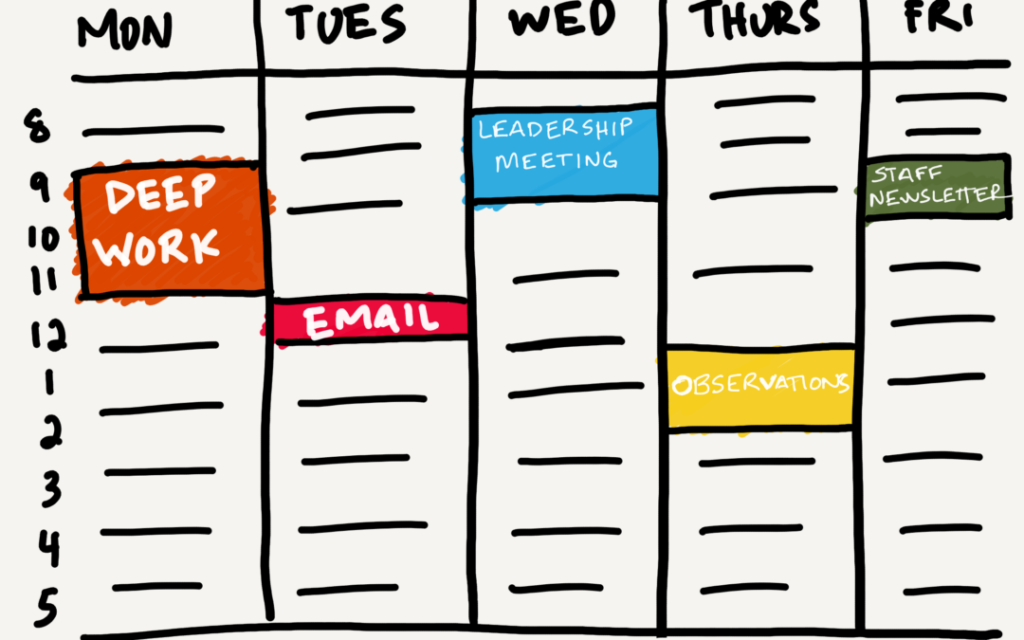
One of the most powerful coaching sessions I offer is helping leaders create their “Ideal Week.”
It’s exactly what it sounds like.
If you scored your day a 10/10, how would you have spent your time?
There are two main enemies to creating incredible value in your organization: emergencies and a lack of intentionality. I’ll explain how to deal with both and share some coaching tips on how to create an ideal week.
Extinguishing daily fires
Is this you at work?
Most emergencies you identify as “fires” are identified incorrectly.
The best way to deal with them is to stop putting them out. Let the fires burn.
Of course, there are some fires that must be extinguished and it would be irresponsible to not in act in the time of real emergencies.
So how do you distinguish what you need to extinguish?
Decide before they happen.
Coaching tip: reflect on the last 20 fires that zapped your time and energy. What were they? Categorize them. Do see any trends or buckets?
YOUR IDEAL WEEK SUBSCRIBE
Get your free ideal week course
If you’d like my FREE video course on creating your ideal week, enter your details below. I’ve created five short videos that walk you through the process.
With your list in hand, identify which emergencies needed your attention. This category of “fires” should be quite small.
So what do you do with the rest?
Let them burn.
You can do this in two ways: delegate these fires to other members of your team or ignore them completely.
Your content goes here. Edit or remove this text inline or in the module Content settings. You can also style every aspect of this content in the module Design settings and even apply custom CSS to this text in the module Advanced settings.
The interesting thing you’ll find is that most problems magically solve themselves when you’re not around to solve them.[/et_pb_text][et_pb_text _builder_version=”4.16″ global_colors_info=”{}”]The problem is that leaders rarely leave fires unattended. The result is that they feel stressed to the max and constantly frustrated. They are disconnected from the work they find truly satisfying.
Stop it.
Keep your list handy. Meditate on it daily. Communicate to your team and larger staff what constitutes an emergency and what does not. Correct your people when they bring something to you that they need to handle on their own.[/et_pb_text][et_pb_text _builder_version=”4.16″ global_colors_info=”{}”]
Being intentional with your time
Now that emergencies are dealt with I want you to really reflect on how you use your time.
“What most often keeps you from being exceptional is not a lack of time, but the way you allocate the time that you have.” -Brian Moran
What would I see if I looked in your calendar? Does it guide your day, every day?
That’s an easy first step.
The much harder part is adding to your calendar the right kind of tasks.
How do you know what is going to bring the most value to your organization?
I think of it this way: shallow work is not the same as deep work.
Shane Parrish uses an amazing analogy to describe the difference between shallow and deep work.
He says that work is like poker.
When you play a hand of poker and you are dealt into the game, it’s up to you if you match the bid. This choice does nothing for you other than allow you to continue playing. It does not guarantee that you win the hand.
That’s the same with shallow work. Shallow work allows you to continue playing the hand. Deep work is the strategy necessary to win and in the case of work … to create the most value for your organization.
Use your calendar. Once you get that down, make sure that deep and meaningful work outweighs the shallow, but necessary, tasks of each day.
“Ask yourself at every moment, ‘Is this necessary?’”
-Marcus Aurelius
Why an ideal week matters
“The more of the details of our daily life we can hand over to the effortless custody of automatism, the more our higher powers of mind will be set free for their own proper work.”
-William James
An ideal week is foundational to your success as a leader.[/et_pb_text][et_pb_text _builder_version=”4.16″ global_colors_info=”{}”]
[bctt tweet=”Great post by @alienearbud: https://betterleadersbetterschools.com/how-to-build-an-ideal-week/ #education #blbs #HustleForGood #RuckusMaker”]
The reason is that it automates your life. You turn the work week into a routine. You know what is going to happen next. As William James points out in the quote above, routine clears the way for you to do your best work.
I have yet to meet an elite performer who lacks an ideal week. Each elite leader I coach in the mastermind has their week dialed in. They know their priorities. Even more important — they know what to ignore.
Just like a vivid vision, an ideal week sets the target. It tells you where you are going.
Seneca said, “If one does not know to which port one is sailing, no wind is favorable.” We’re all going somewhere. You can choose to get there by letting the waves carry you where they may, or you can sail with intention.
An ideal week shows me your priorities.
YOUR IDEAL WEEK SUBSCRIBE
Get your free ideal week course
If you’d like my FREE video course on creating your ideal week, enter your details below. I’ve created five short videos that walk you through the process.
Accomplish Your Dreams
Have you ever said, “I wish I had time for that”?
That usually represents something amazing. But we punt, we defer, we kick the can down the road.
It is a classic example of important vs urgent like President Eisenhower described in matrix.
Rory Vaden improved the “Eisenhower box” by adding the idea of the significance in his book, Procrastinate on Purpose, which is worth the read for the idea of the “Focus Funnel” he introduces.
Use the funnel to focus on high-quality tasks.
“In order to think clearly, it is essential that each us figures out how to filter out the inconsequential from the essential.”
-Ryan Holiday
Significance is about long-term thinking. The value of that task is 10x more important than important tasks and 100x more valuable than an urgent one.
The way you accomplish your dreams is that you work on the significant tasks, important, and then urgent tasks in that order.
Tips on Creating Your Ideal Week
Mindset
In terms of mindset there are three big ideas that will help you approach building an effective ideal week:
- Being intentional with your time is most important.
- The ideal week is a guide, not a grade. Seek progress, not perfection.
- Think bigger and think categorical.
Work in “batches”
A study done by Microsoft found that distracted workers took an average of 15 minutes to get back to work. Switching tasks and purposely multitasking is a terrible idea if you want to be productive.
The answer is to work in batches. Process email for a block of time. Then stop and switch tasks. Do all your administrative paperwork at one time. Then stop and switch to a new task. Do a full observation, write your notes, enter it into the system, schedule the debrief. Then stop and ….
Five Types of time according to Brian Moran
Below are five types of time categories you’ll want to include in your ideal week. I enter these blocks as categories into my Google calendar and then add specific tasks when I plan my week each Sunday.
Strategic Blocks
- 1.5 – 3 hours in length and scheduled early in the week.
- Work on your school (or business) not in it.
- Schedule during times work activity is lowest
- No phone calls, emails, faxes, visitors …
- Focus and energy spent on
- Time use = intellect & creativity
- One per week is normally sufficient
Buffer Blocks
- Lower-level activities
- 30-60 mins
- 1-2 times per day
- Focused on “administrivia” (e.g. phone calls, email, etc.)
- Power = grouping together unproductive activities “batching.”
Breakout Blocks
- Prevent burn out & create more free time
- 3 hours in length; during normal business hours
- Once per month
- Do not start until everything is running smoothly
- Spent on things other than work
- Goal = reinvigorate your mind … return to work with more focus & energy
White Space
- Don’t schedule every minute
- Adds margin
- Short blocks during the day
- Time to dream
- Time to catch your breath
- Self-care
- Stretch, meditate, read …
- Opportunity for something magical to happen
Other considerations
- Observations
- Shadow a student
- Celebrations
- Etc (anything else that doesn’t fit into the other categories based on your industry)
Your Turn
Now it’s up to you to take this action and make it a reality. As John Doerr says, “Ideas are easy. Execution is everything.” Take what you learned in this post and start building your ideal week.
If you could use some coaching and my step-by-step guide on how to build your ideal week, make sure you grab the free course below.
YOUR IDEAL WEEK SUBSCRIBE
Get your free ideal week course
If you’d like my FREE video course on creating your ideal week, enter your details below. I’ve created five short videos that walk you through the process.
Helpful Resources
The following resources will help you continue your learning:
- The 12 Week Year. If you haven’t read this book, I highly recommend it to anyone looking to become more productive. You can also read more about the 12 week year on Brian’s website here.
- Read Procrastinate on Purpose and implement the “Focus funnel.”
- This post on OKRs. OKRs will help you accomplish more of your goals.
- Your schedule can make or break you.
- Sanebox. I have an annual membership to this tool. It changed my life. Last week I saved 3.1 hours of processing email because of Sanebox. It filters my email so I only see the important ones I can I scan unimportant emails when I choose. Click here for a free trial.
- Subscribe to The Better Leaders Better Schools Podcast on iTunes and Spotify
- Subscribe to The School Leadership Series on iTunes and Spotify
- If you’d like to work with me 1:1, just send an email here: [email protected] to discuss your goals.
- Check out the mastermind. I facilitate the world’s greatest PD for school leaders. “Everyone wins when a leader gets better. Everyone wins when you get better.”
Photo by Chris Liverani on Unsplash
