What is the hot seat? It's a 25-minute protocol where one leader brings a real problem, a small group works it, and the leader walks out with a next step. The presenter talks at the start and the end. In the middle, they listen.
Play-It-Safe Principals carry their hardest problems alone. Ruckus Makers bring them to the room. The hot seat is how the room works.
It runs the same way for a principal, an assistant principal, or a whole leadership team. You need a timer, a facilitator, and a few people willing to think hard about someone else's problem.
Get the one-page Hot Seat Protocol.
All six steps and their times on one page. Print it and put it on the table.
You'll also get Ruckus Maker News, our weekly newsletter. Unsubscribe anytime.
How does the hot seat protocol work?
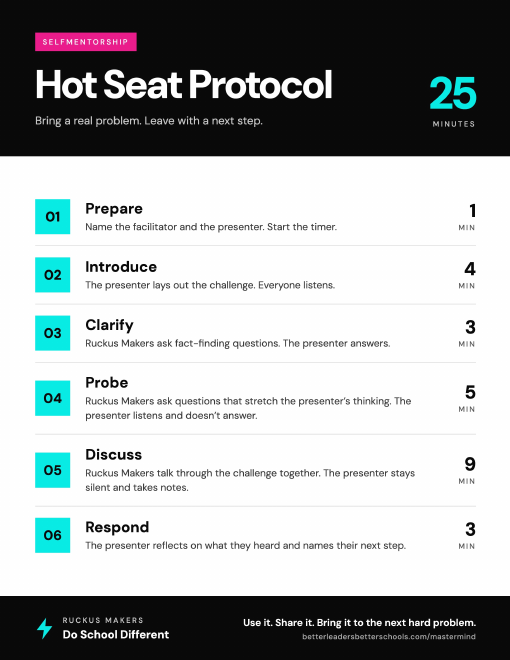
The hot seat runs in six timed steps that add up to 25 minutes: Prepare, Introduce, Clarify, Probe, Discuss, and Respond. The presenter talks during Introduce, Clarify, and Respond. During Probe and Discuss, the presenter stays silent and takes notes while the group does the thinking.
Prepare.
Name the facilitator and the presenter. Start the timer.
Introduce.
The presenter lays out the challenge. Everyone listens. Four minutes covers what's happening, what you've tried, and where you're stuck.
Clarify.
The room asks fact-finding questions, and the presenter answers. How many teachers? When did this start? Who else knows? No advice yet.
Probe.
The room asks questions that stretch the presenter's thinking. The presenter listens and doesn't answer. What are you assuming about this person? What's your part in this?
Presenter stays quiet.Discuss.
The room talks through the challenge together. The presenter stays silent and takes notes. This is the longest step, and it's where most of the value shows up.
Presenter stays quiet.Respond.
The presenter reflects on what they heard and names their next step. It's one step, not a plan.
Why does the presenter stay quiet?
The presenter stays quiet during Probe and Discuss so they stop defending their own explanation of the problem. Silence turns them from a defender into an observer. They keep the questions instead of batting them away, and they hear their problem the way people outside it see it. That's when it starts to look different.
This is the part people push back on, and it's the part that matters most.
Your explanation is part of the problem.
When you're stuck, you've already explained the problem to yourself many times. Every time you tell the story, you tell it the same way, with the same villain, the same constraints, and the same dead ends. If you get to answer every question, you'll defend that story, and you'll leave with the same view you came in with.
When you're stuck, your explanation is part of why you're stuck. The hot seat takes the microphone away from it.
Questions work better when you can't answer them.
During Probe, you don't answer. That feels strange for about a minute. Then you notice the questions stay with you instead of getting resolved on the spot. Most of the time, the question you most want to answer is the one you most need to think about. Write it down and let it work on you.
The room talks about you, not to you.
During Discuss, the group talks about your problem as if you weren't sitting there. That frees them to say what they really see, without softening it for you. You hear your problem reframed by people who don't share your boss, your staff, or your blind spots. Your notes capture what you'd otherwise argue with.
Respond ends in action.
A hot seat that ends with "that was helpful" didn't work. Naming one next step out loud, in front of people who'll ask about it later, turns insight into movement. That's Selfmentorship: you do the work, with peers who hold you to it.
Run this at your next meeting.
Get the one-page Hot Seat Protocol in your inbox. Print it, name a facilitator, and start the timer.
You'll also get Ruckus Maker News, our weekly newsletter. Unsubscribe anytime.
Where did the hot seat come from?
The hot seat belongs to a family of educator protocols, and its closest relative is the Consultancy Protocol, developed by Faith Dunne, Paula Evans, and Gene Thompson-Grove through the Coalition of Essential Schools and the Annenberg Institute for School Reform. In the Consultancy, the presenter also listens silently and takes notes while the group discusses the dilemma.
You can read the original Consultancy Protocol from the National School Reform Faculty. Educators have used it for decades because the silent presenter works.
We're not against the Consultancy. It's a strong tool, and published versions often run 30 to 60 minutes. We're against treating a long protocol as the only option, because a principal's week doesn't have that much open space. The hot seat keeps the same bones (clarifying questions, probing questions, a silent presenter) and fits them into 25 minutes, so a weekly one-hour room can run it every time it meets.
What problem should you bring to the hot seat?
Bring a problem that's real, current, and yours to act on. A good hot seat problem is something you're facing this month, where you have the authority to make the next move, and where you honestly don't know the right answer yet. Venting about a decision you can't change wastes the room.
A good hot seat problem.- It's happening now, not last year.
- You can make the next move without anyone's permission.
- You've already tried something, and it didn't fully work.
- You can explain it in four minutes.
The strongest problems often start from success. Imagine a principal who says, "Our new walkthrough routine is running every week, but teachers see it as compliance. This means the feedback isn't changing instruction." That's a problem of practice the room can sink its teeth into.
Not sure where to start? The School Leadership Scorecard shows where your leadership is strong and where it's stuck. Bring the gap.
What does the facilitator do?
The facilitator protects the process so the presenter and the room can do the thinking. They keep time, name each step out loud, stop advice that sneaks into Clarify, and keep the presenter silent during Probe and Discuss. In Respond, they hold the presenter to one next step, not a plan.
Lines a facilitator can use.- "That sounds like advice. Hold it for Discuss."
- "Let's not answer that one. Write it down."
- "We have two minutes left in Probe."
- "What's your one next step?"
Get the one-page Hot Seat Protocol.
All six steps and their times on one page. Print it, put it on the table, and run your first hot seat at your next meeting.
You'll also get Ruckus Maker News, our weekly newsletter. Unsubscribe anytime.
How do you run a hot seat with your team?
Run it at your next admin team or PLC meeting. Pick a facilitator and a presenter before the meeting, ask the presenter to bring one real problem, print the protocol, and start the timer. At the following meeting, ask the presenter what happened with their next step.
Make it work.- Rotate the presenter so everyone takes a turn.
- Go first yourself, so your team learns it's safe to bring a real problem.
- Give the facilitator permission to interrupt anyone, including you.
- Follow up on every next step at the next meeting.
- The presenter jumps in during Probe or Discuss to explain.
- Advice slips into Clarify as a question, like "Have you tried…?"
- The problem belongs to someone else, so the presenter can't act on it.
- Respond turns into a rebuttal instead of a next step.
- Nobody follows up, so the next step quietly disappears.