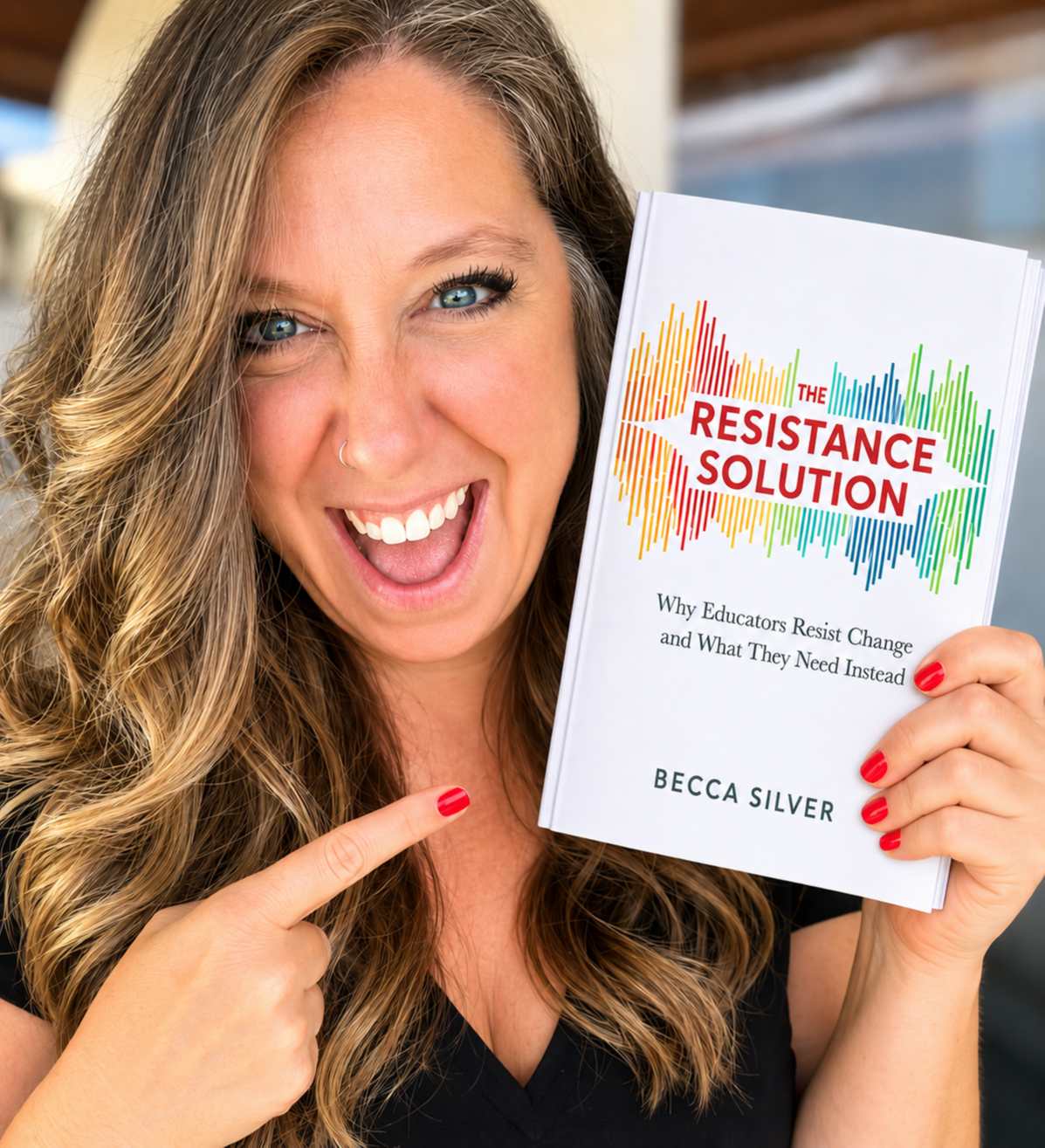
A former classroom teacher who once refused to use her own smart board, this educator, coach, and podcast host has spent nine years consulting with school leaders on the hardest part of any initiative: the people who won't move. Becca Silver taught for 10 years, including two in Tanzania, before turning her own resistance into a framework leaders can actually use.
Her book, The Resistance Solution, gives principals a way to diagnose teacher resistance to change instead of fighting it. Find her at thewholeeducator.com
Teacher resistance to change is the reason good initiatives die in the hallway. Most principals answer it with more training, more accountability, or one more relationship-building push, then watch the same resistance come back next month. The problem isn't your teachers. It's that you're treating a will gap like a skill gap.
📚 What You'll Learn
- Why teacher resistance to change is a will gap, and why skill-based fixes keep failing.
- How to replace "they should" thinking with "how could I support them" before it poisons the room.
- The NODR approach (notice, observe, diagnose, respond) and the five catalyst mindsets that show where buy-in breaks down.
- Why "build trust" is too vague to fix anything, and how to tell character trust from competence trust.
- How to use teacher complaints as diagnostic data instead of smoothing them over.
🤩 Key Insight #1: Teacher Resistance to Change Is a Will Gap, Not a Skill Gap
- What's broken: Principals react to resistance by grabbing the usual toolbox (more training, more accountability, more relationship-building) and loop back when it fails.
- The shift: Diagnose which of the five catalyst mindsets (value, belonging, success, growth, ownership) is missing before responding.
- Impact: Your response targets the actual gap, so you stop solving the same resistance problem over and over.
🤗 Key Insight #2: How Principals Make Resistance Worse by "Shoulding" on Staff
- What's broken: Frustrated leaders slip into "they should care more" and "they should know better," which is its own form of resistance that teachers can feel in the room.
- The shift: Pair expectations with curiosity and ask, "How could I support them in this?"
- Impact: You stop bringing your resistance to their resistance, and the standoff loses the fuel keeping it alive.
😎 Key Insight #3: Escape the Niceness Trap by Treating Teacher Complaints as Data
- What's broken: School cultures of niceness push leaders to spin complaints positive or rush to fix them, which quietly builds compliance instead of ownership.
- The shift: Go to the resistant teacher's room, ask how it's going, and keep asking questions until you hear what's underneath.
- Impact: You walk away knowing the teacher's real barriers and priorities, which gives you a specific place to start supporting change.
💬 BECCA SILVER QUOTES FROM THE RUCKUSCAST
"We hire critical thinkers... And yet we ask those critical thinkers to comply with changes they didn't choose."
— Becca Silver
"Resistance isn't a skill issue. It's not a skill gap. It's a will gap."
— Becca Silver
"We bring our resistance to their resistance, and what you resist persists."
— Becca Silver
"If a teacher doesn't trust your competence... stopping and asking on Monday mornings how their weekend was will never build that trust."
— Becca Silver
"Curiosity isn't a nice to have. It's a must have for us to actually navigate resistance effectively."
— Becca Silver
"We're not lowering the rigor here. We're raising the support."
— Becca Silver
"Resistance is a compass, not a stop sign."
— Becca Silver
📆 Your Do School Different Challenge
Ready to implement? Start here:
- Tomorrow: Write down one "they should" thought you have about a staff member and rewrite it as "How could I support them in ___?"
- This Month: Visit the classroom of one teacher resisting your current initiative, ask how it's going, and listen to every complaint without fixing it or spinning it positive.
- This Semester: Before launching your next change, map likely resistance against the five catalyst mindsets (value, belonging, success, growth, ownership) and build a support for each gap you find.
⌚️ Episode Timestamps
- 00:00 - Why shoulds keep resistance alive
- 04:21 - The teacher who refused a smart board
- 08:41 - Hiring critical thinkers, demanding compliance
- 12:14 - What happens when leaders should on staff
- 15:39 - The notice-react loop vs NODR
- 17:18 - The five catalyst mindsets
- 20:08 - Why build trust is the wrong diagnosis
- 23:07 - Integrity is not about being a good person
- 31:02 - Efficiency bias and the weed analogy
- 34:41 - The niceness trap and why complaints are gold
- 38:52 - Human-centered leadership without lowering rigor
- 41:29 - Resistance is a compass, not a stop sign
00:04
Speaker 1
We say things like they should care more. They should just come and do their job. They should know better, right? And they do what I call we should on people. We should on people. We're like, you should be different than the way you are. And when we slip into our shoulds, sometimes we should everywhere, sometimes we should on ourselves. I should on myself yesterday, always, right? So we this is very natural part of being human. The issue is shoulds are a form of resistance and we don't realize that. So what ends up happening is we bring our resistance to their resistance and what you resist persists. So our shoulds are keeping around the very resistance we don't want around foreign.
00:56
Speaker 2
The jobs your students will have in 10 years. They probably don't exist yet, but Orchard helps them explore what's coming and how to build a plan for it. It's with an AI career buddy that they call Orchi. You can learn more about Orchard and Orchi at BetterLeaders Orchard Careers. That's BetterLeaders Orchard Careers. Looking to create the kind of campus experience students never forget, ODP Business Solutions transforms ordinary spaces into extraordinary learning environments. Visit ODP business.com education and let's do school different. That's ODP business.com education. If you could differentiate instruction in 20 minutes or less, would you do it for all your students? Well you can with IXL. Over 1 million teachers use IXL because it empowers them to use effective data informed instruction. And you can get started [email protected] leaders. That's ixl.com leadership.
02:12
Speaker 2
You didn't take the principal's chair for the budget meetings and the paperwork. You took it to change kids lives. Kids First Education helps you get that back with coaching and with support that's built specifically for school leaders. This episode is brought to you by Kids First Education. Learn more at Kids First LLC leadership. That's KidsFirst LLC leaders. Corey talked to Digital Danny 910 times in just five months and when I asked him about why he hired Digital Danny he said well the first job was to communicate things. Those high stake messages I needed to share a non renewal of a teacher, a difficult parent situation and I needed those message to land. And Digital Danny helped. I had an idea of what I wanted to share but Digital Danny gave me other ways of thinking about how to communicate based on the stakeholder.
03:17
Speaker 2
So if you have high stakes messages that you need to land as well, maybe you should hire Digital Danny for that job as well. Get started and try for yourself at myprincipalcoach.com Ruckus that's myprincipalcoach.Com Ruckus.
03:38
Speaker 3
All right, I want to welcome to the show today, Ms. Becca Silver. She is an educator, a leader, an author, and a podcast host herself. Becca, welcome to Better Leaders, Better Schools podcast.
03:51
Speaker 1
Thank you. Thank you. I'm so excited to be here, and I'm excited to talk about our topic today.
03:57
Speaker 3
Absolutely. We're going to talk about resistance and all the work that you've done there. One of the things that we like to start off with is an impactful story for you that really got you going when it comes to, you know, education or your why. So can you share with us the story that's impactful and, you know that we'll be able to connect to our discussion today?
04:21
Speaker 1
Yeah. Yeah. So in the middle of my teaching career, I moved abroad, and I lived in. In East Africa, in Tanzania. And I lived there for two years teaching. And when I came back to the States, everyone had a smart board and a smartphone. When I left, I had my beautiful metallic blue flip phone, and I loved it so much. And I came back, and everyone looks like they're talking on calculators, you know, and I'm like, what is going on here? And so when I started teaching, my principal with this new school I was teaching at, she brought me around to all the classrooms, and she showed me all the smart boards. She's very elaborate and, like, look at our smart boards. And I said, listen, do you think you can give me a classroom without a smart board?
05:12
Speaker 1
Which I think she thought was ridiculous because it was very exciting at the time for everyone to get a smart board. So I ended up having to get a smart board. But I spent that first year refusing to use technology. And what was happening in the school was ev. It felt like every week they're bringing us to a staff meeting and showing us a new app. Do you remember that time, Demetrius? Do you remember when it was like, the new app and the new technology time? Yeah, I totally resisted it for a whole year. And I did the smile and nod thing, and I refused to use it. And it wasn't until the end of the year that I really got. The future of our students had changed. Right. And I had.
05:53
Speaker 1
I had, you know, looking back on it now, I resisted the change because it felt like it threatened, like, my abilities as a teacher, and it didn't have anything to do with me being a good teacher. It's like things had changed and I needed to update my teaching practices. All of that to say, I, a good, skilled, passionate teacher, experienced resistance. Right. And so fast forward, I start coaching teachers and they're resisting me, and I'm doing the things that I'm doing, which is like, this is what I would do in the classroom. I did a lot of that. This is what I did in the classroom. And they were resisting me. I was making no progress. And that's when I realized. And I remembered, oh, yeah, right.
06:37
Speaker 1
I experienced resistance as a teacher myself, and I had to shift how I was coaching and leading to understand why someone was resisting. And I know we're going to talk a lot about that today, but I wanted to share that. That's part of my own fabric of being in education, of resisting change and having to figure out why I did it and why other folks are doing it.
07:00
Speaker 3
That's great. I think telling that story is so crucial because that is one of the things that. That's what we're going to focus on today. You recently wrote a book, the Resistance Solution. And, you know, it's really about why leaders see resistance to change. And so I have a bunch of questions. I read the book. If you haven't, you ruckus makers, go get a copy. I'll hold mine up. Yes, I've got tabs and writing and highlighting and all the different things. It is really good to help us understand, you know, the steps that we need to take, and not just the steps we need to take with change, but the reasons why. So. So, Becca, how about you kind of, you know, let us.
07:48
Speaker 3
Let us in on, you know, what are the things that you learned about where resistance comes from when you're trying to make change?
07:55
Speaker 1
Yeah. When I was kind of doing my work around resistance, I. I'm going to just give you a little background. I. When I became a coach and I kind of wrapped my brain around like, ooh, I. I can navigate this differently. A lot of it was intuition. And so do you know the ladder of competence? Right. There's unconsciously competent conscious competence. Unconscious unconscious incompetence. And incompetence. Right. So I was unconsciously competent. What that means is I was naturally skilled and I had no idea how I got there. And so I was exceptional at helping educators that were not. That were experiencing resistance. I was really good at it. And what I found is when I was going into schools and trying to help the leaders lead better, I couldn't transfer my knowledge and my skills.
08:41
Speaker 1
I was good at it, but I couldn't help them be good at it. And so I had to Step back and ask, like, really zoom way out. Why is resistance happening? How do I help people navigate it? I had to, like, start from the beginning because I was just operating like, I'm good at it. I don't know. Right. And so when I zoomed way out and I looked at the context and what I love this is ruckus makers, right? So I'm talking to everyone that has a bit of a, like, rebellious side. When we zoom way out and we look at it, schools have this default compliance culture, right? So it's. It's. How. How. How do we do school? Right? We go in. There's. There's.
09:21
Speaker 1
If there's change happening, usually someone with power, positional power, has made a decision to make a change, when often it's like a superintendent, someone way up high, we're going to make a change. Right? And this is what I saw with the folks navigating resistance, including myself. We hire critical thinkers, right? We hire critical thinkers. We are interviewing people. We want teachers that are critical thinkers. We want folks that can differentiate for different kids. We want folks that can pivot if a lesson's not going well. And yet we ask those critical thinkers to comply with changes they didn't choose. This is the context of education right now, right? All.
10:02
Speaker 3
The time. That's it.
10:04
Speaker 1
That's.
10:04
Speaker 3
It. I was just.
10:05
Speaker 1
Yeah,.
10:05
Speaker 3
I was just having a conversation about some changes that some folks outside of the school building want to make. And, you know, it's like, do we need that? Why do we need that?
10:15
Speaker 1
Yeah, yeah, right? They're doing the thing. You hired them. They're critically thinking, but they're like, hey, we want to make changes, right? Oh, are you talking about the people that want to make changes? Like leaders.
10:23
Speaker 3
Outside? Yeah, leadership. But you're. But. But you're absolutely right. You know, our teachers in the classroom, you know, we hire them to think and do their job the best way that they can. And so hopefully we're not stifling that creativity.
10:37
Speaker 1
Yeah, yeah, exactly. Right. And sometimes when a change comes down the pipeline and folks are grappling with that change, Grappling. They're asking themselves, do I value the change? Is it relevant? Is it meaningful? Will it help my kids? Will I be successful? Is it going to be okay if it's a little messy in between? Right. People are going through all those thoughts, grappling with this change, and sometimes that looks like resistance. So what you asked me, why does resistance happen? Right. It's because of this context that we've created around school that if we're being really honest, when it comes to changes in schools, we often does not embrace that beautiful critical thinking that we've hired folks to do.
11:20
Speaker 3
So is that when in the book you talk about us getting in the way?
11:25
Speaker 1
Yes.
11:25
Speaker 3
Of change,.
11:26
Speaker 1
How we get in the way? I read it. Oh, let's talk about it. I read.
11:30
Speaker 3
It.
11:31
Speaker 1
Yes. So I've been consulting for nine years, okay. And I was teaching for 10. And so this is how we get in the way. And this is the biggest gap that I've experienced with leaders, like a gap of what makes us ineffective. Okay? So, folks, when we go and implement a change, the first thing we do is support folks, right? We train them, we model for them, right? We, like, tell them the expectation. We send them a nice little email. We support them. We support them in implementing the change, and then we keep supporting them. And some folks change and some don't. So we keep going back. We're like, I'm going to help you. You haven't implemented yet, but I'm going to help you. Right? So we keep showing up over and over again for these folks that aren't changing, right?
12:14
Speaker 1
And eventually something happens within us. We get frustrated, right? Something happens within us, and we slip into what I call the shoulds. We say things like, they should care more. They should just come and do their job. They should know better, right? And they do what I call we should on people. We should on people. We're like, you should be different than the way you are. And when we slip into our shoulds, sometimes we should everywhere. Sometimes we should on ourselves. I should on myself yesterday, always, right? So we. This is very natural part of being human. The issue is shoulds are a form of resistance, and we don't realize that. So what ends up happening is we bring our resistance to their resistance, and what you resist persists. So our shoulds are keeping around the very resistance we don't want around.
13:07
Speaker 1
So one way that we get in the way is how we are thinking and interacting with other folks that are experiencing resistance. And I want you to think about yourself for a second, right? I'm asking you, Demetrius, have you ever felt someone shooting on you? They think you should be different than you are? Yeah,.
13:24
Speaker 3
Absolutely.
13:25
Speaker 1
You can feel it. You can feel it, right? And it's. It's. We have, like, little, like, human spidey senses, right? Sometimes it's, like, very obvious. Sometimes they say it out loud. Often it's just there in the space. They don't have to say should to know. Here's the thing as leaders, it's in our space. We bring it in the space whether or not we're saying it to them or not. So the first thing we want to do is shift our shoulds. Notice, we'll be like, whoop, there it is. There's my should. And we want to shift to support. So we want to shift from they should be doing this to how can I support them in? Or a different way of saying it is how could I support them in? So shift from our shoulds to our coulds.
14:10
Speaker 1
So I'd say that's always the first thing that we want to do. Really check ourselves on how we get in the way.
14:16
Speaker 3
Yeah. And I really liked in the book how you had equations for both of those. You had the expectations, but judgment plus judgment equals the shoulds. And then for support equals expectations plus curiosity. So when you asking, you know, asking those questions, okay, here are my expectations. Let me get curious about how I can get them there.
14:40
Speaker 1
Yeah.
14:40
Speaker 3
Versus judging them about what they shouldn't be doing. I love it.
14:45
Speaker 1
Yeah. And I want to say this about curiosity. I hear that a lot in the kind of education consulting space. Like, we just need to bring curiosity. Curiosity isn't for funsies. It's not like I just. It's warm and fuzzy. It's not. It's actually the thing that makes us effective and it's the thing that gets us out of being ineffective. So this isn't like a nice to have. Curiosity isn't a nice to have. It's a must have for us to actually navigate resistance effectively.
15:12
Speaker 3
And I think that goes to leaders being problem solvers. And like, you're not going to. You got to find the different variables and what are the things that I can help control in order to get us where we want to go. So. So I love that. I love that. I think you also. So you have a. Basically a format that you came up with. Can you speak to us about that? This, this catalyst mindset.
15:39
Speaker 1
Yeah. Yeah. So this is a framework. So I'm going to just zoom out for a second to explain kind of the context of this. There's the typical way we approach resistance, and then this framework lives in an approach. Okay. So the typical way we navigate resistance is what I call the notice react loop. So we get in this note, the notice is, oh, I know. There's the resistance. Oh, there's a resistance. And then we react. And the way we react is we usually pull from this usual toolbox, things like more accountability. Oh, you mean you must need more training. Oh, let me go build a relationship. They just need more relationship, right? So we have these like this toolbox we just kind of grab from, right? And then when it doesn't work, we loop back around and noticing it again.
16:29
Speaker 1
And we're going over and over through this loop. We're stuck in this loop, right? And so we want to shift to this approach I call nod R, N O D, R. And it stands for notice. We want to notice the resistance. And then we want to observe. Observe what is going. What is happening? So we don't want to react. I want to observe and ask, huh, I wonder what's underneath that resistance? What's motivating it? Because resistance isn't a skill issue. It's not a skill gap. It's a will gap, right? So we want to listen for the will. What's they're unwilling to change, right? So we're observing and asking questions. And then we go into D, which is diagnose. We would. Then we want to diagnose the resistance. And I like to say we want to stop demonizing resistance and start diagnosing it.
17:18
Speaker 1
And so that's. And then the R is respond intentionally. Okay, but I'm going to focus on the D for a second. So the N, we've noticed the O, we've observed an S, and now D, we're ready to diagnose. We can diagnose with my framework, and it's called the catalyst mindset. The reason why the framework is mindset is just like I said, resistance is not about skill gaps, it's about will gaps. And often we use skill strategies for a will problem. All right, so. So this framework, the catalyst mindsets, we can use them to diagnose. So there are five mindsets, and we want to ask ourselves, where's the gap? Where's the gap in the mindset? So the five mindsets are value mindset. I believe this has value for me. Value, relevance, purpose, meaningfulness, belonging mindset. So it's I believe I belong here.
18:11
Speaker 1
And that involves a sense of trust, safety, and connection. Success mindset is I believe I can be successful. And so that is what we call self advocacy. And that's not only I believe I can be successful, but I believe my students can be successful. We have growth mindset. I believe I can improve and embrace the messiness of gross. And then the last one is ownership mindset. I believe that by taking responsibility, I can change things. And the interesting thing about ownership, what ownership actually Requires is. It requires a sense of agency, and agency is both internal. I believe inside of me that I can change things, but also externally, I'm actually allowed to change things. Right. There's like, there's an environmental agency. Right. And will I get fired if I do things? And we have to acknowledge that as leaders. Right.
19:03
Speaker 1
And then the other. There's four other components that are required for someone to experience ownership, and the other four are the other four mindsets. So ownership requires someone to value the change, believe they belong, believe they can be successful and embrace growth.
19:19
Speaker 3
Yeah, I think those first two, you know, the value and belonging are so key. Like, is. Is this valuable to me? Am I a contributor? And is this a space for me that is huge for anyone? So I love the framework, and I just have a few questions kind of dealing with each of the components. There's a couple of them. So one of the things I mentioned when were talking earlier is about belonging. And one of the things that I pulled from the book was that belonging grows when people trust one another, feel recognized as professionals, and believe it is safe to speak honestly about their work. I think, man, that is so huge for an educator. Do you have any examples of what you've been able to see and observe and maybe even apply when it comes to belonging?
20:08
Speaker 1
Belonging. Oh, my gosh. I think one of the things that Within. Okay, there's so many things I'm like, what do I want to share? I want to share about trust. I love sharing about trust because there's a myth about trust, and the myth is that trust is one thing we want to. We say things like, oh, we need to build trust. Like, it's this one thing. Build this one thing. And it's not. There's multiple elements of trust. So trust can be. I can trust you because of your character, and that would be having integrity and good intentions. Or I could trust you because of your competence. That means, like, relevant skills and you produce results. Or I could have trust for both. Or I could not trust you because it's missing one of those.
20:56
Speaker 1
And so one thing I am very often doing with coaches and leaders is when they say, when they identify some, there's a lack of trust. I often am helping them diagnose which element of those four is missing so that we can actually help, like, address what. What's needed to address. And. And a. A non. Example of that is. Well, let me see. Hold on. I'm gonna think. I'm gonna give you the. Let me give you an example. And then a non Example, So I was helping a coach and she said, I have this great relationship with a teacher, great relationship. And yet she still won't implement the coaching. And I, after some questioning, we realized the teacher really likes this person but doesn't trust her competence. And it's not because the coach is incompetent, it's that the teacher hasn't seen it yet. Right.
21:55
Speaker 1
And so an example I give that I think is pretty clear and obvious is if a teacher doesn't trust your competence, if she doesn't believe you are, you have relevant skills or can produce results, stopping and asking on Monday mornings how their weekend was will never build that trust.
22:11
Speaker 3
Ever.
22:13
Speaker 1
Right. And so I think that goes back to that notice react loop where we pull from. We're like, build a relationship. Sometimes relationships actually isn't what's needed to help someone navigate. You can have a great relationship with someone and they're still resisting. Go ahead.
22:29
Speaker 3
Yeah, And I was just going to say, I think you have to have an intuition about that as far as, like if you're the coach yourself or if you're the leader trying to build trust, it can be difficult and hard to really diagnose and figure out, okay, what component of trust do I need to dig into? Do I need to show that I know what I'm doing? Is this going to take a lot longer because I need some opportunities or my integrity? Hopefully your integrity is not in question. But know at the same time, like you don't know what someone may have as a preconceived notion about you.
23:07
Speaker 1
I want to say something about integrity, now that you mentioned it, integrity is not being a good person. That's not about being a good per. It's not about, it's just not about being a good person. It's a, it's not a morality question. It's about being good to your word. So.
23:24
Speaker 3
I would.
23:24
Speaker 1
Assert.
23:25
Speaker 3
Everyone listening.
23:25
Speaker 1
Here goes out of integrity at some point in their lives. When we say we're going to be somewhere and we don't show up, that's out of integrity. And it's not a judgment. It's just, hey, that lacked integrity. And when we think about, and I think as busy leaders, one of the ways integrity goes out often is we fires come up. So we say things like we say to a teacher, hey, I'm going to show up in your classroom at 8 to give you an observation. Something happens, we cannot make it right. So we don't show up. Yeah, inevitably it's going to Happen. Right. We don't show up. Right. So that lacked integrity. And the thing to do is make it right as quickly as possible as the. Soon. As soon as you have a moment, you go. And it doesn't matter.
24:11
Speaker 1
So integrity and intent are different. So it doesn't matter if you have good intentions. Well, I tried to make it right. It still lacked integrity. And my. My point about that is it impacted the teacher who was expecting you. Right. We're not. We need to, like, really think about, oh, that had an impact, whether or not I meant that, for that to happen. So I don't know. I wanted to share that as, like, a really important piece of. Of trust.
24:39
Speaker 3
Yeah. And I think that is something that grows all the time. Like, you. You know, you'll go back and forth. Is that integrity, that belonging that. All those things. I don't know if it's. I don't want to say continuum, but it's a constant. Constantly working on it. That makes.
24:58
Speaker 1
Sense. That's exactly it. Yeah. You're constantly like. Yeah. You're constantly building on it or diminishing it. Right. Depending on what our actions are. Yeah.
25:07
Speaker 3
Right. All right.
25:12
Speaker 2
Most career plans end with a checklist. Take the quiz, you grab the brochure, you name three careers, it's done. But checklists, they're not a. They're not a plan. Orchard's different students have an AI career buddy named Orchi to explore options, compare real plans. Compare colleges, trades, apprenticeships, military. And it builds a personalized plan with steps they can take right now, not someday, this week. And it grows with them as their interests change. This is what career readiness should have looked like all along. Go see it for yourself at BetterLeaders Orchard Careers. That's BetterLeaders Orchard Careers. ODP Business Solutions, formerly Office Depot Business Solutions division, has been a trusted partner for schools for 30 years. At ODP Business Solutions, we're by your side to meet your evolving education needs. Now, picture this. A learning environment so engaging students forget to check their phones. Sounds impossible.
26:24
Speaker 2
That's exactly what we helped Belago Academy create. Their secret. Working with ODP Business Solutions to build collaborative spaces that actually work. We didn't just deliver furniture. We delivered a completely new way of learning. From tech integration that makes lessons come alive. To flexible spaces that adapt to any teaching style, to sustainable solutions that reduce your carbon footprint. We're here to help you do school different. And the best part, you get it all from a single supplier. All to help you simplify ordering and streamline budgeting while staying compliant with easy access to cooperative contracts however you want to advance. ODP Business Solutions has 30 years of experience helping districts like yours get ahead. Visit ODPbusiness.comeducation to learn more.
27:19
Speaker 2
That's ODPbusiness.com education as a school Leader Time is your greatest resource and there is a real sense of urgency when it comes to getting students what they need right now. That's why I love IXL's universal screener. In 20 minutes or less, you can identify students in need of intervention, and IXL's Learning Adaptive Platform makes differentiating instruction easy. As students learn, IXL adjusts to the right level of difficulty for each individual student. Get started [email protected] leaders. That's ixl.com leaders somewhere under the emails, the compliance and the crises, there's a reason you got into education. It was for the students. The kids. Kids First Education exists to help school and district leaders put that reason back at center. It's led by educators who've done the work that have partnered with teams across the nation on coaching, leadership development and professional learning.
28:34
Speaker 2
And it's all built around what's best for your students. It's practical, it's personal, and it sticks. 98% Of educators that Kids first works with says they left ready to use what they learned that week. Principals Admin District leaders let's put Kids first together. You can partner with Kids first at KidsFirst LLC leaders that's KidsFirst LLC leaders of all the principals who use Digital Dandy, the one who uses him the most lost a teacher in the first week of school. It was an abrupt resignation and students and staff thought about quitting or leaving the school. In response, this principal had to address his staff Monday morning. The wrong tone in any direction would have made the situation worse. Too soft and it sounds like nothing happened. Too hot. And it sounds like you're blaming the teacher who left what he needed wasn't a rider.
29:44
Speaker 2
He needed someone who'd sat in that same exact seat for hundreds of reps to help him land the right move. Teaching as a calling connection over compliance and then crafting the right words. The principal followed up with his speech and a memoir to the staff that week. And it worked. If you also have high stakes messages that you need to land Digital, Danny can help. He was built for this. And you can get started with him at myprincipalcoach.com Ruckus that's my principalcoach.com Ruckus.
30:35
Speaker 3
So one of the other things and again folks, I'M telling everyone to check out the book. Tell us about the idea of efficiency bias, if you can talk about that, you know, with, you know, leadership, our instinct to move quickly.
30:51
Speaker 1
And.
30:52
Speaker 3
Take action.
30:55
Speaker 1
And find that.
30:55
Speaker 3
Solution. And find that solution.
30:58
Speaker 1
Yeah, yeah.
30:59
Speaker 3
But oftentimes we need to do something else.
31:02
Speaker 1
Yes, yes. And I think that this actually goes back to my notice react loop. We think being efficient makes us effective. Right. So we think, I know I notice it, so I'm going to take action. And that bias of like me taking action over and over again is going to help me be effective. The quicker I can take action, the more effective I am. And literally in our brains actually reward us. It shoots dopamine. It's like, look at me, I'm taking action. By the way, it happens in my brain too. And it's, it's not always the case. Case sometimes be getting an action quickly does help, but not with resistance, because we are navigating someone's motivations. We are like, huh, I wonder why they behaved that way, right? Huh? Like, I wonder why there's a pattern of this thing.
31:54
Speaker 1
And so it does not behoove us to act quickly in these situations. Even though we think being efficient, we're just going to get it off my plate. Right. Okay, I'm going to, okay, I, I gotta do this thing and then move on. It's gonna keep showing up. And I give the analogy of weeds, right. How do we actually get rid of weeds? We don't take scissors and cut the leaves off, even though the leaves look shorter when we do it because they grow back. Right. The same thing with resistance. If we don't spend the time to find the weed, pull it by its root, it's going to keep coming back. And so the efficiency piece, it's actually not efficient. We end up spending a lot more time solving the same problem over and over again.
32:43
Speaker 3
Yeah, I think about that when it comes to, you know, addressing different challenges, when it comes to, you know, whether it's behavior or, you know, if you just kind of do the minimum, do the bare minimum, the work is going to be something that continues to come back up unless until you got to get to the root if you want to solve an issue or solve a challenge.
33:04
Speaker 1
I want to say this, I want to say this. Navigating resistance can feel vulnerable for the leader. Right. And so there might actually, there might feel a pull to be like, I don't want to do this work. Right. It actually feels less vulnerable. Most of the time to just react. Right. If I could just, like, keep reacting, reacting and then being like, you know, I don't know why they don't change. Or sometimes I have leaders try to convince me, like, is it possible that someone. That's just who they are. That's what they say to me, that's just who they are, that they just are resistant. And I say, no, it's actually not possible. It's not who anyone is. It's not part of their character.
33:44
Speaker 1
It's an experience someone is having, and we can learn tools and navigate our own vulnerability around it to help someone navigate their resistance.
33:55
Speaker 3
Yeah, I think that is one of the key leadership challenges. One of the things that I really like about leadership is digging into that understanding of who I'm working with and how do we move in the direction that's best for us. Maybe it's the organization, maybe it's a class, maybe it's. Maybe it's, you know, family, all the. All of the above. I think that's a leadership challenge. I think that keeps motivating me, keeps bringing me back each day. So one of the things that I wanted to talk to you about also was about the niceness trap, you know, and where we think that, you know, we're going to preserve the peace when we avoid conflict, but we're impacting that trust that you just talked about.
34:41
Speaker 1
Yeah. So we have a. Most schools have a default culture of niceness. We think we value harmony over authenticity. And I think one of the biggest kind of mental misnomers or mindsets around this is we're afraid that if we talk about the elephant in the room, it'll get bigger. So what we tend to do is try to, like, throw a blanket over the elephant. We look around the elephant, we talk. We. We don't. We don't talk about the thing that needs to be talked about. Right. And we're just, like, nice all the time. And we call it, quote, unquote, being professional. We're like, I was professional. I sent her an email. Right. Or. Or we glaze over things. So someone comes to us with complaints, for example. I'm going to tell you about complaints in a second because I love them. But what?
35:27
Speaker 1
Oh, yeah, I love complaints. That.
35:28
Speaker 3
Makes one of us. That makes.
35:29
Speaker 1
One of us. I know. No, I'm going to sell you on it. I'm going to sell you on complaints. But when someone comes to us with complaints, typically the way we respond is a couple ways. We tend to try to, like, you know, look on the Bright side, we try to be really nice about it or we try to fix it. Right. We kind of do one or the other. But that culture of niceness has us trying to create harmony over actually solving the problem. Right. So here's the thing about complaints. Complaints help us in that nod r approach. The O is observe and ask. We notice there's a resistance. The O observe and ask. One of the juiciest ways to find out what's underneath someone's resistance is their complaints.
36:15
Speaker 1
It is full of awesome information that helps us listen for what's important to them, what are their challenges and barriers, because then it gives us a place to start to support them. But we just throw those amazing complaints out the window and we try to positive over them and it is what it is and we still got to do it anyway. Right. We like, say things and I'm like, no, listen to their complaints. And often one of the things I, I'm giving, I give leaders coaching on all the time. One of the frustrations is veteran teachers resisting change. They've been. That's.
36:54
Speaker 3
Not, that's not a thing, is it?
36:55
Speaker 1
That's not a thing. No, only a couple. And I say go to their room, ask them how's it going and listen. Just listen and keep asking questions like get them to complain a lot because you will learn a lot about what's going on. So you can start to do, then you can diagnose it. You have a framework to use. So, Demetrius, how are you feeling about complaints now?
37:21
Speaker 3
I guess, I guess I can handle. No, I think that's really useful insight. I think one of one that one of the critical skills of a leader is to be a good listener. Because just like you said, I think you're gonna. Folks, one of the things that I tell my people is if you give people opportunity, they're gonna tell you how they're feeling.
37:43
Speaker 1
Yeah.
37:44
Speaker 3
And so, you know, give them that space, give them the opportunity and you'll learn so much. So. I totally agree. I totally agree.
37:53
Speaker 1
And I wanna say one more thing about it. One of the things, what happens when we, when they complain to us and we try to like, just nice our way out of it is we're, gosh, what's the word I'm looking for? We're building more compliance. We're actually, we don't realize that. Right. But someone comes with complaints and we're just trying to nice our way out of it. All we're doing is supporting compliance. And that's not what? None. No one listening to this podcast is about compliance. I know that if you're a ruckus maker, you're challenging things and we don't realize all these little things that we do as leaders actually build compliance and not ownership, which is the thing that we want.
38:32
Speaker 3
Absolutely. I think one of the last things that I pulled from the book was about human centered leadership versus task centered leadership. And I'd love for you to tell the ruckus maker, give us, you know, break down the code. What does it mean to be a human centered leader?
38:52
Speaker 1
Yeah, yeah. A human centered leader, or the human centered approach is we get things done through people's humanity and not around it. So when we are being task centered, right, we are saying there's a task and we need to get here. And I'm going to ignore the human in front of me and you know, as their humanity. And we're just going to make sure this happens. Right. And we're sending emails and we're checking in and making sure it gets done. But human centered approach isn't fluffy and isn't lowering the rigor. I like to say we're not lowering the rigor here. We're raising the support. We're not lowering any expectations and we're not lowering any rigor. But what we're doing is we are understanding the human in front of us. And by the way, we do this with kids all the time.
39:39
Speaker 1
We don't give up on kids. We're not like, well, I don't know, it's just who they are. We don't say that about kids. Right. We're understanding the human in front of us. What motivates them. Right. Like what? And this. So this goes beyond jeans passes and popcorn carts. Right. We have to go deeper than candy dishes. Those are fun candy dishes.
40:02
Speaker 3
I like that. I like.
40:03
Speaker 1
That. Yeah. Go beyond the candy dish. The title of my next book. Yeah, but. But it. That's so fun. But that's not what. What builds true connection. And that's not a human centered approach. And so a human centered approach really involves us doing the vulnerable work of understanding my own humanity. What motivates me? Where's my resistance? Which mindset gaps do I can I own for myself? Because if I'm resisting their resistance, I have one of those catalyst mindset gaps. Right. And then I get to look over there and say, huh? And I get to have compassion for their care. And I want you to know something. I get to. Instead of I've Got to. Right? Get to. Versus Got to. Like, ugh. I get. I got. No, I get to.
40:53
Speaker 1
Because it is incredible, that moment that I can understand their needs, their unmet needs, and I can actually meet it. It's an incredible moment when that happens. So that is a human centered approach.
41:06
Speaker 3
That is amazing. And I think that is the big way that we can work with all the resistance that appears. Becca, this has been awesome. I have three final questions for you before we get out of here. So my first one is, if you could put one message on all school marquees around the world for a single day, what would your message be?
41:29
Speaker 1
All right, this is a message for all leaders. So this would be on the marquee, on the leader professional development day. And it would be. Resistance is a compass, not a stop sign. That will be the message.
41:42
Speaker 3
I love it.
41:43
Speaker 1
Resistance,.
41:44
Speaker 3
Stop sign. Okay. All right. You're building your dream school from the ground up. You're not limited by any resources. Your only constraint is your ability to imagine what are three guiding principles for building your dream school?
42:00
Speaker 1
Three guiding principles. The first guiding principle is diagnose first. That'd be one guiding principle that we always dive in. We diagnose first. The second guiding principle is the human before. I don't know what to call it. The other stuff. The human before. I don't want to say the learning, but like the human before the academics. Right. And the. My last. What is it? Is like a rule or a guiding principle. Guiding principle. Guiding principle. Yeah. The last guiding principle is get curious. Get curious. Get curious. Get curious.
42:42
Speaker 3
There you go. All right, Becca, we have talked about so many great things, and of everything that we've discussed today, what's one thing you want a Ruckus maker to remember?
42:53
Speaker 1
Ruckus makers, listen up. I want you to remember that resistance is information, and I want you to go and get curious about what's underneath that resistance and start meeting your teacher's unmet needs.
43:11
Speaker 3
That's powerful. That's a powerful message. All right, Becca Silver, thank you so much for your time. We are grateful to have you.
43:19
Speaker 1
Thank you for having me. This is a really fun conversation.
43:25
Speaker 2
Hey, Ruckus makers, thanks again for pressing play. I hope you enjoyed the show as much as I enjoyed creating it for you. And before you go, if today's episode shifted something in you so that you want to do school different, or maybe you have a new idea about how to reimagine education on your campus, then check out my principal Coach. It's your AI powered leadership mentor. It's trained on 10 years of mastermind and private coaching experience that I've had. It's like having a world class Ruckus maker mentor in your pocket 24. 7. You can start your free 7 day trial at myprincipalcoach. Com.
Transcribed by https://fireflies.ai/
🔗 Connect With Becca Silver
🌎 Website: https://www.thewholeeducator.com/
- https://www.thewholeeducator.com/link-in-bio
🔗 LinkedIn: https://www.linkedin.com/in/becca-silver/
🎧 Listen & Subscribe
Listen to Better Leaders Better Schools on Apple Podcasts, Spotify, Youtube or wherever you get your podcasts. If today's episode moved you, leave a review — it helps more Ruckus Makers find the show.
🧔🏻♂️ Your SelfMentorship Guide
Meet Digital Danny — your Self Mentorship guide. Always available, never forgets, and evolves with you. Think through your next leadership move at myprincipalcoach.com
🤩 Today's Ruckuscast in Partnership With:
IXL
IXL's adaptive platform finds every student's knowledge gaps, adjusts difficulty as they learn, and gives you a dashboard showing exactly where growth is happening.
🔎 Over 1 million teachers use it — get started at https://ixl.com/leaders
ODP Business Solutions®
ODP Business Solutions has supplied schools for 30 years — converting dead computer labs into STEAM centers, stocking multiple campuses, upgrading whiteboards to interactive displays — all from a single supplier through cooperative contracts.
🔎 Learn more at https://odpbusiness.com/education
Orchard
Orchard gives every student a personalized career action plan and scores readiness across 8 dimensions — a number you can take to your board.
🔎 See how it works at https://betterleaders.orchard.careers
Kids First Education
Kids First Education builds professional learning around your district's priorities, your data, and your classrooms — not pulled off a shelf — and 98% of educators walk out ready to use what they learned.
🔎 Partner with them at https://kidsfirst.llc/leaders
Twelve Practices LLC © 2026 | If Education Ain't a Bit Disruptive, Then What Are Your Students Learning?


