Leading a 25-school network to a 96% graduation rate and 91% staff retention — with zero tenure protection — takes more than good policy. It takes a leader who has lived the exact inequity his schools now solve for. Pablo Villavicencio grew up in East LA, where his own neighborhood school graduated less than half its students, and only got a real shot at a quality education because his parents falsified an address to send him to a school 30 miles away.
He carried that lesson through Teach For America, a school closure in Harlem, and five years as a founding high school principal in the Bronx before landing back in the exact Los Angeles community he grew up in — this time as CEO of Alliance College-Ready Public Schools. Find Alliance's work at laalliance.org.
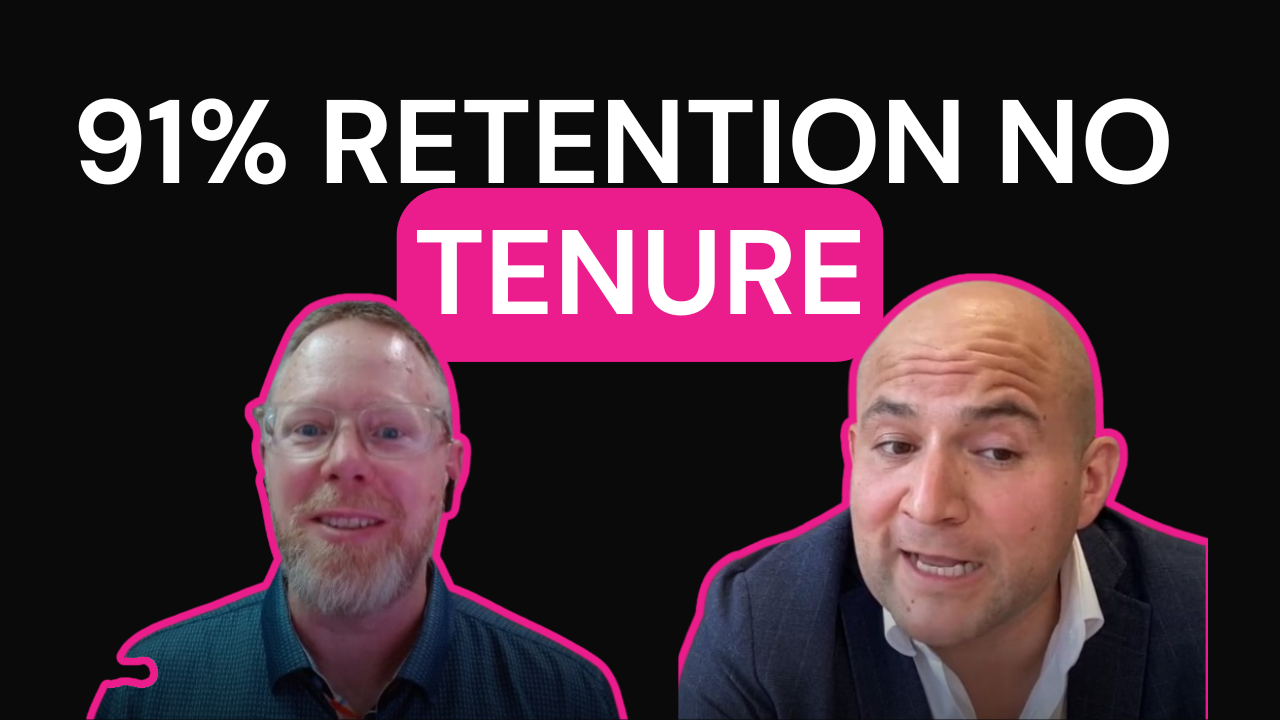
Teacher retention is the number every superintendent claims to be working on and almost none can move. Pablo Villavicencio's network sits at 91% retention across every employee group, without tenure, while running 25 schools and a 96% graduation rate in some of LA's highest-poverty neighborhoods — and in this episode, he breaks down exactly how belief, not policy, got him there.
✍️ What You'll Learn
- Why "all kids can learn" has to function as infrastructure, not a mission statement, before it changes anything
- How to build a wraparound services model that pairs academic teacher teams with therapists and social workers
- What actually drives teacher retention without tenure protection
- How to keep 25 schools aligned to one vision without creating a siloed bureaucracy
- Why redefining "college ready" to include community advocacy and wellness changed Alliance's outcomes
🚀 Key Insight #1: Why School Culture Change Starts With a Belief System, Not a Policy
- What's broken: Most school systems write "all students can learn" on a banner and call it culture work, while the master schedule, staffing model, and discipline systems tell students something else entirely.
- The shift: Villavicencio treats the belief that every kid can learn as an operating system — it has to show up in the master schedule, the staffing model, and the wraparound services, or it isn't real.
- Impact: Alliance's 25 schools graduate 96% of students and get 89-93% to college-ready status, compared to roughly 49% graduation and 59% college-ready rates at neighboring LAUSD schools.
🚀 Key Insight #2: The Wraparound Services Model That Turns Around Low-Performing Schools
- What's broken: Teachers are left to diagnose whether a struggling student is "lazy" or dealing with something deeper, usually alone and without the information to know the difference.
- The shift: Villavicencio built "kid talk" teams that pair content teachers with therapists and social workers — partnering with outside organizations for family therapy — so root causes get surfaced instead of guessed at.
- Impact: At the high school Villavicencio founded in the Bronx for English language learners, the first graduating class hit 66% graduation from a starting point of 10% — climbing to an 88% six-year graduation rate.
🚀 Key Insight #3: How to Hit 91% Teacher Retention Without Tenure
- What's broken: Most systems either get good at attracting talent or good at retaining it — rarely both — because they never build a stable, consistent container people trust enough to stay in.
- The shift: Alliance runs focus groups across every school, shares the real narrative of what staff are facing, and refuses to place value judgments on how different generations of teachers experience the same problem.
- Impact: Alliance holds 91% retention across every employee group in a sector where turnover is the norm — with no tenure protections in place.
🎙️ PABLO VILLAVICENCIO QUOTES FROM THE RUCKUSCAST
"You have to believe, deeply believe, that all kids can learn."
— Pablo Villavicencio
"Equity to me is not about fairness. It's about making sure kids get what they need in order so that they're successful."
— Pablo Villavicencio
"We have 91% retention across all employee groups in Alliance. It is not common in the educational space."
— Pablo Villavicencio
"Large bureaucracies or large systems will never fully get the results that are needed for hyper community, like for local context, because those closest to the impact that you're hoping to have are not at the decision-making table."
— Pablo Villavicencio
"You have so much power, you have such a high locus of control."
— Pablo Villavicencio
"You have to be talking to your teachers and your kids on a regular basis. You have to be in relationship, you have to have a pulse on the ground."
— Pablo Villavicencio
🚵♀️ Your Do School Different Challenge
Ready to implement these ideas? Start here:
- Tomorrow: Ask three staff members the same open question Villavicencio uses in his focus groups — "Tell me what's good, then tell me what's bad" — and just listen.
- This Month: Run a "kid talk" style meeting where content teachers and support staff (counselors, social workers) sit down on the same struggling students and name the root cause together.
- This Semester: Pilot one structural change to protect planning time — Alliance is testing 8-12 additional hours a week at seven of its schools — and track whether it moves retention or instructional quality.
⏰ Episode Timestamps
- 00:00 - Why Pablo's parents falsified an address for school
- 03:53 - Immigrant roots and the path to UC Berkeley
- 05:18 - First teaching job in a Harlem sixth grade classroom
- 11:51 - Building a high school from a 10% to 66% graduation rate
- 13:55 - Joining Alliance and eventually becoming CEO
- 15:58 - Alliance's 96% graduation rate versus LAUSD's 49%
- 17:48 - College readiness numbers and a 3.5x persistence rate
- 21:19 - Keeping 25 schools aligned without going siloed
- 22:43 - The planning time experiment seven schools are running
- 25:28 - Leading five generations of teachers with shared values
- 35:18 - Hitting 91% retention with zero tenure protection
- 43:57 - Inside the wraparound services model built on kid talk
- 46:55 - Pablo's final message on locus of control and belonging
00:03
Speaker 1
Most school leaders spend their careers climbing a system that was never designed for the kids it was supposed to serve. Pamela Villavicencio grew up in East LA, in a neighborhood where the local school had a 49% graduation rate. His parents falsified their address so he could attend school 30 miles away. And that detour, that workaround, is what got him to UC Berkeley and into teaching and eventually back to the same exact community he grew up in. Now, as CEO of Alliance College Ready Public Schools, a network of 25 schools serving 12,500 kids in Los Angeles, his schools graduate 96% of their students, 89% are college ready, and staff retention sits at 91%. Without tenure. The system didn't do that. The beliefs did. And that's what today's conversation cuts to.
00:58
Speaker 1
The bone of Pablo leads from a place most administrators never reach, a deep, unshakable conviction that every kid can learn and then builds everything else around that. The culture, the wraparound services, the master schedule, the staffing model. All of it traces back to these beliefs. So the question is, do you actually believe it, or do you just say you do? I'm Dan Watt and this is Better Leaders, Better Schools, the original ruckuscast for visionary leaders who want to do school different, even within a traditional system, so that students are excited to be at school and learn. Thanks to Ruckus makers like you, this podcast ranks in the top 1% of over 4 million worldwide podcasts. So once again, thanks for listening and we'll be right back after a quick message from our show's sponsors.
01:55
Speaker 2
For over 30 years, ODP Business Solutions has helped schools transform from whiteboards to smart boards. Why? Because when you get the right tools, everyone wins. Visit ODPbusiness.com education to revolutionize your school's learning spaces@odp business.com education if you're making decisions about staffing, student support or operations this year, having the right Context matters. Frontline Education's 2026 K12 lens report shows where pressures are easing, where they're not, and how districts are responding. It's based on insights from 1000 school leaders across the country. Visit FrontLineEducation.com leaders to uncover insights from over 1000 school leaders across the country. Over 1 million teachers rely on IXL because it's empowering. It helps them make better decisions with reliable data, and it adapts instruction based on student performance. You can get started [email protected] leaders. That's ixl.com leaders.
03:22
Speaker 2
A principal I work with walked into her staff meeting last week with one clear next move on the culture problems she'd been circling for months. She didn't get there alone. She got there with Digital Danny. He's always there, never forgets, and he evolves with you. Get started with Digital [email protected] Ruckus that's my principalcoach.com Ruckus.
03:53
Speaker 1
Good afternoon. My name is Dan Watt and I'm here with Pablo Villavicencio. And we're getting ready to kick off another edition of the Better Leaders, Better Schools ruckuscast. So welcome listeners. And Pablo, I thought maybe we could start today by you introducing yourself and telling us a little bit about yourself.
04:16
Speaker 3
Thanks, Dan, for having me on the podcast and to all your listeners, appreciate the space just to be here and share my story, my perspective. So I'm from Los Angeles. My parents are immigrants from Ecuador. And we came as very typical immigrant story, came with the hopes of a better education, more opportunity for me and my brother. And we landed in Los Angeles in the northeast corner called El Sereno and really had sort of a subpar educational experience in our local public school that really didn't reflect a deep belief that all kids can learn. I think that really shaped a lot of my life later on. And my parents made the tough decision to falsify my address to go to a really great suburban school about 30 miles outside of where we lived.
05:06
Speaker 3
And that experience and sort of the education I received afforded me the opportunity to go to UC Berkeley and then enter teaching through Teach for America. And I've now been in education for nearly 25 years.
05:18
Speaker 1
Wow. And in our intro call, you talked a little bit about your first teaching experience in Harlem. Could you tell our audience a little bit about that?
05:28
Speaker 3
Yeah. So my first placement of a school was in Harlem and a school that was really viewed as a dumping ground, and I don't use that word lightly, for kids who had not been successful in a very large district, the New York City Department of Education, and this is in the early 2000s. And so I had a class of about 39 sixth graders and a third of them were over the age of 14. And I'd say the vast majority were not coming reading at a grade level. And so this was often viewed as the last school effort, last ditch effort for kids and not a place that had a deep sense of belief of kids either, and spend a lot of time trying to do my best. I was a brand new teacher teaching such a hard craft.
06:12
Speaker 3
But I think what I learned was really the need to love kids and to create safe spaces for them. That allowed me to make some real gains with our kids that year. But more than anything really taught me that school wasn't a good place for kids. And so there was a group of us that had come in from Teach for America and a few long term district teachers who began to organize and advocate for better conditions for our kids.
06:37
Speaker 3
And ultimately what that led towards was that school being closed down that following year as a result of, I think, you know, not just the advocacy that we had done, but a part of a larger reform change that was happening to make difference in New York City schools with better outcomes, smaller schools as part of the small school movement, but taught me a lot as a first year teacher in those conditions and advocating for what eventually became the school closure.
07:05
Speaker 1
What happened to those kids?
07:06
Speaker 3
You know, they were, as in most school closures, they were transitioned into schools that have better outcomes. And so they were all stay together. And of course it was a middle school between the ages of 6th grade to 8th grade. The existing kids were sent to a variety of different schools. I know there was also an effort to put them into schools that had new growing charter schools at other schools in the area that I think we're trying to drive towards better results for kids, a better educational quality for kids. You know, I didn't keep track with those kids. So my hope is that they landed in schools that were able to sustain them beyond the initial placement that they had. But this was an uphill battle in conditions that were really difficult. So I think about those kids often.
07:52
Speaker 1
I betcha. Well, and I bet you haven't had a class with 39 kids in it since then either.
07:57
Speaker 3
Well, unfortunately my following year my class was 35 kids. So this is back in the 2000s. Classes were huge and they were trying to make a lot of fiscal reality. I think in actually in Los Angeles, where I'm currently, our classes got up to 40. Now of course that doesn't account for chronic absenteeism or attendance issues, but that was. That unfortunately was not normal for lots of teachers at that time.
08:25
Speaker 1
And how did those early experiences shape you as an educator?
08:30
Speaker 3
I mean, I think it really confirmed this deep held belief that kids need safe places where they feel loved and seen. And I think that even emerged to understand how important creating spaces where their identities are affirmed to be not only show up for themselves in that classroom, but also in a space where they're able to, I think, get to a place where they are invested in their own education. And ultimately what you want is to give them an innate sense of wanting to learn that lots of kids learn, like, actually deprogram themselves from. They become like apathetic middle schooler in the high schools.
09:12
Speaker 3
And so continuing to nurture that and continuing to kindle that, I think, which all good educators do, it made me realize that you have to have a personal relationship, but you have to create a lot of structure in the classroom in order to enable that, which is.
09:27
Speaker 1
Tricky to do with 34, 39 kids.
09:30
Speaker 3
Tricky, but not impossible. I really, you know, it was funny enough that first year. You know, I have a lot of, like, sad moments in my teaching, But I think by the time February came around, kids knew that I wasn't going to go anywhere, and I was really trying to love them, and kids responded to me differently. And, you know, even with that many kids, that's not the ideal. I think obviously, smaller class size are ideal, which is what we have here at Alliance. But regardless of that, having an invested adult made a dramatic difference for kids who just wanted the stability and wanted to know that they had someone who carried in front of them every day.
10:09
Speaker 1
So we don't want to jump the chart too early here, but you haven't talked about alliance yet. And I'm curious how those formative years for you influenced your work eventually at alliance or how did you get from there to where you are now?
10:24
Speaker 3
Yeah. So I think as a result of that first year, I was looking for another school that was a turnaround situation, but had enough investment from their leadership, because that was the other lesson I learned. The leadership at the first school wasn't as invested. It was their leadership. You don't have supportive principals or assistant principals or even the infrastructure to care. And I don't think these were bad human beings. They had kind of given up. And there was a high level of incompetence and a high level of apathy at the leadership level, which I think a lot of district schools in the early 2000s were experiencing, after generations of not getting results and a lot of other policies that led towards low outcomes for kids.
11:04
Speaker 3
And so I was looking for a school, found that in the Bronx in a great middle school that had actually just been going through their own challenges, but had a principal on a team of adults that cared about and then spent four years with that school, helping turn around that school from pretty poor results to good results and really helping transform that culture around school. And that offer afforded me the opportunity to eventually open up a high school for the same group of kids that I was Serving which were English language learners often coming into the country later on in their educational career in the fifth, sixth, seventh, eighth grade years coming with low levels in their native language. And so opened up a high school in the Bronx. Spent five years doing that and had the most amazing experience.
11:51
Speaker 3
Being a principal was definitely where I want to end my career again. But built a school for a group of kids that had very low. A low probability of graduating from high school. And then created a model that was a wraparound service. We focused on love, we focused on a high quality of education. And then we focused on a lot of wraparound services that affirm their identity. And got some really incredible outcomes for our group of kids that in our first graduating class, 66% of them graduated where they had a 10% graduation rate.
12:23
Speaker 3
And then their six year graduation outcome I believe was 88% got sick, had to come back to California and then landed in district work in San Francisco and Oakley Unified overseen as a principal supervisor of high schools in San Francisco and then overseeing innovation as deputy chief of innovation in Oakland. And that was really a learning curve for me in regards to understanding the complexities of what it means to turn around a large system and a system with chronic issues that we're really dealing at the systemic infrastructure issue. Not just at the unit of change of the school, which is still the most powerful unit. You really can make a huge difference at a school level with the right level of the right leadership and the right investment of adults.
13:09
Speaker 3
And then was trying to do so at a system level by building relationship with schools and helping build leadership pipelines that really empower leaders to be able to make those changes. And at the time I became kind of concerned that this was going to be really hard to do at the district level because of a lot of just political interest of adults and very few conversations around kids and what was best for kids. And had someone reach out to me about Alliance. It was my first charter experience. Not have much experience with charters. I had coming from the district world and in many ways had been seeped into a rhetoric that there was this district charter divide. But had become very disillusioned with what really drives me impact and systemic change.
13:55
Speaker 3
And was offered an opportunity to be part of a charter system that was actually in the neighborhood that I grew up. So I could have had a school that had offered me a great education that didn't require to falsify my address and go 30 miles out. And so really fell in love with the community of schools that I'm part of now. And so I've been with the Lions for the last eight years. I was a chief of schools originally, then the president and now the CEO.
14:20
Speaker 1
That is a lot. What a journey. And to re back to your neighborhood. That's interesting to me because one of the things, another thing that you mentioned in our intro call was about sustaining results in a hyperlocal system. And it's beautiful how you went full circle all the way across to the east coast and back again. And I'm curious how you sustain what you've learned and how you bring that back to your local.
14:49
Speaker 3
Yeah, I think that's, you know, we talked a lot about the fact that I ultimately believe large bureaucracies or large systems will never fully get the results that are needed for hyper community, like for local context, because those closest to the impact that you're hoping to have are not at the decision making table. And ultimately what you want is to have empowered individuals that understand the context that they're working in and they're serving in to be able to make those decisions.
15:19
Speaker 3
And of course there are things that a large system brings, but really as a CEO or trying to figure out like what needs to be universal because it's what's really good practice and it sets the bar or the floor for our communities and where we get out of the way to allow that autonomy and to help schools actually drive the results that they need based on the context that they're experiencing. And so and charter law was meant to do that, to create innovation that allowed for different kind of results. And I think alliance has always been great at trying to figure out what works at the hyperlocal level that gets these really incredible results compared to our local schools.
15:58
Speaker 3
And so not only just on graduation rates from high school, which we superseded a long time ago when alliance was founded, it was because LAUSD had graduation rate of 49% from high school. That wasn't even for college readiness. That was just to graduate from high school with a pretty low bar since we don't have rigorous exit exams in California from high school. And so quickly within four or five years our graduation rates were at 95 or 96%. There are numbers of kids with special education and multi language learners is the same. So I know there's always a perception that we might be taking some of the best kids.
16:35
Speaker 3
We're like, we actually serve a higher level of kids with special needs in many of our schools and at least on the same level of kids for multi language learners, which was a non negotiable for me when I entered into a charter space. And so I think the innovation that has allowed us to do that and the kind of results that's driven has come from a place of figuring out how do we create these containers at the local level that can be responsive to the needs while beginning to really set the floor for quality practices across our schools.
17:10
Speaker 1
And not a small charter organization. As I recall, there's like 25 schools in alliance or something like that.
17:16
Speaker 3
You're right. I forget the context. And sometimes some of your listeners might be coming from districts like the district of my high school have handful of schools. We have 25 schools with 20 with 25,000 alumni now and 12,500 kids in our system.
17:33
Speaker 1
Wow.
17:34
Speaker 3
And we're secondary a 6 through 12 model.
17:37
Speaker 1
It'd be interesting. I don't know if you do this, but it'd be interesting to capture what those kids do after alliance. Like how many of them go on to the trades and how many of them go on to post secondary.
17:48
Speaker 3
Well, you know, we are a college. It's alliance college ready public schools. And our model became to not just have kids graduate from high school, but to be prepared for a G requirement which is sort of a college ready indicator in California. And so we know that about 87% of our kids go to a two or four year college. And our persistence rate right now through that four year university is about 37%. And so for our demographic of kids which are predominantly coming from free and reduced lunch from some of the most marginalized communities in our Los Angeles area and have it's a 9 to 12% persistence rate for our demographics. Clearly we're 3.5 times the national average for our kids persisting through college.
18:41
Speaker 3
We know that most of our kids go to college, most of them don't graduate from college, but they are graduating from college at a much higher rate. And so what we've been trying to do is to actually ensure what else can we do to better set up their success rates to persist through college so that we make sure that they're in the right place. And we've also begun to do work. What we know is a group of kids who college is not the right fit and what kind of trade experiences or other experiences can they receive while understanding that we're not a very large system. So offering full CTE vocational training, which is very capital intensive to do. Right. Isn't the right thing for us.
19:18
Speaker 2
Right.
19:18
Speaker 3
We are in the name attracting families that potentially want to go to college, but that we can begin to do other things that better set them up for success. And when I first started in the system eight years ago, our college persistence rate was around in the high teens, low 20s. And so we've done a lot of work to actually ensure that over the course of time, the type of experience that our scholars receive in our 25 schools is something that is better supporting them in their journey to persist through college.
19:50
Speaker 1
It'd be an interesting experiment to consider, what do you do with those kids who get partway through their school journey with you and realize maybe college isn't the direction they want to go and how to plan differently for that cohort of kids? Well, maybe not cohort, but you know what I mean, that population.
20:08
Speaker 3
Yeah.
20:09
Speaker 1
Could there be cross and rolling?
20:11
Speaker 3
And I think there's a group of, you know, one of the things that we have amazing people who work here, amazing people who work at our school sites. And there are folks who are trying to think that. Which is why we begun to pilot, which is one of the benefits of a charter. You really can pilot things. And so we're beginning to pilot pathways for kids that start, you know, in the 10th grade, say, okay, can you explore something else? It also couples with the work that we're doing around middle college or early college, and so that kids leave with an associate's degree at least by the time they graduate college or having done their first two years of college in the California systems that you see in Cal states. And so we've begun to pilot that.
20:51
Speaker 3
Which is one of the benefits of charter schools, where we're able to try these different things and see if we're getting different outcomes for kids who may have been encouraged to go to college, but might have been better served by just having the certification or other sort of technical skills that come as a result of just needing an associate's degree, at least.
21:10
Speaker 1
Well. And it speaks to that topic we touched on earlier about overcoming siloed thinking. How does alliance grow in that regard?
21:19
Speaker 3
I think it's hard. It's easy as a system for you to think about, because we believe in the local. There is obviously this tension between the hyperlocal and it becoming siloed, where schools are doing something different, but not just at the school level. This is common of districts, and I'm sure, like, district divisions become siloed and people are not speaking to each other. And as a principal and as a school leader, you're receiving conflicting information that are not speaking to one another and therefore make your job difficult because you're often required to implement things that are in contradiction or intention with one another. And I wish I could say we've liberated ourselves completely from that as a solar system.
21:59
Speaker 3
That's not the truth because some of your listeners might be my principals, but who are going to quickly send me a chat afterwards to say that is not the case. But we have done a lot to desilo that work and that really comes through ensuring that our school leaders understand what our priorities are and understand what are the practices that are essential for running good schools. And so through building the sort of the skill set of our principals to understand one the vision, but also understand here are the structures and systems that support that vision that you're going to place at your school. And then being intentional about how they plan for that or around that. Sometimes I would say with some principals they're able to say, okay, here is what I'm trying to do and adapt that into my school.
22:43
Speaker 3
Here's how this makes sense, here's how that drives towards that result. Here's how I have to layer on this innovation that really matters to me because even at the, even there are innovations that are happening at the school level, but there's also innovations that are happening at the network level that just require a few of our schools. So one of those innovations is making sure that we actually to me, the craft of teaching requires dedicated time that is unfortunately not funded for in most funding models from states. And you see states, countries like Finland or South Korea, where they're given 50% planning time because they understand that the intentionality required to drive towards scholar outcomes is a big lift. And here in America we just give them maybe 10% of our time is given towards that.
23:36
Speaker 3
And that 10% having been a teacher is usually like I'm covering for another teacher, I have a meeting. So you're left to do that after hours. And there was a period of time where many of us relied on this as being a mission driven role that were going to go above and beyond. And my entire Sundays, while my friends were having Sunday fun days, was spent me planning. And that way of thinking in that sense of I'm going to sacrifice my work, life balance or my family's commitments is a model that was really put into question during the pandemic and probably have been put into question for a long period of time. But definitely the pandemic that it became clear with differences in the way that generational shifts about work are happening and some of us are reprioritizing even as we're older.
24:25
Speaker 3
And I'm Gen X became like, this is a model that's not great. And I wish I had a magic wand to be able to give more funding for us, but we don't. So what we did is like what's in our locus of control, the master schedule of a teacher. Let's figure out what we can do. And so you know, the sort of like we now have about seven schools that are trying to increase playing time by 8 to 12 hours a week so that teachers have dedicated time to do the work that really gets them there. And that's happening at seven schools, but the other schools are not. And so we have to figure out how to orchestrate across all those priorities and allow that to be a priority because it's so incredibly important.
25:04
Speaker 3
In addition to coming back to some of the basics, which is really at.
25:07
Speaker 1
The instructional core, you've touched on a couple of key points, their needs and solutions. Working with multiple generations of teachers. I think it's been said this is the first time in history we've had five generations of teachers in the workplace. How is your organization tackling that?
25:28
Speaker 3
He's such a load of. Bruce, you Dan. I mean, I think ultimately what we're driving towards is first and foremost having a organization that has a shared identity and values. Right. Because I think value is really when you articulate your values. And for us it's growing together, pursuing excellence and advancing equity. There's common language that allows us to talk about what we may be experiencing. Now of course everyone knows that's not sufficient. It's necessary, but not sufficient. And so what we've done is to really make sure that one, we're casting a vision and making like I think strong leaders need to say, here's what we stand for, here's our vision. And you are joining an organization that we hope will keep us accountable to that. But know that when we make decisions, we. That's also what you're following for and that makes it clearer.
26:18
Speaker 3
So that also probably self selects certain people to join us and other folks are just like, I might not be aligned to those values ultimately leave. We're also trying to do work on trying to help understand the larger context that we're in. So there's a lot of storytelling and strong leaders share narratives and we try to share the narrative that's happening. So right now the narrative is that we're all in chaos. We're dealing. A lot of education is under attack. Many of the communities that are in urban centers are under attack and we're in a moment of Deep, like uncertainty or transition, depending on how you see it. And so in order.
26:54
Speaker 3
And that has resulted in economic uncertainty, which is driving a lot of the realities that people are facing on the ground in their personal finances, because all of us have to go to grocery store and know what we're experiencing. And in the educational landscape around layoffs, around mergers, around consolidations of schools, around having to forego benefits that we've had in the past. And that's been really important narrative to share with folks that they make sense about. And then understanding that generational differences that exist, these larger generations that we have here may be experiencing those differently. And so we have to do. One is, as a leader, I make sure that we have focus groups and advisory committees that try to have as broad of a voice of our stakeholders as possible so that we're hearing different perspectives.
27:45
Speaker 3
And honestly, that's where I see the biggest generational differences there. Two, that we're not placing value judgments as good and bad of the way that people are experiencing this, because that's still their reality. That's what they're experiencing. I think that happens a lot. And that can often happen on in both directions with like, you know, alpha feeling a particular way about boomers or Gen X and vice versa, and not placing value statements around that and trying to really get to like, what are we trying to solve? When I share with teachers that we're trying to create more planning time that isn't based on a generation. Now, they may experience that differently, right? They definitely do experience that differently, but they all understand that there is a problem, that the way we're structured and funded isn't serving sustainability in the role.
28:31
Speaker 3
It isn't really allowing them to really put forward their best practice in the classroom because their priorities are all over the place. In trying to manage 90% instruction with all the other demands that come in teaching, you add on layers of that to not just differences in generation, but also employee groups. Like the ways that your principals or your assistant principals may experience that challenge is different than a teacher or different than operational staff who's like, hey, what about my extra hours? I'm dealing with all these competing efforts. And so that you have to translate and make sense and sort of be like, at the core, we're here to make sure that 75% of our scholars persist through college. We're here to provide a quality education. It's why we're one of the top performers.
29:17
Speaker 3
We're one of the top performing networks in the state of California. And so we have to prioritize scholar outcomes with close scholar outcomes and then help them walk through the decisions and the competing interests that naturally would come.
29:33
Speaker 2
ODP Business Solutions, formerly Office Depot Business Solutions Division, has been a trusted partner for schools for 30 years, and ODP Business Solutions were by your side to meet your evolving education needs. Here's the thing about creating remarkable learning spaces. You need a partner who gets it. Someone who understands that transforming education isn't just about swapping whiteboards for smart boards. It's about reimagining what's possible. That's why innovative school leaders trust ODP Business Solutions. We don't just deliver supplies. We help you design dynamic learning environments that make students actually excited to show up. From tech integrations that bring lessons to life to flexible furniture and that transforms any space into a collaboration zone to sustainable solutions that teach by example. We've got everything you need to do school different. And the best part?
30:32
Speaker 2
You can get it all from a single supplier that helps you simplify ordering and streamline budgeting while staying compliant with easy access to cooperative contracts. However you want to advance, ODP Business Solutions has 30 years of experience helping districts like yours get ahead. Visit ODP business.comeducation to learn more. That's ODPbusiness.com education with so much changing across K12, it's not just about reacting. It's about making decisions that hold over time. Frontline Education's 2026 K12 Lens report brings together insights from over 1,000 school leaders to show what's shifting across staffing, operations, and student support. Learn where momentum is building and where districts are feeling the pressure. By visiting FrontLineEducation.com leaders, you can get your full report at FrontLineEducation.com leadership something that drove me nuts as a ruckus maker was hearing teachers say things like I taught it. They should have learned it.
31:51
Speaker 2
But really, some teachers just don't know how to teach, or reteach for that matter, so that all kids get it. That's where IXL comes in. IXL's diagnostic automatically identifies knowledge gaps for teachers and provides them with a personalized growth plan for each individual student. Teachers can step into the classroom every day, knowing what their students know and what they don't know. IXL's adaptive platform makes differentiating instruction easy. As students learn, IXL adjusts to the right level of difficulty for each student. Close knowledge gaps and accelerate learning with IXL. Get started [email protected] leadership that's IXL.com leaders. I was talking with a principal last month who'd been wrestling with the same staff problem for six weeks. Every Monday it was on her list. Every Friday it was still there. She kept telling me she needed more information before she could make the call.
32:59
Speaker 2
Here's what she actually needed. She needed someone to ask her, if you already knew the answer, what would the answer be? That question cut six weeks of circling down to about four minutes. She made the move that afternoon. And that's the conversation Digital Danny is built for. He's your AI coach, trained on a decade of how I actually work with principals. And he's available the second you need him to think through something. You can get started with Digital [email protected] Ruckus.
33:40
Speaker 1
So as the CEO, I love the values you stated, and I didn't capture them perfectly. But growing together, pursuing excellence and achieving equity, is that fair to say, Advancing?
33:52
Speaker 3
I don't know if we're ever going to achieve equity, Dan. That's a big one. But each of us has a role of making sure we leave a little bit better and we help people, you know, and equity to me is not about fairness. It's about making sure kids get what they need in order so that they're successful and looks different at different, like for different kids. And so that's what we said. Advancing. It was very intentional around that.
34:13
Speaker 1
Yes, advancing. I like that choice of word. I also love the phrase that you used, creating a tidal wave in education. So how do you get as many people as possible behind that as you create that tidal wave in education?
34:29
Speaker 3
I think first you set the vision. You actually put a belief. I know it sounds so simple, Dan, but it goes back to what I learned that first year of teaching adults stiff B. I mean adults and kids stiff bs. And so you have to believe, deeply believe that all kids can learn. And that's something that's been weaponized, like all kids can learn or whatever, like. But you have to believe it. And then you have to set that in the system. All we're doing is in support of that deep belief that our kids can achieve incredible outcomes. And once you do so, once you set that vision, and of course you set structures and systems that support that vision, you have to ensure that every single school is a container or environment that is going to be supportive of both kids and adults.
35:18
Speaker 3
And because people are translating the experience that they have in the school site, whether it matches with their vision or whether it matches what with your values. And whereas disconnect people begin, there's some folks who just like, get frustrated and leave. There's other folks who begin to lower their own expectations, probably unconsciously at times. And that creates, I'd say, a downward trend of where schools should be and then really impacts culture. And then so, and I've already mentioned, you have to have adults in leadership positions across the system that reinforce those deep beliefs and that share the same approach as you. And so once you do so, you then have to create a sense of wanting to retain people and be there. And so look, we have 91% retention across all employee groups in Alliance. 91%. It is not common in the educational space.
36:08
Speaker 3
And we're not a place where there's tenured positions, where there's like, these are folks who are wanting to be here, the system wants them to be here. And we have a deep commitment to, because we make sure that we're trying to talk the talk and walk the walk. And so that's come from a lot of intentional efforts to deal with the issues that we're experiencing, ensuring that we're listening to folks. So I think what really matters is that once you've done that, you also create spaces where folks are able to be part of the improvement, the continuous improvement that's required from a school and from a system and that they're invested and bought in. And some schools do that really well. Not all our schools do. But that's when I come in, I actually hold focus groups across all our schools.
36:52
Speaker 3
I expect our principals to do that. Their principals, ours is the instructional superintendents do that. And then I do that across every single one of our schools. And then I just say, tell me what's good and then tell me what's bad. And trust me, people tell me what's bad all the time. And they'll say, okay, what can we change about this? What can we address? Here is the context of what's preventing that. Because some things, you know, like I remember talking to kids stakeholders and they really wanted to change our nutritional provider. And I was like, strange, I get it, the food is terrible. This is the worst thing. And this is the hill you're gonna die on. And then we gave them context and then we're like. And then they also helped us drive some solutions be like, what if we did this?
37:28
Speaker 3
What if we're offered that? So I actually believe it's a two way street. So we're not just releases. So the more you're invested, then people see, oh, the, you know, the school, the system that's listening to me, it's actually helping address the issue. It's not perfect because no system will be perfect. And systems are systems, no schooling perfect because schools are mic are systems upon themselves. And so. But you do have a belief that at least there's a willingness to address that. And then at any point when there isn't leadership, that's actually believing that because sometimes or there are cultural issues that become too large, you have to be like, okay, at the core, what are we trying to drive here? How do we get there? Who are the right people to be able to drive that?
38:13
Speaker 3
And that's also something as a system that you have to do in order to ensure that you're holding to these values, but also to some to leading towards really audacious outcomes when there is a general sentiment that it can't be done. There's been like a little bit of foregoing sometimes that this is even possible because the challenges seem so insurmountable and it's only getting more complex. Kids are not all right. Their social emotional needs are significantly larger. Social media has dramatically changed our culture and changed youth. And as we noticed, as we already talked about, there are a lot of changes in the workforce that are recipe for very complex realities at the school level.
38:59
Speaker 1
Well, it sounds like you're well on your way to those audacious outcomes you outlined. I'll bungle the exact stats, but we can go back and watch the replay. I think he said 93% retention.
39:11
Speaker 3
91% Retention. And that's across groups. Yeah.
39:15
Speaker 1
And at 88% graduation rate, our graduation.
39:18
Speaker 3
Rate from our high schools is 96%.
39:21
Speaker 1
76.
39:22
Speaker 3
Yeah. Serving over 93 or 94% for your reduced lunch. So our outcome, college and our A through G, which is, it's the marker California for how many of those are college ready. So like in LUSD schools, that's somewhere around like 59%. We're 89% to 93% for AQG. So our kid, our schools, our leaders, our teachers, our support staff are doing amazing work. Kids leave having the option to go to a UC or California State University and our kids are persisting at 3.5 times the national rate through college because of the experience that they're having. Is it enough? No. Can we do more for those kids who probably college isn't the best path. Yes. And that's where some of our innovation work and where community grad schools are all community schools now.
40:12
Speaker 3
So our 25 schools are really invested in trying to build these community pathways. Part of that work with the community pathways is understanding more youth development towards.
40:22
Speaker 1
Career readiness, well, graduates are one thing, but persistence and the ability to solve problems, that's a whole other episode.
40:30
Speaker 3
And honestly, I think the quality of any quality education requires kids to have that experience where they're leaving like as whole adults formed, able to tackle the challenges that whole adults at the age of 18 is a whole other conversation as ready and possible to challenge. And honestly, the world is so much more complex than when we left to college. And the circumstances are not in the favor of a lot of our kids already. That's true across many demographics groups. Now, that wasn't the. It's not easy to be a young person regardless of where you come from, given just the inequity in our economic reality, the challenges of what it means to actually thrive in a workforce is dramatically changing and at the same rate of the industrial revolution with this AI change. And so we're in.
41:20
Speaker 3
We have to do our best to show our kids not just like resilient learners, not just like solid thinkers. As part of our college profile, but we've been really focusing on, like, how are you a powerful communicator, you. How do you navigate complex relationships? Because I can't do that. You could do that as a human. So what is it? How do you. How are your wellness seeker when modern world is really changing the way you think and feel? And what are you really doing to be this community advocate, this light in the world? Like, you actually have a social responsibility to your community members, to this world. And so that community advocate piece is the other things we're like, you know, and I think that those are key parts of what we mean, what we define as college ready.
42:01
Speaker 3
And I think we're doing a good job. I think my hope is that we're on the path from good to great.
42:05
Speaker 1
Good to great. Well, if we could just rewind the tape. I feel like you just articulated that one message on all school marquees, wellness seekers who are community advocates. So if you could put a message on all school marquees around the world for a single day, what would your message be?
42:25
Speaker 3
I mean, honestly comes back to this idea of loved. Like, I know this sounds so cheesy, Dan, but I like, you are worthy and you belong. And I know that, like, ultimately that is the key message I would leave for all the adults because I think there is such a attack on a sense of like, where I fit in this world. It's why we're seeing larger numbers of youth suicide. It's why we're seeing so much division. I think if that Message of love any way you want to iterate, it isn't quite there. Then the real the message becomes like, every kid can succeed. It's your job as an adult to ensure that happens. And I think those are the two messages. Like this locus of control of adults in so many ways, because us as adults are overwhelmed and we feel so disempowered.
43:15
Speaker 3
It's not easy every day, like our political processes alone, regardless of where you stand, and it feels disempowering, we're kind of foregoing our responsibility to really like. And that worries me. And so the other message is around, like, you actually have a lot of control in the world, not just you as a parent, which is critical. And it's a message for parents, by the way, as well, because so many parents are foregoing that responsibility because of the complexities of what it means to parent in this age, this time and age, but also any adult in the community has a responsibility for that.
43:48
Speaker 1
Thank you. My next question is about designing your dream school from the ground up, which it sounds like you're doing.
43:57
Speaker 3
And I did, actually. And this is why I want to be a principal. I was a founding principal for a school. And what I did, I think at the core, the message of love, the message of affirming your identity regardless of where you're coming from, the message of high expectations. So those were critical to our mission statement. But what we did was we created. We had a group of committed adults. We trained them up. We gave them a sense of shared responsibility for the cohort of kids. And then we created systems and structures that were wraparound services for kids around the social, emotional, and the academic domains. And in the academic domains, you had groups of teacher. We called it kid talk. And you would meet like. And this is a high school.
44:41
Speaker 3
So you had a lot of content teachers who came and really trying to drive content. And they would sit there with others and talk about. This is what Louis sees.
44:50
Speaker 2
This is what they.
44:51
Speaker 3
And they would figure out how they can support each other. And they saw each other as resources to be able to drive that result and that experience and provide, like, a cohesive experience for the kid and then get more information on how they could help in their particular classroom, make that happen. We then did wraparound services that provided family therapy and individual therapy. We partnered with Good Shepherd Organization. We had access to like, six at different times, either therapists or social workers. And they would do planning around that same sort of data. And we'll look. And then we'd had different times where Those individuals met with academic folks and we talk about kids in general and then figure out, hey, this root issue, the root cause of something is not this kid is just lazy, doesn't want to work.
45:38
Speaker 3
This kid is feeling like this is really attached to the family structure. Can we get support? There's a lot of enabling behaviors or conflicting behaviors happening at home. They would go in family therapy, an amazing team wraparound services coupled with like, you know, I think the bread and butter of data driven instruction with adults that really cared and a support in a community that really tried to nurture their identity and create Horsewood, that nurtured their identity, which was really powerful to do for such a diverse group of kids who had such a low outcome, like predictive outcome of what they're, how they're going to graduate in New York State, which has rigorous exit exams just like Massachusetts. And so we also.
46:21
Speaker 3
I feel very confident that the kids left with like passing their five regents, doing really hard work and feeling loved and valued and those I'm in touch with a lot of those kids still. And you know, and I go back and I was like, I could have done so much more. We could have really thought about this. Like that sense of joy of learning, like we didn't quite get to there. That sense of like creating project. I really do believe in project based learning and in helping kids understand how to navigate when like, you know, in many ways you've created too many scaffolds that doesn't set them up for like, you know, high school, I mean for college. Those are the things that I wish I would really would have spent time on.
46:55
Speaker 1
Of all the things we discussed today, what's the one thing you want a ruckus maker to remember?
47:01
Speaker 3
You have so much power, you have such a high locus of control, but really ensuring that you are a values driven leader that has a clear vision that is really being driven by your values. And so think about where your life comes from and then create conditions by being innovative by allowing people to thrive in their space, by having conversations with folks and hearing them. And the only way you're going to do that is if you're nourishing yourself, but you're also nourishing those individuals by being in relationship with them, even principals. I have to remind them of this. Like you have to be talking to your teachers and your kids on a regular basis. You have to be in relationship, you have to have a pulse on the ground. Not just that pulses like really be in relationship and in community.
47:47
Speaker 3
So you're able to translate that back to that vision, to those values that therefore then is able to put that into system and structures that they get these kind of results where you're not only attracting people, where you're retaining them. Because some of us are really great attracting folks, but are really not that great retaining them by not setting this container that is consistent and stable and able to create those spaces of continuous improvement. And then others of us are really like sometimes have a hard time attracting them and then we create kind of safe spaces. But you're also not doing innovation. You're not really pushing the envelope. And I think the challenges of education are so dramatic right now that it requires us to continuously be improving. And yeah, that's what I'll leave with folks.
48:27
Speaker 1
Thank you. Pablo, I'm standing here with my hand on my heart because I'm hearing you share about the need to love, to be in relationship and to help foster a sense of belonging in our schools. And I really appreciate hearing that message today. So thank you.
48:46
Speaker 3
Thank you Dan. I appreciate that.
48:51
Speaker 1
Hey, Ruckus map here. Thanks again for pressing play. I hope you enjoyed this episode as much as I did. One thing Pablo taught me that even when we're pursuing audacious outcomes for ourselves students, it all begins with a sense of love, a sense of belonging and growing together. This matters because Ruckus Makers do school different. And if education ain't a bit disruptive, then what are the students really learning? Ruckus Makers create a campus experience worth showing up for. And before you go, if today's episode sparked an idea or shifted your thinking, then I know you're going to love the Ruckus Maker Mastermind. It's a private community of innovative school leaders who meet weekly to grow, reflect and disrupt the status quo. Create the campus experience your staff and students deserve.
49:41
Speaker 1
Applications are now [email protected] apply and you can also subscribe to the Ruckus Maker newsletter. I hear they've got a really great author. Three new opportunities to do school different each week trusted by over 5,000 forward thinking leaders. Join free at Rocketmakers News. And finally check out my Principal Coach, your AI powered leadership mentor trained on 10 years of mastermind and coaching experience. It's like having a world size Rucks Maker mentor in your pocket. Start your seven day free trial at myprincipalcoach.com.
Transcribed by https://fireflies.ai/
🔗 Connect With Pablo Villavicencio
- Website: Taylor Stanley
🎧 Listen & Subscribe
Listen to Better Leaders Better Schools on Apple Podcasts, Spotify, Youtube or wherever you get your podcasts. If today's episode moved you, leave a review — it helps more Ruckus Makers find the show.
🧔🏻♂️ Your Self-Mentorship Guide
Meet Digital Danny — your self-mentorship guide. Always available, never forgets, and evolves with you. Think through your next leadership move at myprincipalcoach.com.
🤝 Today's Ruckuscast Partners
ODP Business Solutions®
ODP Business Solutions has spent 30 years equipping schools through negotiated cooperative contracts that stretch every budget dollar — from furniture and tech to sustainable cleaning solutions, all from a single supplier. They helped Baldwin School District transform its entire campus while staying under budget by pairing smart design with smarter purchasing.
🎙️ See how at odpbusiness.com/education
Frontline Education
Frontline Education's 2026 K12 Lens report digs into how districts connect professional growth to staffing stability — districts that automate professional growth report easier hiring nearly 50% of the time, compared to 30% of those that don't. If you're building a campus where great educators choose to stay.
🎙️ The full report is free at frontlineeducation.com/leaders
IXL
IXL eliminates the guesswork in lesson planning with ready-made plans aligned directly to your textbooks and state standards, so teachers spend less time building and more time teaching. Daily performance insights let teachers adjust instruction before a small gap becomes a big one.
🎙️ Get started today at ixl.com/leaders.
Twelve Practices LLC © 2026 | If Education Ain't a Bit Disruptive, Then What Are Your Students Learning?


