Adam Wolfsdorf chairs the Humanities Department at Bay Ridge Preparatory in Brooklyn and teaches graduate students at NYU and Wesleyan, drawing on 26 years inside the classroom. He's the author of Teaching in the Riptide, where he names the moments educators get pulled under by something more powerful than their plan — and what to do when that happens. Outside the classroom, he spent 25 years performing professionally, including national tours of RENT and Grease.
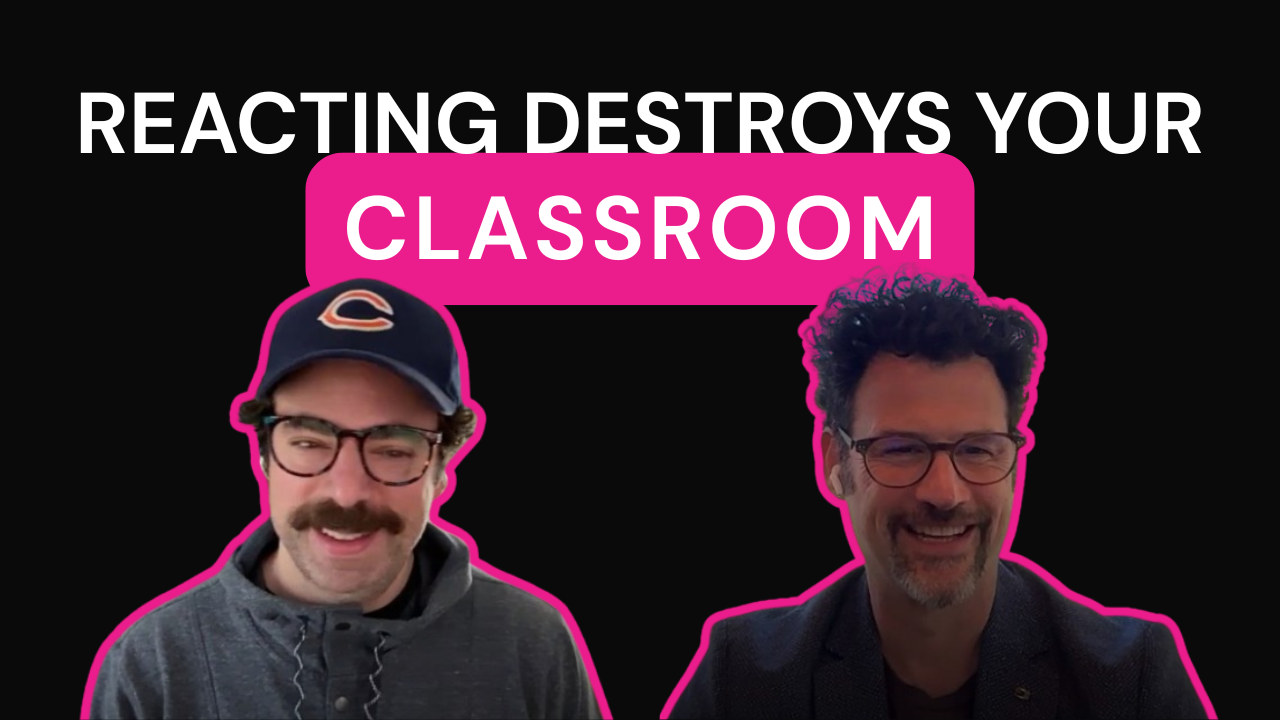
A student kicks over a trash can, slams the door, and storms out mid-lesson. Seventeen other students sit frozen, waiting to see what the teacher does next. That moment — and the instinct to fight back in it — is what most classroom management training gets wrong. Dr. Adam Wolfsdorf has spent 26 years studying what happens when teachers refuse to match a student's energy, and why that refusal is the most powerful classroom management tool no one teaches.
🫶 What You'll Learn
- Why matching a student's outburst with your own energy guarantees you lose the room.
- How "constructive subversion" turns a disruptive moment into the most powerful lesson of the year.
- What separates teachers who do harm from teachers who do good — and it isn't classroom control.
- Why compliance is the wrong goal for both students and educators.
- How to teach students to feel a story instead of just analyze one.
✅ Key Insight #1: Why Reacting to Student Outbursts Destroys Classroom Management
- What's broken: Teachers are trained to regain control the moment a student acts out, so they react instantly — and the reaction is what costs them the room.
- The shift: The strongest move is often no move at all — sitting in the discomfort of a disrupted classroom without flinching or matching the student's intensity.
- Impact: Students who provoke a reaction to feel powerful lose that power entirely once a teacher stops giving it to them — Wolfsdorf reports the student who kicked over the trash-can, never had another outburst that year.
✅ Key Insight #2: How Constructive Subversion Turns Disruption Into the Best Lesson You'll Teach
- What's broken: Teachers walk into a lesson with fixed expectations for what students are capable of, then read any departure from the plan as a problem to shut down.
- The shift: Wolfsdorf names a category he calls "constructive subversion" — student behavior that breaks from the assignment but exceeds everything the teacher hoped for, like a ninth grader's poem about her father's death disguised as a poem about vegetables.
- Impact: The student who wrote that poem has now worked with Wolfsdorf three separate times and is heading to college — a years-long relationship built from a moment he almost dismissed as off-topic.
✅ Key Insight #3: Why Compliant Students and Compliant Teachers Both Stunt Growth
- What's broken: Schools reward compliance in students and conformity in teachers, treating obedience as the marker of a "good" classroom.
- The shift: Real progress — for a student, a teacher, or a system — requires people willing to push back, because systems don't change unless they get rattled.
- Impact: Wolfsdorf points to his own students calling him out at home for thinking too rigidly, forcing him to revise his own positions in real time rather than defaulting to authority.
🎩 DR. ADAM WOLFSDORF QUOTES FROM THE RUCKUSCAST
"Do you understand that you are the punchline of the classroom?"
— Dr. Adam Wolfsdorf
"Sometimes the student needs to give the teacher a hard time because the teacher is the one who needs to learn more than the student in that particular situation."
— Dr. Adam Wolfsdorf
"There are educators who really want students to learn, and then there are educators who kind of want to torture students."
— Dr. Adam Wolfsdorf
"Systems don't change unless they get rattled."
— Dr. Adam Wolfsdorf
"We have to be aware that we could be a counter narrative to those destructive elements."
— Dr. Adam Wolfsdorf
"Sometimes it's the case that it's the teacher even more than the student who needs the education."
— Dr. Adam Wolfsdorf
"If you have the equanimity to resist, even if you're feeling it, that's a pretty powerful lesson."
— Dr. Adam Wolfsdorf
🧠 Your Do School Different Challenge
Ready to implement these ideas? Start here:
- Tomorrow: The next time a student pushes your buttons, pause for three full seconds before responding instead of reacting in the moment.
- This Month: Identify one student whose disruptive behaviour might actually be a "constructive subversion" worth leaning into rather than shutting down.
- This Semester: Build a feedback loop where students can call out your own rigid thinking, the way Wolfsdorf's kids challenged him at home.
⌚️ Episode Timestamps
- 00:00 - Why reacting to outbursts destroys your classroo
- 04:13 - How to handle subversive behaviour without shutting it down
- 05:55 - Teaching a student who identified as a Neo-Nazi
- 12:50 - The ninth-grade poem that changed his perspective
- 19:20 - How schools are creating the focus crisis in kids
- 23:27 - The trash can story: a student's full classroom outburst
- 35:05 - The Harvard professor who tried to break his confidence
- 38:34 - Are good students and good teachers actually compliant
- 44:59 - The professor who taught him to feel a story
- 53:04 - Building a dream school with no limitations
00:03
Speaker 1
When a student pushes your buttons, your first instinct is to push back. That instinct is destroying your classroom. You've been in the moment, the outburst, the disrespect, the chaos and everything in you wants to respond, so you do. And the second you match their energy, you've lost not just the situation but the student every time you react from that place. Do you understand that you are the punchline of the classroom? Kids learn fast that they can unseat you. Kids learn fast that it's funny when you lose control, so they continue to do what they can to watch you unravel. The teachers who change lives aren't the ones with the best classroom management plans. They're the ones who learn to sit in the discomfort without flinching. This is a great episode to pass on to educators that have trouble with reacting with students.
01:10
Speaker 1
My guest today is Dr. Adam Wolfsdorf. He's written a fantastic book called Teaching in the Riptide. He has 26 years of experience under his belt. We also get into a wild story when a student cussed him out, knocked over a trash can, you know, slammed the door as they rudely barged out of class. And you get to hear how he responded. He handled it really well and it's a really cool teachable moment again for your staff. Hey, I'm Danny Bauer and this is Better Leaders, Better Schools, the original Ruckus cast for visionary leaders who want to do school different even within a traditional system, so that we create a campus experience worth showing up for. Thanks to Ruckus makers just like you, this podcast ranks in the top 1% of nearly 4 million shows worldwide.
02:02
Speaker 1
So thanks again for pressing play and we'll be right back after a quick message from our show Sponsors. Want to know how top schools create collaborative learning environments that actually work? ODP Business Solutions has equipped innovative educators for over three decades. Visit ODP business.com education and let's make a ruckus together. That's ODPbusiness.com education strong school culture doesn't happen by accident. It's built through meaningful support and opportunities to grow. Frontline Education's 2026 K12 Lens report explores how districts are connecting professional growth to stronger staffing outcomes. Visit frontlineducation.com leaders to see the full report. That's frontlineducation.com Leaders to see the full report. IXL takes the guesswork out of lesson planning for teachers. IXL's ready made lesson plans are aligned to your textbooks and state standards so teachers can turn to IXL for The exact content they need to help their students.
03:29
Speaker 1
You can get started [email protected] leaders. That's ixl.com leadership. There's a framework I built called the Ideal Week. It saves principals about 10 hours a month once they implement the system. Digital Danny can walk you through your version of the Ideal Week. Tonight, create your ideal week and [email protected] Ruckus that's my principalcoach.com Ruckus Foreign Dr. Wolfsdorf, welcome to the show.
04:11
Speaker 2
Thank you for having me.
04:13
Speaker 1
Absolutely. So I want to start with how do you think about dealing with subversive behaviors that take our plans off the rails?
04:23
Speaker 2
All right, so I think there's a lot of different types of subversive behaviors that can happen in a classroom space. I think some of them can be, you know, kind of destructive in a way that really doesn't do anybody any good, but some of them can actually be really eye opening. And I think that if students are acting in ways that, you know, upend our plans or, you know, kind of take things in a completely different direction, I think if we roll with it and rather than shutting it down, if we try to understand where they're coming from and why these things are happening, I think then education can be amplified for everybody in the space. So I think oftentimes teachers, you know, or educators want control in the space.
05:04
Speaker 2
And I think that the idea of students acting out, you know, can really rattle us. But I think interrogating that rattle and living in that rattle can be a really powerful learning experience and help us all to grow.
05:17
Speaker 1
Yeah. I want you to say more about control in a second. I'm going to do a 30 second version of a story because I've told it so many times on the podcast. But the 32nd version is I have these emotions as a teacher. These emotions are pulling me all over the place. Kids are triggering them. I'm taking stuff personally. So I write kids up, and then I realize maybe there's a different way and I stop taking things personally. The emotions are still there. I don't take it personally, and I never write up a kid again. So that's. That's the 32nd version. Yeah. Jam more on the idea of control because that's. I think that's real.
05:55
Speaker 2
Yeah. I mean, maybe I'll start out with a story says that work for sure. You know, maybe I've been teaching for 26 years. It's a little bit hard for me to believe, but it's true.
06:05
Speaker 1
I've been doing the podcast for 10. So it's like, yeah, I know it feels like yesterday.
06:10
Speaker 2
And I had an experience probably about a decade into teaching, where I became aware that one of the students in my classroom identified as a neo Nazi and was. We found out because the student was affiliating with neo Nazi groups online and doesn't matter what religion I am, I happen to be Jewish. But no matter what, it was just a really disarming, you know, kind of terrifying reality to deal with. And the complicated thing was he wasn't a bad kid in the space. He was just lost and. And he was trying to find himself in ways that were not conducive to anybody's mental health. And I decided that I wasn't going to amplify the situation. I was going to kind of play it very cool and not bring anything up about my religion, my identity, my cultural heritage, or certainly anything about his affiliation.
07:10
Speaker 2
I knew that, like, our mental health, like, guidance program was working with him in a separate capacity. So what wound up happening over the course of the year is we wound up having a pretty good relationship. And I think he liked me. He regarded me like we kind of, you know, we had. We had a bond. And I, to your point of not taking things personally, it had nothing to do with me. It was about him and, you know, an unfortunate journey that he was on. And right around this time of year, right around March actually, were heading into Passover, and I very deliberately said to the class, I asked them what they were doing for the weekend, and then I said to the class, you know, I'm going to be celebrating Passover with my family.
07:50
Speaker 2
And I did it very deliberately, knowing that he would hear it and he didn't know that I was Jewish. And I could see. I kind of like glanced over and looked at him, and I could kind of see that he was surprised by that. And to me, it was like a moment of allowing his regard for me to be its own lesson in conversation with the discomfort he might have had about my religious identity and my cultural identity. And so I. I feel like, you know, rather than being up in arms, you know, our job is to educate, right? And kids are coming into the room, they're coming into the space with all sorts of identities, all sorts of histories, all sorts of dynamics with their parents, the media, social media, their relationships, their friends groups.
08:35
Speaker 2
So I feel like our job is to be the professional in the room and to enculturate learning. And to your point, if we're taking things personally, or if we're getting easily triggered, we're not really serving their growth. So that to me felt like a powerful example of kind of sublimating my own resistance to hopefully the benefit of that student. And I will say I am still in touch with this person and I know very well this was like, you know, 15 years ago or so. Student has no affiliation whatsoever, like recognized it as kind of a terrible low moment in his life and has actually now moved on as a parent, as a father, and is leading quite a productive life.
09:16
Speaker 2
So I guess maybe the last thing I'll say about that particular question is that the students that are in front of us in the classroom, you know, whether they're pre adolescents, wherever there are in the continuum, they're just along a journey, they're not finished products. And so we gotta kind of, we kind of have to acknowledge that potential for growth in them.
09:35
Speaker 1
Yeah, that's a very mature and awesome way to look at it because they are in progress. Right. They're not fully baked and so impressionable, you know. That's right. So it's wild that you could step back and still try to have that relationship and then let the relationship sort of do the work, know with that student. So when are you inviting them to Passover?
10:00
Speaker 2
This is a good question. I. I got to do it.
10:02
Speaker 1
What?
10:03
Speaker 2
What? I. I also, I. I just want to say as like, I don't want to write like, like a major victory narrative with like this, you know, kind of like resent this was a. Fireworks at the end of it all. But what I want to say is that I think that it was one of the things that maybe had an impact on how he saw himself and what he was affiliating with. Right. So like when people change, especially if the change is like meaningful and holistic, obviously it's a major sequence of many different events. And I guess my hope is that I don't want to overstate the idea that somehow I, I magically changed this kid's life and we all went to Disney World together or whatever. Right.
10:39
Speaker 2
But I, but I do believe that if we can be positive role models and hold these students in positive regard, that will have a net effect over time and be part of their growth.
10:50
Speaker 1
Yeah, absolutely. There's this guy, you know, Shane Parrish over at the Knowledge Project and he's always talking about like mental models and stuff like that. But you know that the idea to me is the map's not the territory. Right. So he has this map that he's getting online of, like, Jewish culture, whatever, you know, and he's. He's falling into this neo Nazi sentiment and this kind of stuff, and then he meets you. Right. Which is a counter narrative to what he's experiencing online. But yeah, it's, you know, I mean, I. I talk about too, like, hey, back in the day, Google Maps, Apple Maps, they used to get me lost all the time. Right. Like, not every time, but often enough. Where I find myself, I turn and I'd be in an alley like this. The concert's not happening here. Well, why did.
11:37
Speaker 1
Why am I driving here? Oh, I'm just dumb and stupid and following a map and not paying attention to the larger picture, the. The reality that's going on around me. Yeah, so anyways. But, yeah, go ahead.
11:50
Speaker 2
No, I was gonna say when. When kids are lost. You know, adolescence is such a turbulent time for so many kids. Right. It's such a intermediary time. Right. And. And it tends to lend itself, well, to extremes. And so adolescents, when they're feeling really lost, often will grab ahold of something that feels strong to them, even if it's radical, even if it's destructive for them. Right. And so we have to be aware that we could, like, as you're saying, we can be a counter narrative to those destructive elements.
12:22
Speaker 1
Yeah, well, yeah, yeah. I mean, you feel a bit lost. Kids are such jerks at that age. You know, you're trying to fit in and find some place to. To matter and. Yeah, there's so many terrible things that kids get involved in because of that, you know? So anyways, let's. Let's talk about vegetables. Right? You had students write poems, and one really impacted you. And the poem's title, I believe, was my favorite vegetable. What. What's the story there?
12:50
Speaker 2
Yeah, I'll tell you the story. So I'll tell this story with a lot of humility. So, first of all, I don't typically work with 9th graders. I teach 11th and 12th graders at a school that I've helped to build called Bay Ridge Prep. It's in Brooklyn, New York. And then I also work with graduate students who are entering the field of education at NYU and at Wesleyan. And one year I was asked to do a creative writing class with a group of ninth graders, and it was the very top of the year. And I had expectations that. That I think were problematic. So I'm actually going to blame this on me. So I thought the group of ninth graders that I was working with were probably going to write some Stuff that was, like, fairly cliche.
13:28
Speaker 2
And especially, like, it was early on in the year. Like, I was kind of thinking to myself, you know, how many SE Hintons are in the room right now? Right. The author of the Outsiders. And. And so I asked them to write a poem about an adverse experience that they'd had in their adolescence. Like, anything that was kind of a challenge for them. And, like, you know, I thought, like, some kids gonna write about maybe going to sleepaway camp or maybe a date that they had their first date or, you know, something, whatever. Like, typical adolescent type stuff. Maybe a conflict with the parent or whatever. So this was literally the first assignment of the year. And there was a student. I'm gonna call her by her real name because she allows me to. And in my book, I, I.
14:07
Speaker 2
By her real name, I got her permission. She hands in a poem called My Favorite Vegetable, and. Can I read the poem?
14:14
Speaker 1
Yeah, do it. I love poetry myself, so this is me, too. Yeah. Appreciate it.
14:18
Speaker 2
Okay, awesome. So the poem's called My Favorite Vegetable, and. And I remember exactly where I am when I'm reading it. It was between classes. I had a prep period, and I was sitting down in the teacher's lounge, and I just started to read it. And I'm going to read it to you now, so. My favorite vegetable. This is by Bridget Bader. My favorite vegetable is not a plump red tomato, nor is it crunchy green lettuce. My favorite vegetable is not a healthy orange carrot, nor is it sweet yellow corn. My favorite vegetable cannot be eaten. My favorite vegetable has no memories. My favorite vegetable is terminally ill. My favorite vegetable forgot who I was. My favorite vegetable spent his last days in a nursing home. My favorite vegetable died last May. My favorite vegetable is my father.
15:08
Speaker 2
So I want to say a couple things about the poem. First of all, I remember just being completely knocked off my feet when I read. Starts off really simple. And I was kind of like, okay, like, what's the point? My favorite event, it sounded like almost like it's just like a very simple type of poem. And then she flips it and shares something unbelievably personal, unbelievably tragic, and have the courage to share this with me in my book. I refer to this as a constructive subversion. And what I mean by that is a subversive behavior by a student that goes above and beyond anything that I expect from them as a student. So it actually aligns itself beautifully with the curriculum, but actually exceeds anything that I've, you know, had in mind for them. And I was completely blown away by her courage.
16:00
Speaker 2
I was completely blown away by her trust. I was blown away by her rhetoric. I was blown away by her turn of phrase, the way she kind of plays with the reader's expectations. And this started off kind of. I, I've actually worked with this student three times. I'm working with this student currently. She's now a senior. I'm applying and going off to college and it was just like for me, an example of a student like completely blowing me away in like encountering my expectations, which is that I thought they were kind of going to do something a little cliche.
16:31
Speaker 2
And so for me this was like a major learning moment of not even so much like what a 14 or 15 year old mind could do, but maybe like what they would be willing to do in the presence of an adult that they didn't even really know that well. You know, to share something this personal and this impactful. You know, I, I'm 51 years old and both my parents are still alive.
16:55
Speaker 1
Right.
16:55
Speaker 2
Thankfully. And, and I have a 14 year old student in front of me who's tragically lost her father. And I just thought it was like an unbelievable like gift and act of grace.
17:06
Speaker 1
Yeah, you know, I used to teach reading, I taught English language arts. So I've been middle school, high school, but same sort of department in same family tree as you, but you know, creating that space right, where kids can open up and process and navigate some of this stuff. So important. So, you know, kudos to you to creating that, that she'd be feeling comfortable enough or, or saw the, you know, the poem as an invitation to explore some of the stuff she was dealing with as well. You know, so that's really, it's really powerful. Was that one featured in Teaching in the Riptide or a different book?
17:49
Speaker 2
It is. Well, yeah, I've actually written about a number of different contexts, but it was in chapter six of Teaching in the Riptide. I focus on constructive subversions and I actually tell the story of this student and kind of like what happened in the aftermath of the poem. And it was interesting because she wrote a bunch of other things throughout the course of the year. Obviously it was a creative writing class and this was just the beginning. But the topic of her father never came up again until the very end of the school year where she wrote another poem about her father and actually wrote about his funeral and asked if she could share it with the class. And this was interesting because this particular One she just shared with me, which is one form of vulnerability.
18:28
Speaker 2
But then at the end of the year, she shared this other poem that she had written about her father's funeral, and she wanted to read it aloud to everybody. And you know, I mean, you've taught middle school, you've taught, you know, early high school or high school. Like, you know, like, you can kind of control a lot of stuff that happens with you, but you can't really control your students and how they're going to respond. And I always, to be 100 honest, I knew my group, but I, you know, I had some knuckleheads in that group. I was a little bit concerned about, like, how they might respond. And like, I guess, you know, again, not to paint like too much of like a victory narrative here, because I want to be realistic.
18:59
Speaker 2
But like, the other students were like, really supportive and like, it was kind of beautiful the way they literally, like they embraced her. But like, literally, like some of the students literally went over and gave her a hug, like, and she felt, you know, that kind of sense of community and bonding. It was, it was pretty powerful.
19:16
Speaker 1
Community bonding. Seen and heard. Yeah. That's great.
19:19
Speaker 2
Correct.
19:20
Speaker 1
You know, people sometimes talk about how kids these days have lost focus and. But, you know, how might schools be creating conditions for this?
19:28
Speaker 2
Yeah, I mean, I, I think, you know, obviously with like a book that really, I know the Anxious Generation is like a huge book that a lot of people are reading and talking about. And then another book that I really like is John Johann Hari's book Stolen Focus, which is about another proliferation of technology and social media and the way that it's stealing focus for not just kids, but adults. Right? It's. Everybody's on their phones, everybody's on their, you know, socials, and kind of everybody's living in too much in like a virtual world. So I think that schools that are emphasizing grades too much, schools that are testing the hell out of kids and making like the economy of education around performance that can be like measured quantitatively. I think that's driving kids crazy.
20:17
Speaker 2
I mean, I know like a lot of high performing kids when they go off to college, you know, like the mental health issues, anxiety, depression, you know, treating kids as kind of cattle. Right? Or treating kids as like racehorses. Like, you know, how fast can you run? How well can you perform? And then by the time they're done being tested, you know, they're kind of burnt out. They just need a break from it all. So I think that educators who are looking at students and not seeing them as human beings and not really, like, seeking to bring out their voice. Like, I. Whenever I teach, I. I have this, like, palpable knowledge and reality that, like, there's all these voices in the room, there's all these brains in the room, there's all these hearts in the room. I'm just one of them. Right.
21:00
Speaker 2
And so, like, enculturating that type of, like, community and that feel and like, you know, that kind of circular learning. To me, when. When you value and regard and respect students, then they feel alive and they feel present and active in your presence, and then it's everybody's classroom. Right. So I think a lot of educators are doing a lot of harm through some of the things that I just talked about. And then I guess one other thing that I would say is that, you know, a lot of. A lot of educators haven't worked out their own issues. Right. I mean, all of us haven't worked out our own issues. Right. Like, we. We all have a lot of stuff. Being a human is a hard thing. Right. But, you know, the.
21:39
Speaker 2
The more metacognitive, the more mindful we can be, the more conscience conscious we can be as educators, the more empathic we can be as educators, the more our students are going to feel regarded, seen, understood, and embraced by our classrooms. And then I think that's antidote to, like, a lot of the, you know, focus issues that you're talking about.
22:01
Speaker 1
Yeah. I used to love to tell students when I'm coaching school leaders, same thing in, like, group settings or doing, like, a workshop, that kind of deal. I'll say, like, I hope. I hope you get something great today. And it probably is not going to come from me. It's even better if it comes from somebody in this room. Right. Yep. So just kind of, like, enrolling or.
22:24
Speaker 2
Yeah.
22:24
Speaker 1
Again, inviting people to be a contribution. I like what you said there. There's a lot of brains, a lot of hearts in this room. I'm just one of them. And. Yeah. Meaning I'm not necessarily the most important one. And just having that high regard, that kind of position might relate to discipline and empathy. But how do you think about those things? Because, like you said, there's sometimes knuckleheads in the room and you have to deal with it.
22:52
Speaker 2
Yeah. I think it goes back to. To what you said earlier about not writing kids off. Right. I mean, I think that reflexively. I mean, all of us have our own history with being punished, whether in a school context or In a home context. Right. And we have our own stories of empathy or not empathy. Times we've been let down or times we've been, like, really well supported. I think it's always a good idea, if possible, when you're feeling agitated or when you're feeling angry or when you're feeling really frustrated with your students, which happens to everybody. Right.
23:27
Speaker 1
Sure.
23:27
Speaker 2
Is to do your best for educators, to take a step back and to reflect on the moment and maybe in the moment where you most want to lash out or discipline or, you know, correct in those. Sometimes you have to. Right. Sometimes you have to because it's a safety issue or like, you really gotta get into the classroom back on track. Right. But oftentimes it can be the case that if you take a step back and, you know, kind of like almost like the situation where you want to write that email, but you don't write it just now because you know it's going to come out wrong and you save it for the next day or something like that. So I can tell. I can tell a tangible story.
24:06
Speaker 2
So I had a situation maybe five or six years into my teaching career where I was teaching American literature to a group of students and were reading Song of Solomon by Toni Morrison. It's a fantastic book. And I had a student who, in my book, this is a pseudonym. Bridget was a real name, but this student's name is a pseudonym. I'll call her Rebecca, I think, in the book. And Rebecca was. Was a hard student because she was incredibly bright and, like, very talented, but she was really good at not leaning into her best abilities and, like, often would kind of like co op the room or like, you know, basically, like, I had an experience where, like, where she. When she wasn't there, the classroom tended to run better than when she was there.
24:50
Speaker 1
Yeah.
24:51
Speaker 2
So I would even be relieved sometimes when she didn't show up. So one particular day, and I. And I feel the most part, I tried to ride the wave and, you know, acknowledge her good moments and, like, you know, not lean in too much to the stuff that wasn't going so well. But one particular day, she was kind of like, maybe struck by a guy in the class and, you know, like, into him and flirting and I'm trying to read Song of Solomon, which is an incredible book and Toni Morrison's an unbelievable author. I felt like whatever Rebecca was doing in his moment was really taking away. Not. Not just like, it's one thing is, like, Rebecca's experience, but, like, the other thing is like, everybody's experience, right? Like, sure.
25:28
Speaker 2
Acknowledging Tony Morrison and all the other students in the room really could have gotten out a lot out of this. So can I swear on your show, by the way? Because I kind of have to. To tell this story. Is that reasonable?
25:37
Speaker 1
Yeah, it's. It's fine.
25:38
Speaker 2
Okay. So I looked over at her because it was just, you know, the flirting, whatever was going on, and. And I said, rebecca, can I ask you a question? I said, like, can we kind of, like, get with the program right now or, like, what's going on? Like, I kind of just, you know, acknowledge that there was something going on that had nothing to do with what were doing. Right. And I really caught her off guard, and I think she got really, like, really agitated. And, like, instantaneously, almost like, without any thought, she stood up from her desk, and she just looks at me and she goes, you.
26:08
Speaker 1
Oh, wow.
26:08
Speaker 2
And it just, like, dead silent classroom. Like, you know, like, you could hear a pin drop standing right there. And then she's looking at me, I'm looking at her. The rest of the class is like, what is going to happen right now? Like, where is this going? And then she winds up. She walks over to the door, she kicks the trash can, slams the door, goes out into the hallway and kind of disappears. And, like, I'm standing there now in front of 17 other students, and they're kind of wondering, like, what is he gonna. What's. What's his next move right here? Right. So this was a moment, like, to just be 100 honest. I'm trying to, you know, kind of emphasize the humility right here.
26:47
Speaker 2
Like, a lot of stuff that I write about in the book, I had no idea how to solve when it was happening. Like, I had to reflect on it. Some of it took years to process. Right. Like, a lot of things. I call the book Teaching in the Riptide because some moments we are literally pulled into a dynamic where it is more powerful than our capacity for dealing with it. And I believe in these moments, like, sometimes you're actually not going to learn how to deal with that situation until it's over and you have time to reflect. But, like, one of the things that seemed very important to me was not to over.
27:19
Speaker 2
I know this sounds crazy because of what you just did, but I didn't want to overreact in front of the rest of the students because I felt like, in a way, my strongest move was to not take it, like, as you were saying, to not take it personally and to kind of sit in the intense ambiguity of it, and then try to, like, pivot back into working with the students. At the same time, I did have to be acutely aware that there was a student who was very angry, who was, nevermind the hole. So I went out and I checked in. I told somebody from our guidance department. But then what I wound up doing is I let a couple days pass before meeting with Rebecca.
27:56
Speaker 2
So I met with Rebecca and a guidance counselor, and I think, you know, ahead of one of our programs and we. We kind of talked it through. And I think one of the things that I want to say is that by the time we met, because I didn't meet her rage with a counter rage, right? By the time, by the time we met, she was feeling really apologetic and embarrassed about what had happened.
28:21
Speaker 1
And because she has to keep coming back to class after having that outburst.
28:25
Speaker 2
And a lot of the corrective measures that I think, like, you know, I think as. As leaders, educational leaders and teachers, and like, we want to correct and we want to teach, but sometimes I think we gotta know that our students are gonna learn what we don't. Like we don't need to teach them. Sometimes. Sometimes the lesson is like, they'll learn that lesson on their own as long as we show them a certain type of dignity and grace. And like, obviously sometimes you have to hold people accountable. But, like, in that case, I didn't have to tell her that what she did was really inappropriate. It was pretty obvious, right? So I think that, you know, nothing like that ever happened again with that particular student. I wasn't. I'm not gonna say she was perfect.
29:04
Speaker 2
She definitely wasn't perfect for the rest of the year. But in some ways, I think, again, like, because kind of like, you know, I know I'm telling some things, you know, dramatic stories today, but like, with the neo Nazi student, like, something about me not overreacting to the scenario allowed for some type of, like, reframing of the relationship on the student's path because I wasn't going to respond to them just like any other, like, angry adult.
29:28
Speaker 1
Well, that's the thing is like, you know, by. By choosing not to meet the rage with rage or poor kerosene on the fire. All the other students learned a lesson too, which is, you know, if we act crazy, it's not going to be met with crazy, right? So I think what I learned about myself in the 32nd story I shared way earlier in the podcast is that it's really entertaining for students, whether it's middle school or high school, whatever to watch an adult that's supposed to be leading the classroom flip out, lose it. Right 100. Yeah, that's really funny. And I don't think that enough educators realize that they're the punchline. And if you just don't react, it takes all the power away from students. Yeah.
30:18
Speaker 1
And students who wanted you to be a punchline now figure out, well, all right, that's not fun anymore. You know what I mean?
30:27
Speaker 2
I love that idea. That's real. I love the way you said that. Yeah. Do you say that often?
30:33
Speaker 1
No, I should. And thanks for naming it, because it's like, when people reflect back, oh, that was a cool thing. I should be like, oh, yeah.
30:40
Speaker 2
Well, it's interesting, too, because, like, let's.
30:42
Speaker 1
Make some shirts for teachers. You are the punchline.
30:44
Speaker 2
You are the president. Well, yeah, but what's interesting, too, is, like, maybe you can be the punchline behind closed doors, like, with a colleague, you talk about it like, you know, you process it with a colleague, or like, if you have a partner at home, boyfriend, girlfriend, or like, you know, a friend. Like, but, like, in that moment, I think that's exactly right. Like, what they're looking, and I don't even think it's conscious. I think it's pretty unconscious. But they like a teacher, an educator, to get unseated out of control. And I think in some ways, like, for some of them, like, it can reflect the ways in which they're feeling off balance or out of control. So if they can pull you into that, it's empowering for them in kind of a perverse way.
31:23
Speaker 2
And then to your point, if you have the equanimity to resist, you know, even if you're feeling it, that's a pretty powerful lesson.
31:32
Speaker 1
Listen, I'm a maniac. And I, I, I do improv. And we had practice last night, and we're, we're with our director, and, you know, they asked for, okay, tell us a location or tell us relationship and this kind of stuff. So I always try to, like, say something that's really hard to work with, but it's safe because we're in practice, we're not in front of a crowd. And you can't control just like a classroom what the crowd's going to say to you. And you got to be able to roll with it, because if you don't take the initial suggestion from a crowd, they're like, oh, they do have a script. They're not really important. You know what I mean?
32:10
Speaker 2
That's right. Yeah. And. And to your point, I mean. Yeah, go.
32:14
Speaker 1
Well, I was just gonna say is, like, when I share. Here's two things, people might think I'm a terrible person. That's fine. One was because two guys got up there, and they were, like, bending over, so I said, oh, you're hunchback models. Right. So they. They had to play that. And then another one. It was two of my peers, two girls. I said, you're conjoined twins. Right. So they had to play that. And it was really hard. But to me, watching them struggle through it and figure it out on the fly was, like, really funny. But I'm like, oh, I'm the student in the classroom right now trying to create madness, and it's entertaining to me. So the same thing is happening in classrooms all around the world. Yeah.
32:56
Speaker 2
And what happens, I think, in so many situations is that teachers can be control freaks, and they can be, like, really deliberate about their lesson plans. I mean, like, I work with graduate students at nyu, and I help them to create learning plans or lesson plans or unit plans. Right. But I always try to emphasize to them that it's a fiction. Like, whatever it is that you're creating. To your point about improv, like, teaching is an improvisational act. You're always responding to different stimuli, to things that you can't expect. And I think that the best teachers are able to work. You know, you talk about being a maniac or madness. Like, it's very like Bakhtin. Like, Bakhtin writes a lot about, like, the carnival asker, like, the circus of, like, life. Like, being able to embrace the circus. That's part of great educating. Right.
33:43
Speaker 2
And because it's gonna tip us into spaces that are truly learning experiences rather than kind of like manicured learning experiences.
33:52
Speaker 1
Right, right. I have no idea where you were in the book at that moment when Rebecca had her outburst, but one way you might have been able to. Yes. And it, too, is just, like, to bring it back to the text and talk about how that passage was fairly complex, and it could really bring out strong emotions at times.
34:10
Speaker 2
I like that. What's interesting is I didn't share the exact quote in the book. I have the exact quote. I don't have it memorized. But the quote actually, ironically enough, had to deal with personal freedom. So interestingly, you know, Tony could have used that. Yeah. She was exerting freedom.
34:27
Speaker 1
Yeah, absolutely. And see, and we're having fun. We're laughing. This was a serious. This was a serious thing that happened in the class. But again, just for ruckus makers who are viewing and listening to this, maybe you share the last few minutes, you know, dialogue that Adam and I had with teachers and maybe with teachers that need to take themselves a little bit less seriously, too. It's like your experience in the class is going to be so much better, I think, you know, if you can open your mind to this sort of approach. But I think this, this. Actually, we've sort of talked about it as a subtext, but how do teachers create problem students and problem classes?
35:05
Speaker 2
Yeah, I mean, so I, I. In the book, I. I have a chapter where I write about taking expository writing as a freshman in college and having a professor who was, I mean, to my mind, was dead set on making me feel awful about my writing. And no, Matt, no matter, you know, no matter. No matter what I did, you know, I. I'd always done, like, a great English dude because that's kind of where. That's where I live, you know, that. That's my pocket. And I'd never received anything lower than even, like an A minus, really, on, like, an English paper. And like, this professor was, like, giving me Cs. She gave me Ds. And it was, like, really disorienting and really problematic and difficult. And it seemed to me like I learned a bit more about her later.
35:54
Speaker 2
I don't want to make too many assumptions or too many claims, but it seemed to me like in some way she was, you know, kind of. There are educators who really want students to learn, and then there are educators who kind of want torture students, right? And, like, knock them down a peg or many pegs, right? And I did wind up meeting with her. You know, this is a long time ago. I was 18 years old, but I wound up meeting with her. And I kind of figured out that if I wrote the paper that she wanted me to write, kind of like followed her vision, you know, in, like, a narcissistic way, she would reward it enough. So she wound up giving me a B plus. And on that paper. And then I was like, do I really want to write like this?
36:32
Speaker 2
Do I really want to write the paper that she wants, or do I want to write the type of stuff that I'm thinking about, right. In terms of literature that we are reading? In any case, I wound up kind of doing my own thing. And then she gave me a C for the course. And I'll never forget, this is the only C I ever got in my life. And then she said to Me, I can't make you. This is literally like, it's like ironed into my brain. She said, I can't make you retake this course because technically you passed. But I recommend that you don't become an English major at this school. She said, you don't have what it takes to make it at Harvard.
37:04
Speaker 2
And it was such a destructive, like, you know, I was a freshman in college and I had a Harvard professor telling me, like, you don't have what it takes to be at the school. And really like I had like several dark nights of the soul over this feedback that she was giving me. And then in spite of the feedback, you know, I decided, you know, I'm going to major in English and know this is a space I really care about. And then I wound up doing great, you know, I graduated, you know, with, you know, an A average in my field. And. But it was just an example of like an outlier educator, like shaking me down basically. And you know, are these things conscious? Are they unconscious? But it happens all the time.
37:45
Speaker 2
So, you know, I have two children, you know, a 12 year old and a 10 year old. And like my 10 year old has been in situations where teachers really haven't understood and have given him like a really hard time. And like, you're working with the kids like your job is to bring out the growth in this kid, not to condemn them, to make them feel awful. And I think in the book I talked with you before about destructive subversions. I talked about constructive subversions. I have a term, not that it matters that much, just to give it some definitional space, but I think when students are responding to really negative, sadistic educators in ways that preserve themselves, I refer to it as an adaptive subversion.
38:23
Speaker 2
So sometimes the student needs to give the teacher a hard time because the teacher is the one who needs to learn more than the student in that particular situation.
38:34
Speaker 1
Yeah, well, I think, you know, that brings us to the idea, are good students and good educators necessarily compliant? Right.
38:42
Speaker 2
Yeah. And to me, I think that clearly there are times to be compliant, right? Like if you didn't have a compliant world, you know, then it would be anarchy. But, you know, we got to pay our taxes, right? But like, there are times where, like really boundary pushing thinkers who push the world forward don't obey. Because if you obey, you never make change. Right. If you think about, you know, a Rosa Parks, if you think about a Martin Luther King, if you think about, you know, resistance, whether that resistance is Malcolm X resistance or it's Gandhi resistance. Right. If you have students who are really thinking outside of the box and educators who are thinking really outside of the box, it's going to rattle the system. Systems don't change unless they get rattled. Right?
39:29
Speaker 2
So yes, I think that absolutely people who are overly compliant probably are, you know, living in fear on some level. And, and I think that, you know, to shake things up, to have counter perspectives. And I think that oftentimes, I mean, I see this like even with my own kids, like my own children, not my student children, but like my biological children, at times they'll call me on stuff, like they'll see me as thinking too strictly or too linearly. You know, like, can we talk about that, dad? Like, why do you think that? And at times it's like you have to have the humility to like say, you know, even though I'm X number, you know, decades older than this person, like maybe I'm wrong here, you know, I, I gotta, I gotta open this up.
40:16
Speaker 1
Yeah, it's interesting. ODP Business Solutions, formerly Office Depot Business Solutions division, has been a trusted partner for schools for 30 years. At ODP Business Solutions, we're by your side to meet your evolving education needs. Remember that feeling when you wanted to upgrade your learning spaces, but the budget said maybe next year? Here's what most people don't know. ODP Business Solutions doesn't just offer competitive pricing. We give you access to negotiated cooperative contracts that maximize every dollar. Want proof? We help the Baldwin school district transform their entire campus while staying under budget. How? By combining smart design with smarter purchasing. From essential supplies to cutting edge tech, from sustainable cleaning solutions to flexible furniture, we're your one stop shop to do school different. And the best part, you can get it all from a single supplier.
41:20
Speaker 1
That helps you simplify ordering and streamlining budgeting while staying compliant with easy access to cooperative contracts. However you want to advance. ODP Business Solutions has 30 years of experience helping districts like yours get ahead. Visit ODPbusiness.comeducation to learn more. That's ODPbusiness.com education. Your school's culture shows up in the little moments. How supported people feel, how connected they are, and whether they believe they can grow. Frontline Education's 2026 K12 lens survey report found that retention, not just hiring, determines staffing stability. And districts with easier hiring are more likely to have professional growth that is structured and automated. Nearly half of districts that manage professional growth with software report easier hiring versus 30% that don't. If you're building a campus where great educators want to stay. Download the full K12 lens report.
42:34
Speaker 1
You can get it at FrontlineEducation.com leaders Get that full K12 lens report at FrontlineEducation.com leaders what makes an assessment effective? I would argue giving teachers access to quick, reliable and useful results that inform the next best steps for teaching. And that's where IXL really stands out. Teachers get powerful insights into student performance on a daily basis so they can address issues the moment they arise. Imagine that adjusting instruction in real time before it's too late. Your teachers have a tool that helps them be even more effective. And your students, they grow. And they grow. Check it out for [email protected] leaders that's ixl.com leaders one of my favorite moments in coaching is when a principal realizes they don't have a problem, they just have a problem someone else has already solved. Meaning there's an automatic school tool that I've built for it.
43:50
Speaker 1
They just didn't know which one to grab. Reactive calendar. Then use the ideal week new principle. Trying to figure out the first 90 days. Then you go to the entry plan bottleneck happening in your own office. That's a lead domino conversation. I've built 36 tools across the automatic school framework. Most leaders don't need more strategy. They need the right tool applied in their exact situation. Tonight, Digital Danny does the diagnosis. He knows every tool I've ever built, when to use it, and how to walk you through it for your campus. You get started with digital [email protected] ruckus that's myprincipalcoach.com Ruckus Foreign. You know, you talked about the teachers that sometimes are on this power trip. Let's say maybe we can end before I get to the last questions I asked everybody. Yeah, like a positive professor.
44:59
Speaker 1
And you were telling me that one of your favorite courses in college was a lit course and professor taught you to feel the stories. Right?
45:08
Speaker 2
Yeah.
45:08
Speaker 1
So what does that mean and why was it so impactful?
45:11
Speaker 2
Yeah, thank you for asking that. So, you know, in contrast to this expository writing professor who, you know was really horrible experience for me and I'm somebody like, literally like I, I love writing. Like, you know, I, when I wrote teaching in the RIP side, I didn't write it because it's going to make a lot of money. I write it because I, I like telling stories. I mean, you know, I know, Danny, that you're a storyteller. Right. So I had a, it's interesting. I, I became an English major. But interestingly enough, most of the English professors that I had in college would try to differentiate themselves by taking a very specific angle and you know, having a position on a text. And it was more about like highlighting their expertise and their nuance rather than like really exploring the text.
45:54
Speaker 2
And I always found that to be really frustrating, to be honest. So the best English class that I took as an undergrad was taught by this guy named Robert Coles, who was actually a child psychiatrist. And he taught, you know, we read a lot of stuff by Raymond Carver. We read James Agee, we just read a bunch of stuff. And like, for him it was all about getting into like the emotional energy and having a strong connection to the text. And to me, like when I teach literature, you know, these stories, like I just saw, I, I teach Death of the Salesman, I just saw it on Broadway. I took a group of students and like, you know, I had like 17 year old students who are like weeping, right? Like that's what literature is.
46:37
Speaker 2
It's not about like, it's not about some like, you know, nuanced perspective that is like, you know, so detailed and like, you know, you footnoted it. And like it's about human connection, right? Like Aristotle talked about like pity and fear, right, in relation to narrative and the idea that like a great work of theater or a great text can actually like have you have a catharsis, right, like a strong emotional release and connection to a piece. So for me, enculturating that type of space, not looking for ways for st to differentiate instruction so that like only a few of the students really get it, but actually finding the like the energies in the text so that everybody can get it. Like almost like, you know, we're talking about the Bears, right? Like, like a great football game.
47:23
Speaker 2
Like you don't have to be a genius to go to a football game and to be so riveted by it. And I actually think the same is true of gray narrative too. I think it's actually for everybody. And then the educators job is to make those channels available for the community. So I really believe in democratizing. I had a lot of experiences of elite forms of education that I felt nauseating. And in my career I think I've really hoped, hopefully done a lot of work to bring really high level education to like a huge range of students. Because people can connect, they can connect to great stories and great characters.
48:03
Speaker 1
So do you have an example of like, I understand the idea of feeling a narrative, but so how do you teach that? Like, how do you get somebody to feel it?
48:11
Speaker 2
That's a great point. That's a great question. So I think, like, getting into the types of questions and leaning into the moments in the text that are really have, like, a universal energy and power to them. And, like, really, like narrative is. Is predicated on conflict. Right. So, like, how do you dive into a conflict? Because everybody has their own conflicts. And if you're living in a rich conflict, then the text has a lot of power. It has a lot of gasoline. So a lot of it has to do with, like, how to lean into textual moments that are really tense and that bring out opportunities for students to interpret that text and have an engagement with that text.
48:46
Speaker 2
And so, like, in some, I think, problematic spaces, educators ask students to interpret a text and they say yes to some interpretations and no to other interpretations, as opposed to creating a space where there's a lot of acknowledgment that there's many different ways to access it and read it and interpret it, and there's a celebration of that. So, like, the community's interpretation is kind of like a subtext of the. Of the overall textual experience rather than a situation where the educator is just telling students how to interpret.
49:18
Speaker 1
Here's how to see it.
49:19
Speaker 2
Exactly.
49:20
Speaker 1
That's why I became an English teacher, was I realized, oh, I could. I could. I could argue almost anything as long as I could back it up. Right. With evidence. Right. And that's. That seemed really fun and creative to me. So that's, you know, that's part of it. The other. The other 10 second version of that story is I noticed all the guys. I went to school to be a math major. Right.
49:41
Speaker 2
Wow.
49:42
Speaker 1
But I noticed everybody leaving the math building didn't have a date. So I was like, nope.
49:47
Speaker 2
Right. Well, the English people don't have dates either, but we try.
49:51
Speaker 1
No, we did. I was the last. Because you just need to hear this. Maybe somebody's first time listening. But so I'm contrasting. You know, you had the first C and D or whatever.
50:04
Speaker 2
Yeah.
50:05
Speaker 1
So I experienced that in math, but not because the professor was bad. It's because I just wasn't getting the math right. Then I noticed guys are not having dates, so it's hard. No dates, bad things. I'm in English class, English 101, Intro to Poetry.
50:21
Speaker 2
Yeah.
50:21
Speaker 1
My professor's blind. He has every poem memorized in his heart, in his bones. Right. And I think he got us to feel the poetry by. That's pretty amazing in a certain way, right?
50:34
Speaker 2
That's right.
50:34
Speaker 1
So I perform Edgar Allen pose. The Raven.
50:37
Speaker 2
Raven. The Raven.
50:38
Speaker 1
And he loves my reading. Right. And I love words of affirmation. So I'm like, this is an amazing experience. And then I'm getting all this encouragement from my professor, and I look out into these sea of female classmates all smiling at me, and I. And in that moment, Adam, I decided, screw math. I wouldn't be an English major.
51:01
Speaker 2
Although one thing I'll say is, I do have some friends who studied math who've made quite a bit of money.
51:06
Speaker 1
Yeah, no, I'm sure they've done well for themselves, but they're, you know, they. Yeah, maybe they're alone and miserable. I don't know. But just. I feel the money. And listen, that's how you make decisions when you're 18 and stupid. So that's me. All right, well, last three questions I asked all my guests. Adam, first one. If you could put one message on all school marquees around the world for a single day, what would your message be?
51:31
Speaker 2
I was thinking about this. Can I. Can I give two.
51:34
Speaker 1
Is that reasonable? Are you sure?
51:36
Speaker 2
I don't want to violate your income? They're both quotes. I just. I thought that there would be a good one. So the first one is, be kind for everyone you meet is fighting a hard battle. And that's Ian McLaren. And then the other one I really like by Ram Dass is, we're all just walking each other home. We're all just walking each other home. I like that idea a lot.
51:59
Speaker 1
And what about. Yeah, for sure. What about building your dream school? Right. If you didn't have any limitations with resources, your only constraint was your ability to imagine what would be the three guiding principles of this dream campus?
52:11
Speaker 2
Yeah. Well, I think one thing is travel. I think that students should be taking international trips. I think that we tend to be, you know, kind of enculturated and in some ways, kind of imprisoned by our own experience. And something about going off into other countries and seeing what other cultures are doing, and seeing that as like, a major part of our education, I think is really important. And I think that another thing that I. That I would say is that a huge emphasis. I know intellectual learning is really important. Ken Robinson talks a lot about the idea that, you know, we're walking around like. Like, in education, we're, like, valued as, like, brains on heads, but we have no bodies. So really, like, emphasizing the body in education. So physical education. And then like the arts.
52:56
Speaker 2
Huge on the arts and huge on emotional learning. And then I wouldn't mind if the campus were on a beach because I do love the water.
53:04
Speaker 1
Yeah, why not? That sounds good. We covered a lot of ground today. Adam. Of everything we discussed, what's the one thing you want a Ruckus Maker to remember?
53:13
Speaker 2
Yeah, so I think it goes back to that question you asked me about, you know, teachers who do harm. So I think, you know, sometimes it's the case that it's the teacher even more than the student who needs the education. And I think if teachers are open to learning, they're going to do a heck of a lot of good for kids.
53:36
Speaker 1
Hey, Ruckus Makers, thanks again for pressing play. I hope you enjoyed the show as much as I enjoyed creating it for you. And before you go, if today's episode shifted something in you so that you want to do school different, or maybe you have a new idea about how to reimagine education on your campus, then check out my principal Coach. It's your AI powered leadership mentor. It's trained on 10 years of mastermind and private coaching experience that I've had. It's like having a world class Ruckus Maker mentor in your pocket 24. 7. You can start your free seven day trial at my principal coach dot com.
Transcribed by https://fireflies.ai/
👩🏻💻 Connect With Dr. Adam Wolfsdorf
🎧 Listen & Subscribe
Listen to Better Leaders Better Schools on Apple Podcasts, Spotify, Youtube or wherever you get your podcasts. If today's episode moved you, leave a review — it helps more Ruckus Makers find the show.
🧔🏻♂️ Your Self-Mentorship Guide
Meet Digital Danny — your self-mentorship guide. Always available, never forgets, and evolves with you. Think through your next leadership move at myprincipalcoach.com.
🤝 Today's Ruckuscast Partners
ODP Business Solutions®
ODP Business Solutions has spent 30 years equipping schools through negotiated cooperative contracts that stretch every budget dollar — from furniture and tech to sustainable cleaning solutions, all from a single supplier. They helped Baldwin School District transform its entire campus while staying under budget by pairing smart design with smarter purchasing.
🎙️ See how at odpbusiness.com/education
Frontline Education
Frontline Education's 2026 K12 Lens report digs into how districts connect professional growth to staffing stability — districts that automate professional growth report easier hiring nearly 50% of the time, compared to 30% of those that don't. If you're building a campus where great educators choose to stay.
🎙️ The full report is free at frontlineeducation.com/leaders
IXL
IXL eliminates the guesswork in lesson planning with ready-made plans aligned directly to your textbooks and state standards, so teachers spend less time building and more time teaching. Daily performance insights let teachers adjust instruction before a small gap becomes a big one.
🎙️ Get started today at ixl.com/leaders.
Twelve Practices LLC © 2026 | If Education Ain't a Bit Disruptive, Then What Are Your Students Learning?


